

World Economy in Danger Zone: World Bank Chief
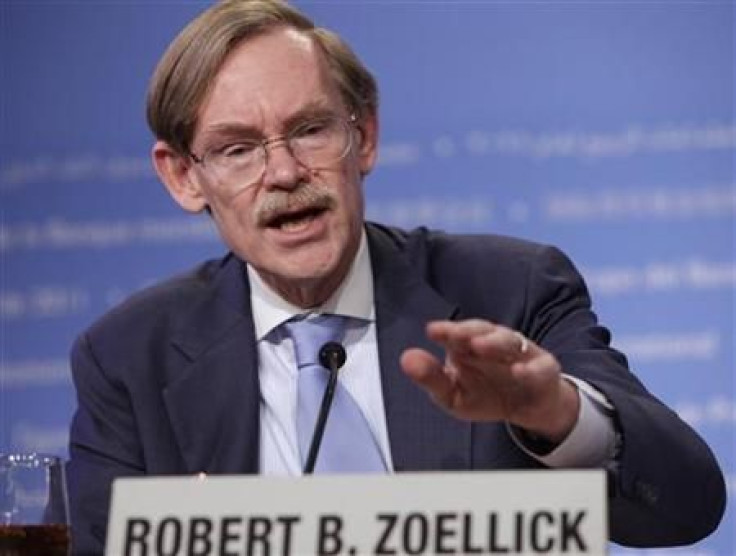
World Bank President Robert Zoellick said Wednesday the world had entered a new economic danger zone and Europe, Japan and the United States all needed to make hard decisions to avoid dragging down the global economy.
Unless Europe, Japan, and the United states can also face up to responsibilities they will drag down not only themselves, but the global economy, Zoellick said in speech at George Washington University.
They have procrastinated for too long on taking the difficult decisions, narrowing what choices are now left to a painful few, he said ahead of meetings of the World Bank and International Monetary Fund next week.
His bluntly worded speech highlighted mounting fears among global policymakers about an escalating sovereign debt crisis in Europe, which has for now overshadowed investor concerns about public finances and reforms in the United States and Japan.
Just as those very countries had called on China to be a responsible global stakeholder as a rising economic power, so too must they act responsibly and face up to their economic problems, Zoellick added.
Chinese Premier Wen Jiabao weighed in earlier and called on developed countries to take responsibility for fiscal and monetary policies to avoid the European crisis from spreading.
Meetings of global finance and development leaders in Washington next week will focus on Europe's debt woes and the risk of a Greek debt default, which has fed growing alarm in financial markets.
Mixed signals from European leaders have escalated concerns the 17-member euro zone may be unable to unite behind a common approach to tackle the crisis.
Zoellick said European countries were resisting difficult truths about their common responsibilities, Japan had held off on needed economic and social reforms, and political differences in the United States were overshadowing efforts to cut record budget deficits.
The time for muddling through is over, Zoellick said. If we do not get ahead of events; if we do not adapt to change; if we do not rise above short-term political tactics or recognize that with power comes responsibility, then we will drift in dangerous currents.
Later, Zoellick said the European crisis had reached a point where its political leaders needed to decide on the future of the euro bloc instead of dealing with problems day by day with patchovers. He said he was confident the eurozone would survive.
But added: To keep the eurozone with all of its current members, you're going to need a much stronger fiscal union than you have today and someone is going to have to pay for that.
If you're not willing to have that fiscal union, then I don't think you can keep the current construct, Zoellick told CNBC in an interview.
Turning to the United States, he suggested slowing the rate of entitlement spending on Social Security and Medicare, and agree on broad-based tax reforms to boost growth.
These in-between solutions, quick stimulus packages, I don't believe will get us where the U.S. needs to go, he added.
Zoellick's speech focused on the shifting global landscape in which emerging market economies are playing a greater role in the world economy -- and increasingly in development.
He said developed countries had yet to fully recognize these global shifts were under way and still operated under a do what I say, not what I do policy. They preached fiscal discipline but failed to rein in their own budgets, and advocated debt sustainability yet their own debts were at record highs, he said.
Zoellick also said it was time to rethink foreign aid, saying that while aid remains a life-or-death issue for millions of people around the world, it had also become a vehicle for helping poorer countries develop and grow, he said.
In a world 'Beyond Aid,' assistance would be integrated with -- and connected to -- global growth strategies, fundamentally driven by private investment and entrepreneurship, he said. The goal would not be charity, but a mutual interest in building more poles of growth.
He said development also meant tapping the power of women by eliminating gender inequality.
We will not release the full potential of half of the world's population until globally we address the issue of equality; until countries, communities, and households around the world acknowledge women's rights and change the rules of inequality, Zoellick said.
(Reporting by Lesley Wroughton, Editing by Gary Crosse)
© Copyright Thomson Reuters 2024. All rights reserved.
-
Taiwan Hit By Dozens Of Strong Aftershocks From Deadly Quake
-
Gaza Health System 'Completely Obliterated': UN Expert
-
In Ecuadoran Amazon, Butterflies Provide A Gauge Of Climate Change
-

50 Years On, Vintage Vehicles To Reenact Portugal's Carnation Revolution
-

Conflicts Push Military Spending To 'All-time High': Report
-
'Thank You, America:' Zelensky And Netanyahu Applaud House Passage Of Foreign Aid Package
-
Women Journalists Bear The Brunt Of Cyberbullying
-
US Aid Shows Ukraine Will Not Be 'Second Afghanistan': Zelensky
-
Elon Musk's X Fights Australian Watchdog Over Church Stabbing Posts
-
Ukraine, Israel, TikTok: The Massive Aid Package Before US Congress


