

10 Years into Afghanistan War, U.S. is Only Halfway Done
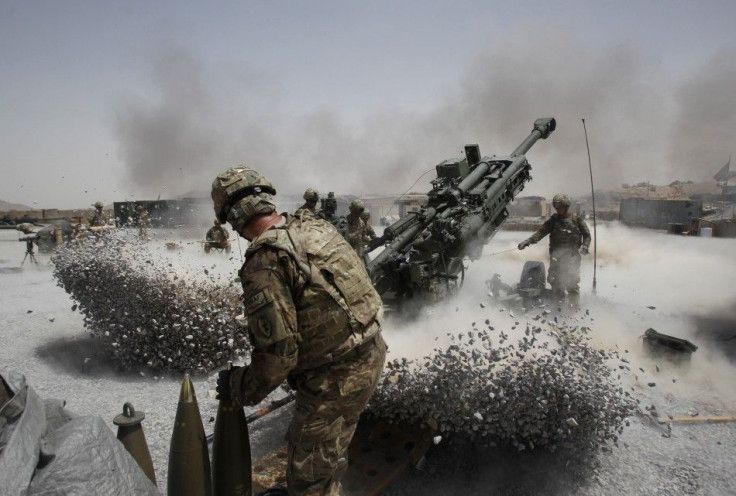
Exactly 10 years ago Friday, the United States entered into a war in Afghanistan. And, despite President Barack Obama's plan to completely remove American troops from the country by 2014, the U.S. could be in Afghanistan for decades to come.
Throughout the war, Afghanistan has again proved itself to be an unconquerable nation. The United States succeeded in destroying the Taliban government that allowed al-Qaida and Osama bin Laden to attack America in 2001, but the Taliban has reformed as a vicious insurgent group capable of punishing Afghan civilians and coalition troops from the lawless border region between Afghanistan and Pakistan.
Approaching the drawback and withdrawal dates, the issues now are security and responsibility. The United States currently has close to 100,000 soldiers in Afghanistan, about a third of whom are scheduled to be home by this time next year, but militants carry out attacks nearly every day. Is it up to the United States to protect Afghan citizens?
The plan now is to continue training local Afghan security forces so that they can protect themselves after the final troop withdrawal in 2014. However, there are concerns on both sides that the time frame is unrealistic.
It is entirely possible that there may still be U.S. forces and other international forces here [Afghanistan)] after 2014, Ryan Crocker, the U.S. Ambassador to Afghanistan, told The Times (of London).
This is because the U.S. and Afghan officials are currently meeting in secret about a long-term security plan that could keep America in Afghanistan not just for further years, but for decades.
These negotiations began in May, and the U.S. would like to leave a small force of troops, as well as spies and some air support in the country, with Afghanistan's permission. The residual U.S. presence would help Afghan security personnel combat insurgents while protecting citizens.
The United States could also use Afghanistan as a launch point for drone strikes on militants in Pakistan and elsewhere.
In responding to questions about the talks, Secretary of State Hilary Clinton recent said that there would be no permanent bases in Afghanistan:
There are U.S. troops in various countries for some considerable lengths of time which are not there permanently, a U.S. official told The Guardian.
That's some tricky rhetoric. Essentially, the State Department only considers a country occupied by American personnel if there is a permanent military base. It still counts as a total withdrawal if there are only semi-permanent installations.
Additionally, by not calling the soldiers combat troops the U.S. can claim that American forces have gone home. However, in a country where insurgents attack both government installations and civilians nearly every day, U.S. soldiers will undoubtedly see combat.
And while the intelligence operations and the troops left behind to support and train Afghan security officers don't count as being in combat either, that doesn't mean they aren't actively fighting an enemy through different means.
The United Kingdom, whose military provides 10,000 of the 30,000 coalition troops in Afghanistan, already said in September that it would stay on after 2014.
We will be there after 2014 to help [the Afghan National Security Forces] in a mentoring role and I imagine [United Arab Emirates] may leave a number of people, said Lord Astor, the Undersecretary of State for Defense, in a meeting with the U.A.E.
This situation is similar to what's currently happening behind closed doors in Iraq. American soldiers are scheduled to leave by Dec. 31, but Iraqi leaders are discussing a proposal from the United States that would leave up to 10,000 U.S. personnel in the country for additional security and training.
Politicians in Iraq don't like the plan, but the vulnerability of the Iraqi police, who have been unable to cope with a growing insurgency, may sway them otherwise.
The ironic aspect of this story is that radical insurgents are largely attacking civilians because they are upset at the foreign military presence in their own countries. By staying, the United States is almost assuring that militancy continues in Afghanistan and Iraq.
However, insurgent groups like the Taliban and what's left of al-Qaida also want to destabilize domestic governments, and attacks would undoubtedly continue if the U.S. completely left.
Without the prospect of... an enduring American presence, the Taliban would have little incentive to negotiate rather than just wait the United States and NATO out, a RAND Corporation study said.
Leaving U.S. troops in Afghanistan is not a popular idea in either country. A recent poll indicated that 73 percent of Americans want the troops to return home, and both Republican and Democratic politicians have been vocally representing this majority position.
In Kabul on Thursday, hundreds of people gathered to protest against the United States. Marching with signs and pictures of dead family members, the group chanted slogans like no to occupation, and Americans out.
The United States said it came to help the Afghan people and provide a good life to Afghan people, but their true purpose was to occupy our country, a woman named Farzana told The Associated Press. It is 10 years since the invasion of Afghanistan and all it has left behind is the blood of the Afghan people. We want the U.S. to leave our country.
Additionally, the Afghan government isn't too keen on the idea either, and has been insistent in negotiations that if coalition troops stay they be subject to its laws.
The U.S. has already rejected five proposals from Afghan officials.
Luckily, the two countries have three years to figure out their final plan. A lot can happen in three years, and the war in Afghanistan could look much different than it does now. Yet, no matter what the result, there needs to be a plan in place by 2014, for the sake of the citizens of both Afghanistan and the United States.
© Copyright IBTimes 2024. All rights reserved.
-
Mass Cancellations Loom Despite French Air Union Cancelling Strike
-
Recycled 'Zombie' Misinformation Targets US Voters
-

Hackers Leak Part Of Source Code Of El Salvador's Bitcoin Wallet
-

Azerbaijan Says 'Closer Than Ever' To Armenia Peace Deal Amid Border Talks
-

How UK's Biggest Water Supplier Sank Into Crisis
-
Taiwan Hit By Dozens Of Strong Aftershocks From Deadly Quake
-
Gaza Health System 'Completely Obliterated': UN Expert
-

In Ecuadoran Amazon, Butterflies Provide A Gauge Of Climate Change
-
'Thank You, America:' Zelensky And Netanyahu Applaud House Passage Of Foreign Aid Package
-

Women Journalists Bear The Brunt Of Cyberbullying


