

Anonymous NYSE: Wall Street 'Hacktivism' Exposes Downside of Anonymity
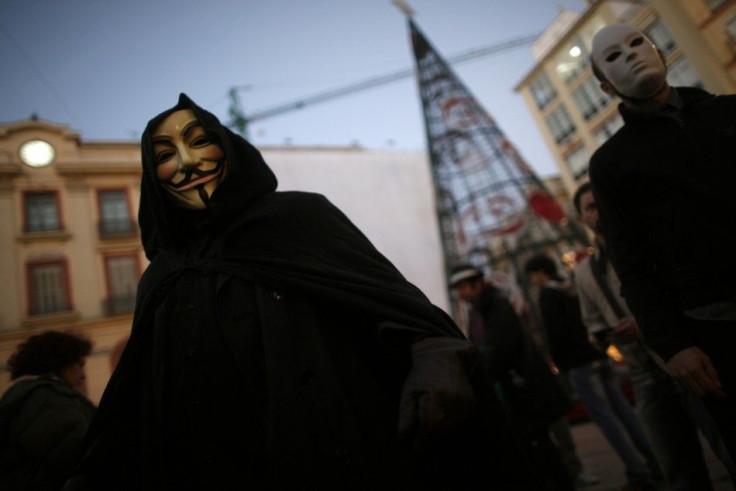
The Anonymous takedown of NYSE Monday, Oct. 10, meant as a show of support for the Occupy Wall Street movement, has exposed a new understanding of hacktivism: anonymity can be a curse as well as a blessing.
On Oct. 3, a YouTube video was posted by someone claiming to be a faction of Anonymous, the hacker collective famous for its attacks on Scientology and its support of WikiLeaks.
Many people refuse to accept that Operation Invade Wall Street is a reality, a computer-generated voice said. Those who are going to be part of the attack have a message to the NYSE: We don't like you... [we] plan to destroy you.
Within hours of the message, people flooded Twitter, 4chan, and various forums. Many of those posting, however, were there to disassociate Anonymous from the upcoming attack, not to endorse it.
Many of our brothers and sisters, a widely circulated statement read, have gone down in the fight for using such tactics [as advocated in the video], it read. Another hinted that the attack might be a plant, or a small faction without the skill set to take NYSE on. You must take all notices and information claiming to be 'Anonymous' with a grain of salt, wrote detractors. 'Consider EVERYTHING... Anonymous wouldn't tell you to use LOIC. Anonymous wouldn't attack NYSE on a holiday. It is debatable if Anonymous would ever even attack NYSE.
Following the attack, meanwhile, an Anonymous supporter with access to some of the movement's main Twitter accounts spoke to the IBTimes. The NYSE attack proved Anonymous is not unanimous, the man said. [The attack] was probably not generally supported. I didn't notice mass support in IRC [Internet Relay Chat] either.
And therein lies what has been the brilliance and will continue to be one downside of the Anonymous organization: it's not really an organization at all.
The Great Non-Movement
In an earlier interview with IBTimes, supporter Michela Marsh addressed many people's misconceptions. [Anonymous] isn't a group or community or movement like everyone thinks, she said. It's just a name under which all these people are operating... a pseudonym, a pen name, something to stop government and the public from knowing these people's identity.
People think they can 'join' and start saying, 'Oh, Anonymous doesn't support that hack, Anonymous supports Lulzsec [a splinter group],' she continued. But they can't, because it doesn't mean anything.
Such a position is what has made Anonymous such a giant, successful, and often unstoppable non-movement.
When it began in 2003, just a name popping up on the imageboard 4chan, Anonymous was almost exclusively hackers, a sort of anarchic, chaotic, but nonetheless sprawling global brainpower. By 2008, when Scientology protests began to grow, supporters helped shape the phenomenon known as hacktivism, and put it to devastating use in a series of well-publicized DDoS (Distributeed Denial of Service) attacks which crashed and overwhelmed servers, while more began to join on-the-ground protests as well.
As more and more people took to the streets under Anonymous' name, however, a new symbol began to emerge. Guy Fawkes masks, referencing Alan Moore's graphic novel and the 2006 film V for Vendetta, overtook the original calling card of a man with a question mark for a face.
A message also began to appear, even as Anonymous supporters continued to diffuse that message's meaning. We Are Anonymous, many statements released by supporters now read. We are legion. We do not forgive. We do not forget. Expect us.
Such terminology is more reminiscent of Code Name V (People should not afraid of their governments. Governments should be afraid of their people) than it is of Trent Peacock in The Face of Anonymous, a statement from 2008: We are doing it for the lulz.
The Power and Problem of Anonymity
As Anonymous grows as a name, there may come a time when it will need to become an organization, if only to ensure that attacks like the one on NYSE happen less frequently.
Coverage of the attack has been divergent at best. Some groups, including trackers like Keynote and AlertSite, reported that the site slowed down around 3:30pm EST, the estimated start of the attack, and registered brief but widespread continuous disruptions between 5:30 and 5:55 pm.
NYSE spokesman Rich Adamonis, however, rebutted the findings. We detected no service outage on our corporate web site at that time, he said.
E.J. Hilbert, president of Online Intelligence and a former FBI cyber-crime specialist, was similarly dismissive. It's like four 9-pound weaklings running into a Sumo wrestler, Hilbert told ABC News. If you don't have enough people behind an event like this, it's just a spike in traffic as far as NYSE is concerned.
Anonymous' attacks haven't always worked. It failed to take down Amazon.com in December of 2010, and even its successful run during the WikiLeaks controversy resulted in as many arrests as it did online disruptions. The NYSE case, however, is striking precisely because it highlights an Achilles' heel: its source of power, anonymity, means anyone can put on the mask, including those bent on taking Anonymous down.
A source notes there has been a huge spike in talks that the Wall Street hacking as a fed sent to discredit the umbrella movement's motives and effectiveness. Recent articles by both The Guardian and The Daily Kos suggest police have tried to infiltrate the Occupy Wall Street movement, and that the U.S. military has begun developing sock puppets, made-up propaganda accounts used to take down grass-roots movements.
Even putting aside conspiracy, however, there is still the problem of some who take up Anonymous not being prepared to deal with its consequences. Many Anons, our source reports, believed that the attack would compromise the on-the-ground effort, which in recent weeks has grown massively.
Such methods, however, also allow Anonymous to stay true to its purpose.
Like Occupy Wall Street, Anonymous shies away from goals, statements, and organization for a reason: they are, at heart, composed of people who have taken action precisely to combat organizations, platforms, and generalizations. Vincent Schiavone, founder of ListenLogic, which helps corporations ward off cyber attacks, still views the group's power and reach as alarming and increasing in scope. The ability of Anonymous to take on so many institutions, without having to stick to a lobby or list of demands, has been one of its most revolutionary accomplishments.
The question for the future is how long that momentum can last. I think we'll see a lot more government activity exposed by the skilled hackers, Marsh told the IBTimes earlier this month. [There will be] many more protests that incorporate not just Anonymous but [all] people who just want to stop corruption, oppression and related injustices.
The newer members are the ones trying to organize protests, Marsh said. [Those are] the ones going out and doing real-world work.
Must Read : Anonymous Takes On Child Pornography Sites
© Copyright IBTimes 2024. All rights reserved.
-
Bitcoin And Crypto Price Review - Another Myth Gets Busted?
-
Mass Cancellations Loom Despite French Air Union Cancelling Strike
-
Mired In Crisis, Boeing Reports Another Loss
-
Recycled 'Zombie' Misinformation Targets US Voters
-
Hackers Leak Part Of Source Code Of El Salvador's Bitcoin Wallet
-

Azerbaijan Says 'Closer Than Ever' To Armenia Peace Deal Amid Border Talks
-
How UK's Biggest Water Supplier Sank Into Crisis
-
Taiwan Hit By Dozens Of Strong Aftershocks From Deadly Quake
-

Gaza Health System 'Completely Obliterated': UN Expert
-

In Ecuadoran Amazon, Butterflies Provide A Gauge Of Climate Change


