

Proposed Removal of Controversial Law Sparks Dispute in Kashmir
ANALYSIS
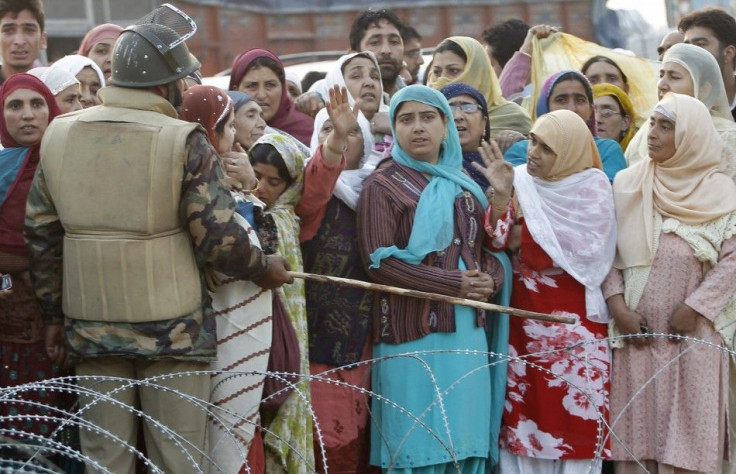
The chief minister of the Indian state of Jammu and Kashmir is locked in a dispute with the country’s army over the removal of an unpopular law that gives unfettered powers to the armed forces in the region and shields them from prosecution.
And he appears to be losing.
Omar Abdullah, who has led a coalition government in the state since 2009, proposed the withdrawal of the Armed Forces Special Powers Act from four districts -- Srinagar, Budgam, Jammu city and Sambha -- where the army has not conducted operations for several years. His move is in keeping with the recommendations of various national and international bodies, most recently the Cabinet Committee on Security that includes senior ministers of the Indian government, and a three-member team of interlocutors appointed to draw a political roadmap for Jammu and Kashmir.
The army, however, rejected the proposal, warning that even a partial revocation of the law would “handicap” security forces in their attempt to fight militancy, and could even reignite the insurgency that has gripped the state in the past.
Moreover, Abdullah's attempts to “narrow the differences” through three days of talks with senior ministers of the central government and India's army chief V.K. Singh, that concluded on November 15, proved inconclusive.
Joining the fray, a senior opposition leader, L.K. Advani, criticized Abdullah, saying the army was being demonized.
It is because of the army that Jammu and Kashmir is still a part of this country, said Advani at a rally in Jammu.
This spat comes at a time when the Kashmir Valley has enjoyed an unexpected summer of calm, a sharp contrast to the previous year when clashes between stone-pelting protesters and armed security forces claimed over 60 civilian lives. Scores of security bunkers that lined the streets of Srinagar have been removed; tourists have flocked to the valley; militant acts have declined sharply.
The tussle over the removal of the law, which pitches the security of the country against the aspirations of the people, comes as a grim reminder that, despite a return to what many have described as “normalcy,” the beleaguered state of Jammu and Kashmir remains a special case.
“There is constitutional democracy here, just like the rest of India,” said Khurram Parvez, program coordinator for the Jammu and Kashmir Coalition of Civil Society.
“Then why is the army playing such a big role in making decisions that the civilian government should be making?”
For over two decades, India has maintained hundreds of thousands of armed forces in this border state where a violent insurgency, partially fueled by training and funds from Pakistan, raged for several years. The Armed Forces Special Powers Act, introduced in 1990 to bolster the army's counter-insurgency efforts, gives security officers the powers to search and arrest without warrant, use as much force as they consider necessary, and even shoot to kill. Officers cannot be prosecuted for acts committed on duty without the permission of the Home Ministry, and such permission has almost never been granted.
The insurgency has largely fizzled out, but the state continues to be heavily militarized. And in this region defined by conflict and animosity, the army is perhaps the most hated institution. Civil rights groups and international organizations have long accused the armed forces of abducting young boys, torturing civilians and killing with impunity.
In August this year, over two thousand bodies were discovered in unmarked graves in Kashmir. While the army says the bodies belonged to militants, human rights groups claim many were civilians who “disappeared,” leaving behind a generation of “half- widows” uncertain about the fate of their husbands and parents still waiting for their sons to return.
Parveena Ahangar’s son, Javed, was 16 when he was taken away in a night raid on August 18, 1990. She hasn’t seen him since. A court inquiry found that security forces were responsible for his disappearance, she said, but the central government has not sanctioned their prosecution.
“I have been fighting this battle for 21 years,” said Ahangar in Hindi. “Even the courts of this country haven’t been able to do anything for people like me.”
Ahangar now leads the Association of Parents of Disappeared Persons that has embarked on a mission to count the number of people that have disappeared in the last twenty years. The number, she estimates, is upwards of 8,000, though official figures are between 1,000 and 3,000.
“There are so many laws for civilians, but there are no laws to control the armed forces,” said Ahangar.
The chief minister's recent attempts to curtail the army's powers have faced grave challenges. They come on the heels of a major controversy surrounding the mysterious custodial death of a political party worker that tarnished the leader's credibility and led to demands for his resignation.
Abdullah had met Syed Muhammad Yousuf, a worker in his party accused of accepting a bribe in return for nominations to the state's legislative council, shortly before Yousuf was handed over to the police, in whose custody he allegedly died a few hours later.
Opposition parties in Jammu and Kashmir disrupted Parliament for several days and raised allegations of murder. They branded his initiative to roll back the Armed Forces Special Powers Act as frivolous and an attempt to divert attention from the scandal.
In the last month, Abdullah has drowned out opposition voices and has taken a tough stance against the army - an institution that continues to shape policies and politics in Jammu and Kashmir. Asserting his government's authority to withdraw the law, he said earlier this month that “no” was not an option. The law would remain in force in volatile areas such as Kupwara, Baramulla and Sopore where the army remains active, but would be removed from districts that are peaceful, he argued.
The situation became more polarized when India’s defense minister, A.K. Antony, cast aside the possibility of a unilateral decision by Abdullah's government, saying the question of the law's removal would have to be decided by the Unified Command of Jammu and Kashmir, a consultative body constituted by members of the armed forces, among others, and headed by Abdullah.
In an effort to evolve a consensus, Abdullah met with Indian Prime Minister Manmohan Singh, President of the ruling Congress party Sonia Gandhi, and several senior ministers of the central government. The talks were “fruitful,” said defense minister Antony, but did not yield any immediate results given the “very sensitive” nature of the issue.
“India should not jump the gun,” said Gagandeep Bakshi, executive editor of Defense and Security Alert magazine and a retired army officer who spent years in the state.
“If we take a decision prematurely, we could cause a setback to the army's operations and jeopardize the very peace that has emboldened the chief minister to consider removing the law.”
In the last few months, security forces in the region have painted a picture of a state that has become “normal” and safe, but not quite. The Jammu and Kashmir police announced in August that over 300 militants are currently in “launching pads” along India's border with Pakistan, waiting to sneak into the valley.
The infrastructure of terror in Pakistan is still intact, said Bakshi, with a few thousand terrorists in training camps across the border. He argued that the chief minister's proposal was ill-timed given that the withdrawal of American troops from Afghanistan in 2014 could provoke a surge in infiltration, encouraged by the fact that a partial removal of the Armed Forces Special Powers Act would create sanctuaries to which terrorists gravitate.
This impasse in the state has left some skeptical about whether the chief minister's call for removal will ever become a reality. Others remain unimpressed by the call itself, but are worried by the conflict.
“It just shows that the army is the real power centre, not the elected government,” said Parvez of the Jammu and Kashmir Coalition of Civil Society.
This view has been criticized by some as an ill-conceived attempt to frame the situation as government versus military. Riyaz Punjabi, a professor at Jawaharlal National University in New Delhi and former Vice Chancellor of Kashmir University, doesn't see this as a turf battle: the army was called into Jammu and Kashmir “in aid of civilian power” and the ultimate authority to withdraw the law lies with the state government. But security concerns have not entirely receded to the back-burner, he said, making it important for the civilian government and military establishment to continue to collaborate.
“The long-term goal is to do away with the law,” said Punjabi.
“But the two parties need to come together, exchange information, and decide whether the time is right.”
Parvez, however, believes that the law’s withdrawal will not have a significant impact on the human rights situation in Kashmir because, he says, “the army gets its impunity not from the law, but from the state of lawlessness.”
He points to reports of human rights violations committed by the Jammu and Kashmir police, an institution not protected by any special legislation.
“The removal of the law is a significant development if the intention of the government is to do away with the atmosphere of impunity for security forces in Kashmir,” he said.
© Copyright IBTimes 2024. All rights reserved.
-
French Air Traffic Controller Strike Threatens Flight Chaos
-
Azerbaijan Says 'Closer Than Ever' To Armenia Peace Deal Amid Border Talks
-

How UK's Biggest Water Supplier Sank Into Crisis
-
Taiwan Hit By Dozens Of Strong Aftershocks From Deadly Quake
-
Gaza Health System 'Completely Obliterated': UN Expert
-
In Ecuadoran Amazon, Butterflies Provide A Gauge Of Climate Change
-
50 Years On, Vintage Vehicles To Reenact Portugal's Carnation Revolution
-
Conflicts Push Military Spending To 'All-time High': Report
-
'Thank You, America:' Zelensky And Netanyahu Applaud House Passage Of Foreign Aid Package
-

Women Journalists Bear The Brunt Of Cyberbullying


