

Obama Kicks off 2012 Campaign with New Love for Vetoes
FEATURE
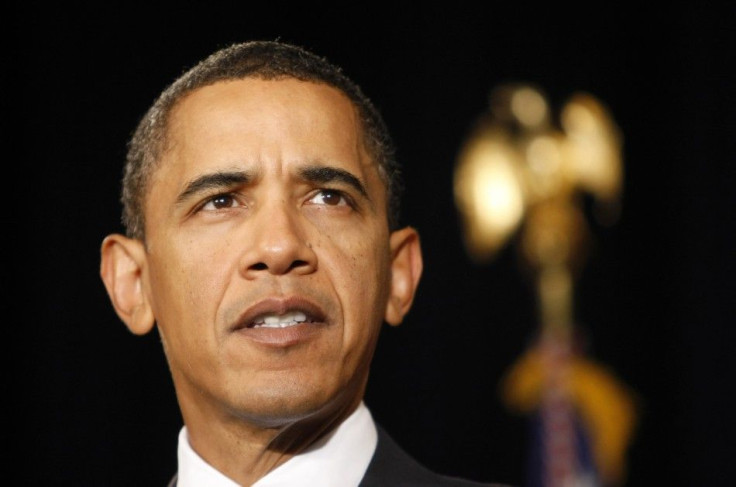
A new word has become more common in the Obama administration's lexicon: veto.
After three years spent cultivating the image of a middle ground-seeking compromiser-in-chief, the White House appears to have made a 180-degree turn. Three veto threats have been floated against major pieces of legislation, after years of only pushing back against Congress on minutiae such as funding for fighter jets. Toss into the mix the controversial recess appointment of Richard Cordray to head the Consumer Financial Protection Bureau and one thing becomes clear: President Barack Obama suddenly refuses take any guff from Congressional Republicans.
Politicos point to the recent recess appointments of three officials to the Labor Relations Board and Cordray's forced ascendancy as the first signals of a newly-emboldened President. But his inner tough guy took over well before any appointments.
Presidential historians depict the shift as the opening leg of a campaign, historically common with previous reelection bids. With 2012 on the horizon, Obama has chosen to show a rigid spine. But can a newfound love of veto threats be enough to secure some legislative victories and galvanize a weary Democratic base?
An Opening 2012 Salvo
While Republicans have yet to offer a presidential candidate, the Obama campaign has set its sights on Congress as an early target for 2012. The re-election effort aims to build upon the image of a reformer stymied by adamant Republicans.
The administration is signaling the change in Washington, the change you can believe in, is not happening and Congress is at fault for that, said Prof. Meena Bose, Director of Hofstra University's Peter S. Kalikow Center for the Study of the American Presidency.
Obama hopes to draw out Congressional Republican adamancy against his policies and prolong a fight over how to tackle a ballooning deficit through a number of measures that will be rolled out this year.
Compromise would be perceived as backing down in an election year, Bose said.
The willingness to campaign against Congress has drawn comparisons to Harry Truman's 1948 run against a do nothing Congress. But Bose and others have likened Obama's strategy to Bill Clinton's 1996 reelection bid, after facing off against then-House Speaker Newt Gingrich and enduring two government shutdowns. Still, there are some differences.
The potential showdown with Congressional Republicans has the potential to fire up a base that has grown disillusioned.
Three Years Of Comprise
Supporters have lobbed one criticism at President Barack Obama during of his first term: spineless. The seemingly audacious Senator who promised to change the culture of a Capitol gone haywire was, at every major turn, willing to meet his opponents halfway. His legislative victories, especially after the Tea Party's run at the polls in 2010, has been a study in concession.
The healthcare overhaul he pushed for eventually bore its opponents' ultimate ideals, nixing plans for a public option early in the debate. It was still passed off as the President's creation, with the eponymous Obamacare nickname.
A deal to extend unemployment benefits was married with an across-the-board extension of the Bush tax cuts, which Obama promised to let expire for higher income earners. Even his staff picks have a smattering of placation towards the very business interests and fat cats Obama once lambasted (look no further than soon-to-be-former Chief of Staff and former JP Morgan Executive William Daley, or General Electric CEO Jeffrey Immelt's selection as head of the President's Jobs Council).
That's really been the arc of his four years; He talked a lot about compromise, about being a centrist in his campaign, said Prof. Robert J. Spitzer, Chair of the Political Science Department at SUNY Cortland. In his first three years, he has attempted to extend the olive branch, to the chagrin of his supporters. That sets up now, here in his fourth year, being mister tough guy.
According to Bose, Obama's populist tone and new willingness to fight is meant to galvanize Democrats who feel estranged after three years.
I think it's an issue of firing up his base but also showing his conviction and resolution to his supporters and his party, she said. It's as much a general election approach as much as it's a party-building strategy. It's essential for the president to look presidential.
Fresh Fights With Congress
The switch in temperament arrived shortly after Obama and House Speaker John Boehner's talks of a grand bargain surrounding the budget deficit and debt ceiling collapsed last summer, making way for a Super committee.
The dozen lawmakers charged with closing a $1.2 trillion hole in the budget deficit failed to draw up a plan, setting in motion trigger cuts which plowed deep holes into defense and social safety net spending. Hawks in the Senate just as John McCain, R-Ariz., and Lindsay Graham, R-S.C., promised to author a bill which would spare the Pentagon from a $500 billion cut over the next decade. Obama's response?
There will be no easy off ramps on this one. We need to keep the pressure up to compromise, not turn off the pressure, he said, promising to veto any legislation that subverts the trigger cuts. The only way these spending cuts will not take place is if Congress gets back to work to reduce the deficit by at least $1.2 trillion. They've still got a year to figure it out.
McCain and Graham still plan on forcing a choice upon Obama, though Senate Majority Leader Harry Reid, D-Nev., can let the bill die a quiet death.
The President rounded off 2011 with two high-profile showdowns with Congress. The first concerned an extension of the Payroll Tax Cut, which would have kept the amount withdrawn from employee's paychecks at a 4.2 percent rate while incorporating a surtax on incomes over $1 million. After some bargaining, a short-term extension was ironed out and passed along to the House of Representatives. There it was met with obstinacy and demands from Boehner that a longer-term deal be passed. Obama gave the Speaker a take it or leave it phone call. A week later, the measure passed a voice vote.
It was a classic opportunity for Obama to use the veto threat, which is pretty effective, Spitzer said. It's really been underappreciated.
A second bill, the controversial National Defense Authorization Act (NDAA), was immediately met by veto threat from Obama unless certain controversial provisions were removed. By New Year's Eve, the NDAA had been transformed into something the President found palatable, garnering his signature despite many civil liberties groups still lambasting the bill.
A Thin Legacy Of Vetoes
Presidents have employed the veto 2,564 times. The king of the tactic was Franklin Delano Roosevelt, who scuttled 635 bills, though spread over four terms. The per-term record goes to Grover Cleveland and his 584 vetoes, averaging out to about 1.5 vetoes per week during his presidency.
Obama's use of the veto has been far from rampant. To date, he has used the constitutional authority to kill laws passed by Congress twice -- both under tepid circumstances. His first veto was so uncontroversial, what has typically been termed a momentous signal of a President's backbone barely merited a headline. It was merely procedural.
The veto came on Dec. 30, 2009. Congress had passed a provisional bill to tide over military spending for five more days until a longer-term defense appropriations bill passed. It did, negating the need for the stop-gap measure, which Obama vetoed with little to no fanfare.
Obama's second veto came with more pertinence on Oct. 7, 2010. Congress passed a bill that would speed up foreclosures by allowing courts to recognize documents notarized out of state, which the President punted back to them in short order.
By contrast, Obama's predecessor George W. Bush waited 4.5 years for his first veto, nixing a highly controversial bill on July 20, 2006 that would have lifted funding restrictions on stem cell research.
Even Obama's threats of a veto have, with few exceptions, surrounded banal issues like funding for F-22 and F-35 fighter planes.
Historically, veto threats tend to grow in the waning days of a president's term in office, according to Spitzer.
We know that veto threats are more likely to occur at the end of a term than a beginning of a term, he said. A president's political resources tend to ebb at the end of a term. The election season tends to dampen the productivity of Congress.
Spitzer believes Obama's image as a compromiser was intentionally cultivated and maintained, rather than genuine.
His political approach has been to trumpet compromise, but I've always felt that's as much a political posture as it was a real attempt to try to get things done, he said. It was important to be seen as a middle of the ground.
Possible Pitfalls
Obama's strategy presents a double-edged sword. Be too tough on Congress, and he stands the risk of being perceived as a hard-nosed man willing to work unilaterally. Blast Congress for too long, and Democratic lawmakers key to his agenda can be caught up in the mix.
The president can behave like the adult in the room, Spitzer said. Congress's approval is always lower than the president's. The only downside is that there are Democrats in Congress too.
According to Prof. Mitchel A. Sollenberger of the University of Michigan-Dearborn, Republicans need to straighten up and gain control of the coming debates or Obama will quickly own the upper hand.
In order for it to backfire, Republicans need to do a better job politically, he said. They looked they were so on the first year, with the budget crisis. It just looks like they just lost their head. It doesn't look like, at least right now, much is going to backfire.
Many provisions and bills still need to be ironed out as well.
We're all looking ahead to see the budget-making policy unfold in the next year. Both the administration and Republican leadership are trying to figure out what will work with voters, Bose said. There could be some criticism about acting unilaterally. There could well be a backlash, but the advantage that the president has is that his supporters don't want to turn against him. I would say at this point, it's more important to show conviction and strength.
Obama could avoid a public backlash if he handles veto threats and tough guy posturing correctly, Spitzer added.
He can follow through with [a veto] if he makes it clear early it's what he intends to do, he said. It allows the president to set the terms. In the circumstance where Obama sees political benefit to being more confrontational with Congress, then he has every motivation. The president generally, but not always, has the upper hand. The president generally gets to frame the issue.
Congress has boxed itself; the Republicans have boxed themselves, Spitzer added. He'd really have to go off the deep end to hurt himself. He'd have to start yelling at his press conferences. As long as he can say 'I've tried to be reasonable but that's not obviously working.'
© Copyright IBTimes 2024. All rights reserved.
-
IMF Says Global Debt Levels Face 'Great Election Year' Risk
-

Divisions Among Colombia's FARC Dissidents Complicate Peace Talks
-
French Far Right Gets Youthful Vibe With 28-year-old Leader
-
US Fed's Powell Says Inflation Fight May Take 'Longer Than Expected'
-
Mideast-related Oil Price Spike Threatens 'Relatively Good' Economic Outlook: IMF Chief Economist
-

Wine Growers 'On Tip Of Africa' Race To Adapt To Climate Change
-

Despite Olympic Truce, Games Wrestle With Political Fallout
-
What Will The Fed Do With The Latest Inflation Numbers?
-
US Retail Sales Up More Than Expected In March
-
Alexandre De Moraes: Brazil Judge In Feud With Elon Musk


