

Mashco-Piro: ‘Uncontacted’ Tribe Photos, Video Highlight Need for Responsible Tourism

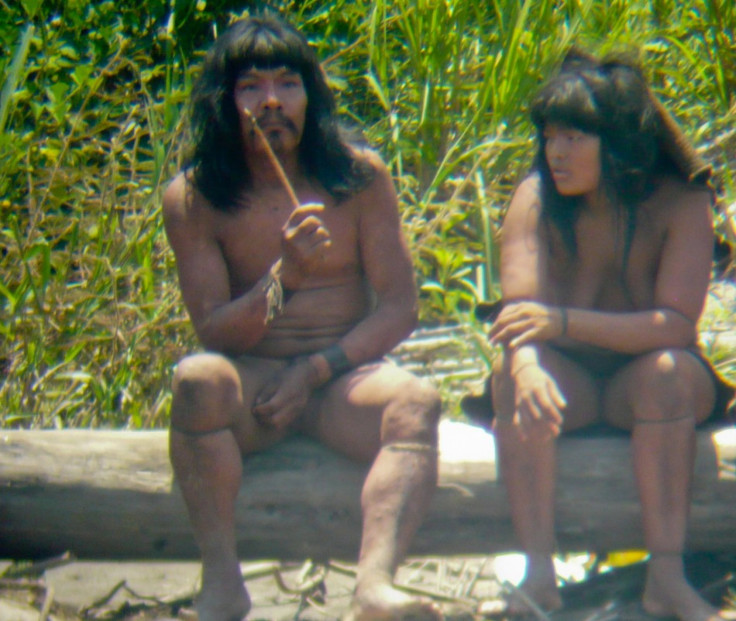
Officials in Peru are working to establish security in a remote corner of the Amazon following a recent spate of attacks on tourists and locals by the isolated uncontacted tribe of Mashco-Piro Indians.
The attacks, which occurred in October and November of last year, come amid an uptick in the number of sightings of the typically nomadic and elusive Mashco-Piro along major waterways in the dense forests bordering Manú National Park. The issue poses an increasingly volatile situation for both settlers and tourists, but also the members of the isolated tribe.
On Tuesday, exactly one year after aerial photos from a nearby uncontacted tribe in the Brazilian Amazon stunned the world, tribal rights organization Survival International released new photos of the Mashco Piro that it called the clearest photos of an uncontacted tribe ever taken.
What exactly is an uncontacted tribe?
Uncontacted doesn't mean they've never had any contact, Survival International campaigner Rebecca Spooner told IBTimes. They've decided to avoid the outside world. Survival defines uncontacted as a tribe that's had no peaceful contact with the outside.
Spooner said the Mascho-Piro likely have contact with other indigenous groups, but resist contact with outsiders.
Mashco-Piro have been known to inhabit the southeast Peruvian Amazon for many years and while a select few have made contact with the outside world, the majority have not. Studies have pointed to there being several Mashco Piro clans numbering roughly between 20-50 individuals in each group. They live in close proximity to about 14 other nomadic uncontacted tribes within the same region of the Peruvian Amazon and have long been considered among the Amazon's most implacable warriors, resisting contact and subjugation.
The majority of the world's roughly 100 uncontacted tribes live in the Amazon with the most found in Brazil. Spooner said there is also at least one uncontacted tribe in both Bolivia and Paraguay.
It's quite common for a tribe to have had some contact, at least during the rubber boom, Spooner noted.
The Mashco-Piro's forebears were decimated along the Madre de Dios River in 1892 by a private army employed by the notorious rubber baron Carlos Fermin Fitzcarraldo, vilified in Werner Herzog's 1982 classic Fitzcarraldo.
The images of Mashco-Piro released Tuesday were taken by two photographers, Gabriella Galli and Diego Cortijo. Galli is an Italian Survival supporter who happened to be in the Manu region on a bird watching trip where she spotted the men on the riverbank from her boat. No contact was made.
Cortijo, meanwhile, is a Spanish archaeologist who was in the region in October on a research trip when the Mashco-Piro group pictured turned up. He took the photographs from a distance of 400 feet with a camera attached to a telescope.
Survival believes the photos are of the same group of Mashco-Piro that is thought to have launched a November attack on Matsigenka Indian Nicolás Shaco Flores, Cortijo's host in the Peruvian Amazon one month earlier. Witnesses say Flores was struck in the heart by a bamboo-tipped arrow near the Manú National Park. He had been leaving food and gifts for a small group of Mashco-Piro Indians for the last 20 years and was the only form of contact they had with the outside.
Shaco's death is a tragedy: he was a kind, courageous and knowledgeable man, Glenn Shepard, an anthropologist and friend of the victim, wrote in his blog and in Anthropology News. He believed he was helping the Mashco-Piro. And yet in this tragic incident, the Mashco-Piro have once again expressed their adamant desire to be left alone.
Rights activists described Flores as a go-between who had long played the role of intermediary between the nomadic tribe and the outside world. He had married a Piro woman and spoke enough of her language to make himself understood in conversations shouted at a distance from the Mashco-Piro, according to Shepard.
Survival international believes drug trafficking, illegal logging, low-flying helicopters, and nearby oil and gas projects have caused the Mashco-Piro to become more aggressive in recent years.
Prior to 2001, there weren't reports of any violence amongst the Mashco-Piro. It's only in recent years that they have begun to retaliate against colonists. They've also warned off tourists along the Manu River.
A park guard was shot with an arrow in October around the same time that Peru's Ministry of the Environment released a sighting videotaped by tourists. The video (below) shows a tribe member warning the tourists off with a bow and arrow.
Contact is dangerous, Spooner said. For the tourists the danger is violence and for the Mashco-Piro, it's disease. Visitors should do some investigative work into areas -- particularly in Peru and Brazil -- and if they hear that there is the possibility of encountering an uncontacted tribe, they should avoid the place altogether.
Tourism has become an increasing threat in recent months as the groups have appeared more frequently on the riverbanks, Spooner added. We were extremely concerned after we saw video footage of tourists leaving clothing to entice the Mashco-Piro out of the forest as a kind of photo-op. All tourism on this particular stretch must be restricted until authorities can assure the safety of the Mashco-Piro and the tourists, as well as local residents.
Survival wrote to Sernap (the park authorities in Peru) last year and was told that the organization planned to set up a guard post in the area and had imposed an inter-fluvial restriction on the river where the Indians were sighted.
This is still in place, Spooner said. However, there is still a real lack of control in the area to prevent the biggest dangers to the tribes, which are illegal loggers and nearby oil and gas companies who fly helicopters low over the area.
The tribal rights organization hopes by releasing the new images Tuesday, they can push the Peruvian government into action to protect the Mashco Piro who have clearly expressed their desire to be left alone.
READ ALSO:
'Human Safaris' Threaten Jarawas in the Andamans: Tourists Treat Tribe like 'Circus Ponies'
Thailand's Lost Tribes: The Natives Who Are Not Citizens
Uncontacted Tribe Discovered in Amazon: Who are they and what is their Plight?
© Copyright IBTimes 2024. All rights reserved.
-
Ukraine, Israel, TikTok: The Massive Aid Package Before US Congress
-

Eiffel Tower Loses Sparkle For Parisians Ahead Of Olympics
-

Former Number One Momota Retires From International Badminton At 29
-

Why Insurance Prices Have Skyrocketed
-

World Bank Aiming To Connect 250 Mn Africans To Energy Grid By 2030
-

IMF Says Global Debt Levels Face 'Great Election Year' Risk
-
Divisions Among Colombia's FARC Dissidents Complicate Peace Talks
-

French Far Right Gets Youthful Vibe With 28-year-old Leader
-

US Fed's Powell Says Inflation Fight May Take 'Longer Than Expected'
-

Mideast-related Oil Price Spike Threatens 'Relatively Good' Economic Outlook: IMF Chief Economist


