

Nevada Caucus Results: A Big Win for Romney, but What Does it Mean?
ANALYSIS
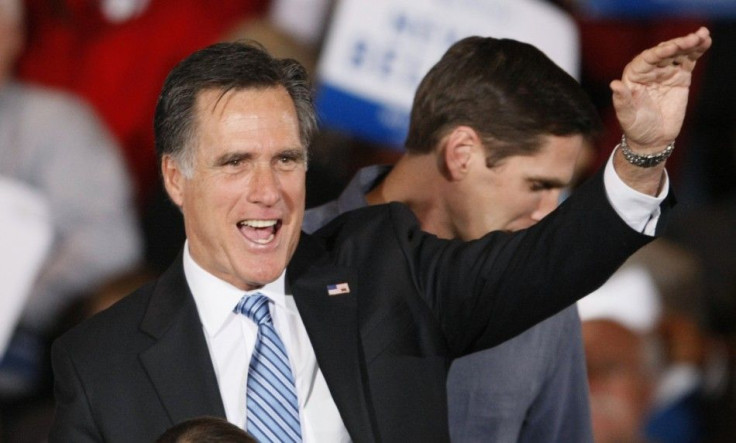
No surprises here: Mitt Romney has won the Nevada caucuses in his second consecutive victory of the 2012 Republican presidential-nomination season.
With 45 percent of precincts reporting as of 4 a.m. EST on Sunday, Romney had 42.5 percent of the vote, followed by Newt Gingrich with 26 percent, Ron Paul with 18.4 percent, and Rick Santorum with 12.9 percent.
Nevada's 28 delegates will be awarded proportionally, and the final breakdown will not be determined until every precinct has reported. But Romney came into the caucuses with 65 delegates -- about twice the number Gingrich (23), Santorum (6) and Paul (3) have combined -- and his double-digit win here will widen that lead by a few delegates.
But, on a larger scale, the results change the dynamics of the race very little. More than anything, Nevada was a story of four candidates trying to change the narrative, and all of them failing.
Mitt Romney
Romney is still the clear front-runner, having won three of five contests so far and placed second in the other two. But since everyone knew he was going to win Nevada, he's not going to get much credit in terms of momentum, said Ted Jelen, a political scientist at the University of Nevada at Las Vegas (UNLV).
If Romney had passed the critical 50 percent threshold -- or if he does so when the remaining precincts report -- it would be a different story. An outright majority in a field of four candidates would allow him to talk about 'electability' and 'inevitability' with more confidence, said Eric Herzik, a political scientist at the University of Nevada at Reno (UNR).
But as it stands, given Romney's high expectations going into Nevada -- two polls conducted in the past week found him with 45 and 50 percent of the vote, respectively -- 40 percent is a disappointment, Jelen said.
Romney can brush off the disappointment to some extent, though, thanks to his opponents' equally disappointing performances. He failed to change the game the way he had hoped to, but no one else was able to change it, either -- so it remains as it was after Florida, which is to say, Advantage, Romney.
Newt Gingrich
While Romney didn't manage a blowout, he is still more than 15 points ahead of his nearest competitor, Gingrich. More significant, he got more votes than Gingrich and Santorum combined, which -- coupled with the same feat in Florida -- deals a serious blow to Gingrich's argument that conservatives could win handily if they only united around a single anti-Romney candidate.
If Gingrich's second-place finish holds, he will have dodged a bullet, because if Paul surpassed him, it would cast doubt on whether Gingrich even was a viable anti-Romney candidate to begin with.
He's pretty much said, 'It's a two-person race, and I'm the anti-Romney candidate, said David Paleologos, director of the Political Research Center at Suffolk University in Boston. Ron Paul edging him out or Santorum edging him out -- either of those scenarios potentially damages Gingrich further than he's already been damaged. I think the observers looking at it would say, 'I don't think you're the anti-Romney candidate.'
Gingrich would try to spin it, naturally, as, 'Well, I didn't have the support, I didn't have the infrastructure, those guys have been campaigning there for four years,' said David Damore, a political scientist at UNLV. But, in reality, he said, it shows that South Carolina was just a one-time sort of bump thing.
Added Herzik, The Gingrich campaign has some serious damage control to perform.
But if the press conference Gingrich held on Saturday night is any indication, he will have trouble performing that damage control. In it, he alternated between blasting Romney's qualifications and blasting Romney's ostensibly unfair campaign. To many listeners, it came across as petty and extremely negative, and his stream of excuses was infinitely more damaging than his poor showing alone.
This is what flailing looks like, Stephen F. Hayes, senior writer at the conservative Weekly Standard, told reporters. He makes these arguments that undermine the rationale for his own campaign. He says, 'Mitt Romney was dishonest on the stage next to me' -- what does he think Barack Obama is going to be? 'I was outspent' -- what does he think Barack Obama's going to do?
An even worse sign for Gingrich is the apparent erosion of his base. In South Carolina and Florida, he was strongest with social conservatives and Tea Party supporters, but, according to entrance polls, those groups actually broke for Romney in Nevada. And if the more conservative elements of the Republican Party are switching to Romney, however reluctantly, that is bad news for Gingrich.
The entire base of his campaign here is trying to tap into the Tea Party, we're-not-going-to-let-the-establishment-shove-Mitt-Romney-down-our-throats crowd, UNLV's Damore said.
That doesn't mean Gingrich will drop out of the race -- but it does mean he will probably be unsuccessful.
I don't think the Nevada results chase Gingrich or Paul from the race. I believe they are in it to the end, UNR's Herzik said. But Gingrich may start finding fundraising becoming more difficult.
Ron Paul
A third-place finish in Nevada -- if the remaining precincts don't move him into second place -- is not what Ron Paul had hoped for. He wanted second place at minimum, and he and his campaign officials indicated publicly that even first place was conceivable.
And it was conceivable, because if there is any early-voting state in which Paul should do well, it is Nevada. For one thing, it holds caucuses, which are much more receptive than primaries are to the sort of grassroots campaign Paul is running. For another, its electorate has a decidedly libertarian streak.
The libertarian message, less government, goes very well here, UNLV's Jelen said. If the Union consisted of 50 Nevadas, Ron Paul would be an excellent president of it.
Paul may spin the results one of two ways. He could call it a triumph because, even though he placed low in relation to his opponents, he outperformed precaucus polls by a substantial margin. Or he could acknowledge that the results were disappointing but try to downplay their significance, emphasizing his potential in the upcoming caucuses in Colorado, Michigan, and Minnesota.
Either interpretation would be partly true, but also misleading. If expectations are measured by polls, Paul did exceed expectations, and he can rightly claim that Nevada validated the scope of his support. But if most analysts expected him to outperform the polls by at least a few percentage points, does doing so still constitute exceeding expectations?
Besides, exceeding expectations is all well and good for establishing legitimacy in the early primaries and caucuses, but if Paul wants to win the nomination, at some point he needs to go beyond exceeding expectations and start, well, winning.
By focusing on proportional-allocation states, he can pick up enough delegates from second- and third-place finishes to wield some influence at the Republican National Convention in August, especially if it's a brokered convention. But he needs first-place finishes in more than a handful of states to actually get the nomination, and that is going to be difficult for him, even in the February caucus states on which he has placed so much emphasis.
Paul is what political scientists call a 'message candidate,' UNR's Herzik said. He isn't going to win, but the race gives him a very public platform to advance his ideas and vision for America.
Rick Santorum
For the fourth contest in a row, Santorum is a side note.
His upset victory in the Iowa caucuses on Jan. 3 brought his candidacy a surge of attention and, for a few short days, an appearance of viability. But that has long since faded, as he placed second to last in the three subsequent primaries: fifth of six candidates in New Hampshire, fourth of five in South Carolina, and third of four in Florida.
In Nevada, it seems, he hit rock bottom. Granted, Nevada was never going to be an ideal state for him -- its evangelical population is small, and voters tend to be more concerned with economic issues than with social issues -- but that in itself underscores the narrowness of his appeal.
I think this could be the night Santorum is eliminated, UNLV's Jelen said. It's conceivable. It's much more likely that he will drop out after a really bad showing than Gingrich. Santorum -- at least his public face is that of a gentleman, and he may be interested in vice president or a cabinet post.
Santorum has insisted he will not drop out of the race, and he has already begun campaigning elsewhere: Colorado, Michigan, Minnesota, and Missouri. He was not even in Nevada on Saturday.
But even if he sticks around through Super Tuesday, he is unlikely to gain any traction. It is telling that, while Gingrich's support has begun, once again, to slide, Santorum's poll numbers have stayed largely the same.
I think he's toast, Jelen said.
© Copyright IBTimes 2024. All rights reserved.
-

French Air Traffic Controller Strike Threatens Flight Chaos
-

Azerbaijan Says 'Closer Than Ever' To Armenia Peace Deal Amid Border Talks
-
How UK's Biggest Water Supplier Sank Into Crisis
-
Taiwan Hit By Dozens Of Strong Aftershocks From Deadly Quake
-

Gaza Health System 'Completely Obliterated': UN Expert
-

In Ecuadoran Amazon, Butterflies Provide A Gauge Of Climate Change
-
50 Years On, Vintage Vehicles To Reenact Portugal's Carnation Revolution
-

Conflicts Push Military Spending To 'All-time High': Report
-
'Thank You, America:' Zelensky And Netanyahu Applaud House Passage Of Foreign Aid Package
-

Women Journalists Bear The Brunt Of Cyberbullying


