By | August 02 2012 9:29 AM

1 of 7
Selena Gomez
Photo: Facebook/Selena

Selena Gomez

Selena Gomez made one of the boldest decisions when it comes to hair: bangs. On Wednesday, the 20-year-old starlet posted photos on her Facebook showing off her new fringe hairstyle with her long, dark brown mane. But Gomez isn’t the only starlet rocking fringe. Take a look at the slideshow to see a gallery of photos of actresses and singers with bangs.
Singapore: Drug Laws and The Death Penalty
Photo: Creative Common

Singapore: Drug Laws and The Death Penalty

Singapore, one of the world’s most dynamic, energetic and powerful economic engines and financial hubs, is widely admired and envied.

However, the wealthy city-state has a dark underside.

Singapore, like much of Southeast Asia, has very draconian laws, particularly with respect to drug trafficking – for which, a conviction often leads to the death penalty.

For example, any adult (aged 18 or above) convicted of trafficking (or possession for the purpose of trafficking) at least 15 grams of heroin, 30 grams of cocaine or 500 grams of cannabis, faces mandatory execution.

Amnesty International, which has long criticized Singapore for its harsh and unyielding form of criminal justice, estimates that at least 400 people have been executed in the island since 1991, mostly on drug-related convictions.

Thus, given its small population (about 5-million), Singapore has one of the world’s highest rates of executions per capita.

“Death sentences continued to be mandatorily imposed in Singapore, mostly for drug-related offences and mainly against foreign nationals,” Amnesty once said in a statement [although the Singapore government had produced figures which contradicted that assertion.]

Moreover, Singapore has defended its drug policies. During the 2009 session of the UN Human Rights Council, the government said in a statement: We strongly disagree that States should refrain from using the death penalty in relation to drug-related offenses. The death penalty has deterred major drug syndicates from establishing themselves in Singapore.

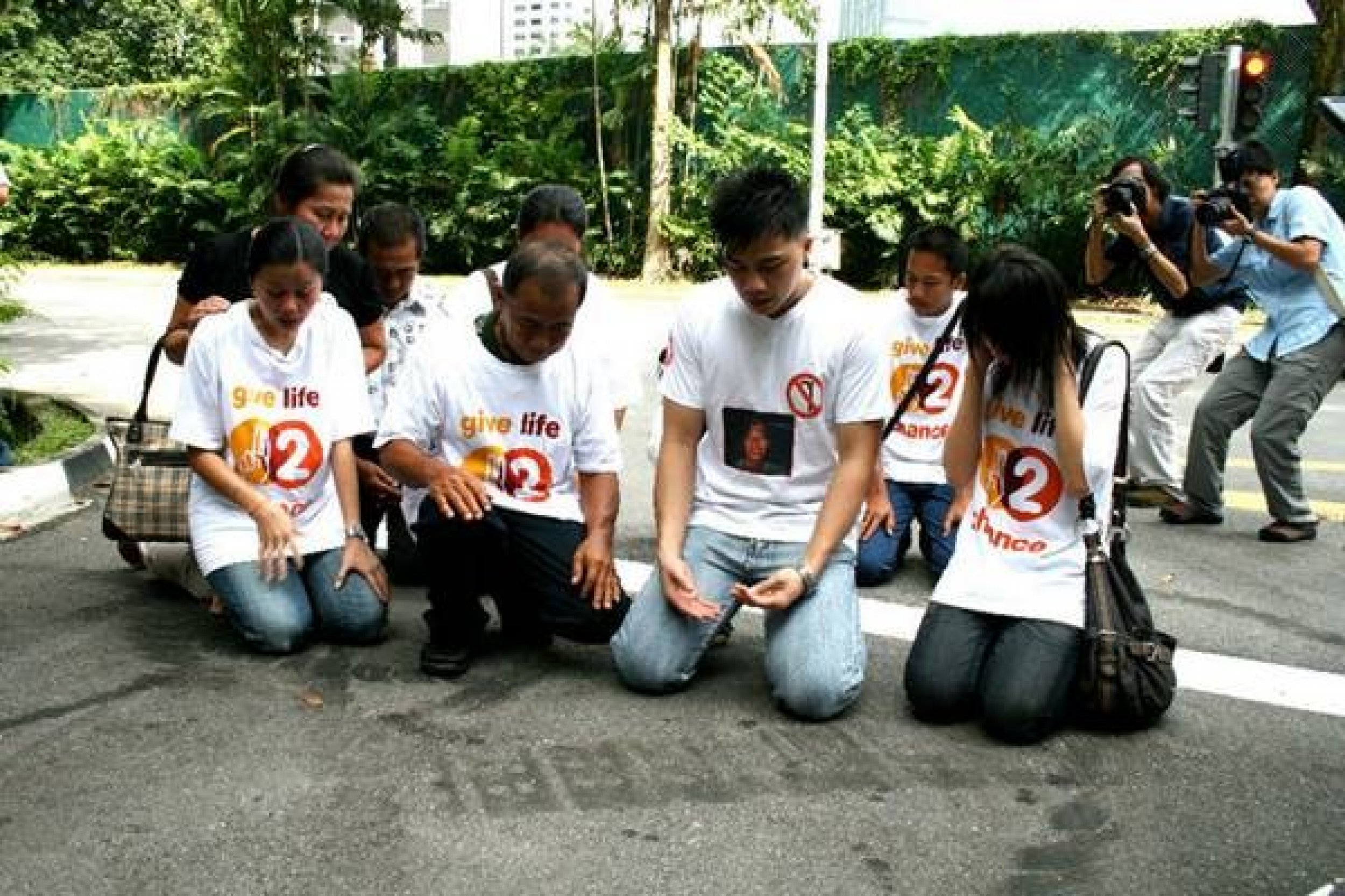
At present, there has been much media focus on Yong Vui Kong, a young Malaysian man who was sentenced to death for drug trafficking in Singapore. Yong has exhausted all appeals and now faces a hanging, despite pleas from his own government.

International Business Times spoke to two Singapore-based lawyers about the country’s drug laws.

Jack Tsen-Ta Lee is Assistant Professor of Law at the School of Law of Singapore Management University.
Michael Hor Yew Meng is a Professor of Law at National University of Singapore

IB TIMES: Drug-trafficking laws in Southeast Asia, especially Singapore, are the toughest in the world. Why is this?
HOR: For Singapore, in any event, it probably has to do with the strong emphasis on governmental efficiency and effectiveness and the weakness of any internal lobby against draconian criminal justice measures.

IB TIMES: Can you estimate how many people Singapore has executed for drug trafficking offenses over the past ten years (or any recent time period for which data is available)?
HOR: As far as I am aware, there are only two sets of publicly available execution figures and these show that from 1999-2003 there was an average execution rate of 27.6 persons annually. This is to be compared with the figures for 2007-2009, when the average dipped to 4.6 persons annually.

IB TIMES: How has the Singaporean government reacted to criticism of its death penalty practices from Amnesty International and other Western groups?
HOR: The explicit reaction has been to stress its position that the decision to impose capital punishment is a matter within the sovereignty of Singapore and not something which is governed by international law -- simply, it is not the business of Amnesty or other Western lobbyists.

IB TIMES: Has Singapore’s Prime Minister, Lee Hsien Loong, made any plans to ease the death penalty laws?
LEE: The Government has affirmed that in its view the death penalty has an important deterrent effect. As such, it has not indicated any intention to abolish the death penalty or reduce the number of criminal offenses attracting the death penalty.

IB TIMES: Are most death penalty convictions in Singapore commuted to life sentences?
LEE: No. Most death penalty convictions are carried out. My impression is that only a handful of such convictions have been commuted to life sentences, usually because the prisoners are suffering from a terminal illness.
I recall one case a number of years ago involving a woman with cancer whose sentence of death was commuted.
HOR: There are no published figures, but it is believed that commutations are extremely rare.

IB TIMES: Despite the severe drug laws, does Singapore have a problem with drug abuse?
HOR: I think it would be fair to say that there is nowhere in the world which does not have a drug problem, but it is also the general perception that the situation in Singapore is well under control. The question is whether the existence and use of capital punishment has materially contributed to this state of affairs.

IB TIMES: Does the Singaporean public generally support the harsh drug laws?
LEE: Yes, my impression is that most people generally support harsh drug laws, and the death penalty.

IB TIMES: Does the Singapore constitution allow for the death penalty for other serious crimes, like murder, rape, etc.?
LEE: Article 9(1) of the Singapore Constitution states that no person shall be deprived of life or personal liberty, save in accordance with law. Thus, the Constitution envisages that a person may be deprived of life (that is, the death penalty may be carried out) so long as legal procedures are adhered to, and it is not possible -- barring a constitutional amendment -- to argue that the death penalty is per se unconstitutional. Legal challenges to the manner in which the death penalty is carried out (namely, that hanging is a form of inhuman punishment or treatment) and to the mandatory death penalty for certain drug offences have so far been unsuccessful.
 The death penalty is not imposed for rape, but is a possible punishment for other offences such as murder, treason, piracy endangering life, and certain kidnapping and arms offenses.
HOR: The current judicial interpretation of relevant Singaporean constitutional provisions is that the death penalty is not inherently unconstitutional.

IB TIMES: Would you describe Singapore as a democracy?
LEE: It depends on what you consider the elements of a democracy to be, but in general, I would describe Singapore as a democracy. We have regular elections at which voters have freely returned the People’s Action Party to power since 1959.
On the other hand, if you define a democracy as requiring broad freedom of speech and freedom of assembly, then it might be said that Singapore is somewhat lacking in this regard as there are various restrictions on these rights.
For example, it is necessary to apply for a permit to hold a political demonstration, and the Government has said that it is not its policy to grant such permits for demonstrations to be held in outdoor locations because of the possibility of public disorder. (Events in indoor locations such as auditoria are allowed, and permits are not required for demonstrations held at Speakers’ Corner if the participants are Singaporean citizens or permanent residents.)

IB TIMES: Are there human rights organization within Singapore itself seeking to abolish the death penalty?
LEE: I am aware that there are some activists who have called for the abolition of the death penalty, though I am not sure if they are organized into any formal association.
HOR: There are a handful of organizations which have expressed dissatisfaction over either the death penalty, or the manner in which it is applied in Singapore. For example, Maruah (http://maruah.org/); and The Online Citizen (http://theonlinecitizen.com/?s=death+penalty).

IB TIMES: What do you make of the case of Yong Vui Kong, the young Malaysian man sitting on death row in Singapore for drug trafficking? Is the Malay government applying pressure on Singapore to reduce his conviction? Is he becoming a “cause célèbre” of sorts?
LEE: I believe that there were some calls from Malaysian activists and possibly even Malaysian Members of Parliament for Yong’s sentence to be commuted to life imprisonment, but I find this rather ironic because as far as I am aware Malaysia also has the death penalty.
I do not sense that Yong is becoming a cause célèbre – since the final dismissal of his case, there has been little in the news about him.
I was not surprised by the judgment of the Court of Appeal in the Yong Vui Kong case, as it essentially reaffirmed legal reasoning that had been applied in the earlier case of Nguyen Tuong Van, a Vietnamese-Australian drug trafficker who was eventually executed.
The Singapore courts tend to be quite conservative where interpretation of the Constitution is concerned, and I did not think it was likely that the Court of Appeal would ‘discover’ a prohibition against inhuman punishment and treatment in Article 9(1) as it does not expressly state so.
HOR: The problem with Malaysian attempts to persuade the Singapore government not to execute Yong Vui Kong is that Malaysia itself has and uses a very similar set of drug laws which prescribes the mandatory death penalty.

Water spray cools down spent fuel pool at Fukushima, but radiation levels stay same
Photo: REUTERS

Water spray cools down spent fuel pool at Fukushima, but radiation levels stay same

Tokyo Electric Power Co. (TEPCO), the operator of the troubled nuclear power plants in northeastern Japan, said that high-pressure streams of water shot Thursday evening by plant workers effectively cooled down an overheating spent fuel pool.

However, radiation levels detected around the facility have not been reduced. The latest figure indicate that after the water sprat maneuver was completed, radiation level at about 3,600 microsievert per hour, unchanged from before.

Five fire-trucks shot 30 tons of water at the No. 3 reactor building of the Fukushima No. 1 nuclear power plant, in an effort to cool down the pool that contains spent nuclear fuel rods outside the reactor wall.

Earlier on Thursday, the radiation level around the power plant’s administration building climbed to 4,000 microsievert per hour from 3,700 after two government helicopters dropped tons of water earlier in the day.

Among the six reactors at the Fukushima No. 1 nuclear plant, the buildings that house the reactors have been destroyed by hydrogen blasts at the No. 1, No. 3 and No. 4 reactors, while the No. 2 reactor’s containment vessel suffered damage in its pressure-suppression chamber at the bottom.

The No. 1, No. 2 and No. 3 reactors were operating at the time of the earthquake, but the automatically halted – it is believed their cores partially melted as they lost cooling functions after the quake.

EUR/USD: Euro bounces from 1.3200
Photo: REUTERS

EUR/USD: Euro bounces from 1.3200

FXstreet.com (Jakarta) - The Euro (EUR) rebounded from week lows under 1.3200 as German Trade Balance beat expectations and stocks reversed direction. German Trade Balance (Feb) forecast at 7.5Bn came in at 8.7Bn.

Easy Forex Team said: Overall the EUR/USD traded with a low of 1.3149 and a high of 1.3308 before closing at 1.3250.

Intel seeks to overhaul compensation
Photo: REUTERS

Intel seeks to overhaul compensation

Intel Corp, a bellwether of the technology industry, announced an overhaul its employee compensation plan, including a freeze on top salaries and an exchange of underwater stock options.

Under the plan, the chip maker plans to exchange all but senior executives' underwater stock options for options that carry a lower exercise price, becoming the latest corporation to try to compensate employees amid a stock market rout.

Intel detailed the plan on Monday in a federal filing of its proxy statement. The move must be approved by Intel shareholders.

The company seeks to exchange options with an exercise price above the stock's 52-week high for a lesser number of new options that have about the same fair value as those surrendered. The plan should be cost-neutral since Intel had accounted for the cost of the options when they were granted.

Companies often try to conduct such exchanges as a way to motivate and retain employees, since stock options are part of a compensation package. But they lose value when the market price of the underlying stock falls below the exercise price, which pushes them underwater.

(Reporting by Franklin Paul and Clare Martine; Editing by Lisa Von Ahn)

EUR/CAD - Euro Canadian Dollar, American Session - 19/03/09
Photo: REUTERS

EUR/CAD - Euro Canadian Dollar, American Session - 19/03/09

1,6724. EUR CAD is in an uptrend supported by 1H exponential moving averages. EUR CAD is in a consolidation after the last bullish movement. The volatility decreases. Bollinger bands are tightened. ForexTrend 4H (Mataf Trend Indicator) is in a bullish configuration. The consolidation should continue. The price should continue to move in 1,6650 / 1,6860 range.
Resistances
1,6860 - 1,6950
Supports
1,6660 - 1,6365

Miley Cyrus and Nick Jonas have 'reconnected'
Photo: REUTERS

Miley Cyrus and Nick Jonas have 'reconnected'

Two of the most talked about teen star sensations, Miley Cyrus and Nick Jonas have reconnected after their break up in December of 2007, Cyrus told a radio station on Friday.

Cyrus said they saw each other and decided this whole thing [separation]was so stupid, and both of their families were happy they are hanging out again.

He's my best friend, and we still hang out all the time, and we've definitely reconnected. We don't know what's going to happen in the future, but right now we're just kicking it and hanging out as much as we can, Cyrus told 107.5 The River in Tennessee yesterday.

Cyrus refused to comment about a jet-skiing trip they were spotted together on June 9 on Tybee Island.

Selena Gomez made one of the boldest decisions on Wednesday when it comes to hair, bangs.

On Wednesday, the 20-year-old starlet posted photos on her Facebook showing off her new fringe hairstyle with her long, dark brown mane.

But the move wasn't just a fashion or style one, according to Gomez, who said she framed her face with bangs for an upcoming role.

"new hair for a new movie :) I love changing my hair!" Gomez wrote on Wednesday.

Gomez most recently was sporting long extensions with the ombre look, with long honey streaks in mid-June. Before that, the former Disney actress had a shoulder-length long bob with a similar dark brown color. In January, Gomez opted for a rocker 'do with electic blue and purple hair extensions.

So far, there is no word on what film the actress is working on which required her to cut bangs, though she is currently filming a movie opposite Ethan Hawke called "Getaway" set for a 2013 release.

Other tween starlets also underwent major hair transformations recently, like Miley Cyrus who dyed her brown locks a golden blonde shaped into a short bob.

But Gomez isn't the only starlet rocking fringe. Katy Perry also sported bangs for the Elle magazine September cover shoot in a short, blunt fringe.

Take a look at the slideshow to see a gallery of photos of actresses and singers with bangs.