

Thursday Meeting Preview: ECB's Draghi To Push Paradox Of Monetization On Reluctant Germans
In the first century of the common era, the Greek historian Plutarch reported on a question that had vexed philosophers 300 years prior: that of whether a ship that was taken down and rebuilt plank by plank would still be considered the same ship after restoration. In the 18th century, Irish intellectual George Berkeley wondered whether a tree falling in a forest with no witness to the event could be understood to make a sound. In 1935, Austrian physicist Erwin Schrödinger mused on the fact the standard model of quantum mechanics allows for a cat, in certain experiments involving feline elements, to be simultaneously alive and dead.
These influential, once-in-generation epistemological breakthroughs all had deep implications on human knowledge, sometimes inspiring entire fields of intellectual endeavor.
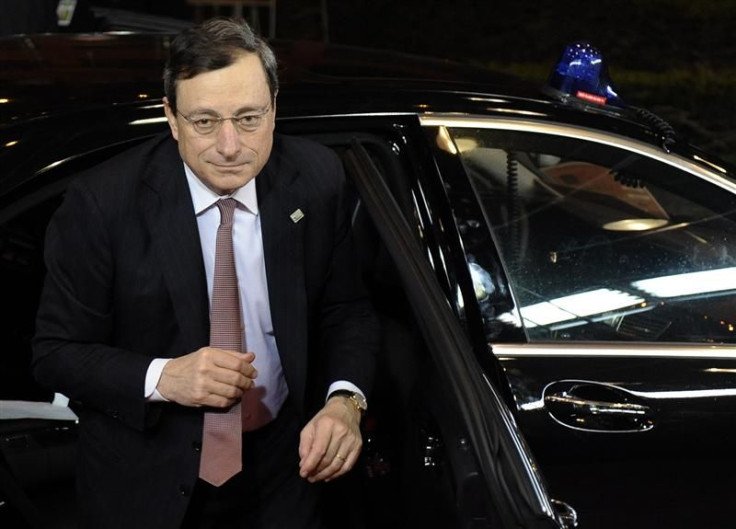
Which is why lovers of thought experimentation will rejoice to hear the latest words from European Central Bank president Mario Draghi, who in the fashion of many a philosopher-king before him, is suggesting his institution might yet save the struggling economies of Europe by committing to a new, seemingly contradictory belief.
Late Monday, word leaked out that Draghi is now saying the ECB should pursue a policy of monetizing sovereign debt of periphery countries -- that is, printing reams of new euro to buy bonds issued by those governments -- even though such a policy path exceeds the central bank's mandate and has been adamantly opposed by the German political establishment. The logical breakthrough that is allowing for the new path to be pursued: Draghi is reportedly arguing that monetizing debt with maturity of three years or less is... wait for it... not truly monetization.
When Is Monetization Not Monetization?
Draghi's paradox posits central bank purchases of that shorter-dated debt would not be "legitimate" monetization as they would not seriously affect yields for longer-dated bonds, meaning their effect on inflation would be checked. At the same time, he believes the action would be "legitimate" enough, on aggregate, to lower the borrowing costs faced by various countries, allowing them a window out of the crisis without a change in fiscal fundamentals, as happens through monetization.
In a closed-door meeting in Brussels, Draghi reportedly told European lawmakers the plan to pursue this new course of action had arisen out of necessity -- the fact the ECB has effectively lost its handle on the borrowing costs for certain members of the 17-nation eurozone, leading to a fragmented Europe in which the bank felt unable to pursue its mission of fostering low and steady inflation.
"We cannot pursue price stability now with a fragmented euro area because changes in interest rates affect only one country, or two countries at most," Draghi said, according to Bloomberg, noting the action would be "a way to comply with our primary mandate," and adding that "frankly, all this also has to do very much with the continuing existence of the euro."
An Epic Showdown
If the leaks are to be believed, Draghi is setting himself up for an epic showdown with other (mainly German) policy makers who have been opposing this course of action from the get-go.
The central banker would not be alone in the fight. Both French and Italian politicians made statements Tuesday asking for the ECB to act to lower borrowing costs, with Italian prime minister Mario Monti noting "the serious obstacle of spreads have no underlying economic justification." French President François Hollande supported his Italian peers.
There is also some logical backing to Draghi's claim that monetization may not really be Monetization-with-a-capital-M if it only touches the shorter-dated tail end of the bond yield curve. Most economists believe the nefarious dynamics that cause inflation to rise whenever a central bank prints new money to buy up a country's debt are a result not so much of the central bank's specific action, but of its implicit promise to keep pursuing the action well into the future. According to Reuters, Draghi explained to lawmakers that short-term bonds "will easily expire" meaning "there is very little monetary financing effect at all in what we are doing."
But it is not sure everyone will buy that explanation -- or that it's even empirically true -- and the stakes are already high. Last week, it was rumored Bundesbank chief Jens Weidmann, the top central banker representing Germany's interests at the ECB, was considering quitting his post in the face of unrelenting pressure from his peers to drop his bank's objection to unrestricted bond-buying. Representatives from Finland, the Netherlands and Austria are also likely to raise a fuss.
And it's all likely to come to a head Thursday, when the governing council of the European Central Bank meets.
Several Options
Besides discussing the leaked plan for buying of short-dated bonds, the ECB has several options to pursue a more accommodative monetary policy, as is generally believed the bank intends to do: the institution could relax collateral rules of cash-for-bonds programs it currently runs to provide Eurozone banks with liquidity. It could cut its benchmark deposit or repo lending rate. It could make a commitment to further specific action in the future.
The details that come out of the meeting will also matter. For example, if the bank does decide to engage in bond-buying, will it impose explicit targets it wishes to drive borrowing costs down to, or will it just announce how much money it is willing to print? Will it demand senior status on any of its bond purchases, which would make the program less effective but make the bank's actions safer?
Analysts so far have been bearish on the central bank's ability to announce aggressive action Thursday. Credit Suisse said in a note last week the most likely scenario was one where "little or no new information on bond buying" arose, though perhaps a cut for the bank's benchmark repo rate would be in order.
More explicitly, Morgan Stanley noted it didn't "believe that the conditions for the ECB to start buying government bonds are likely to be met already at the upcoming Governing Council meeting on September 6."
Bank analysts who see more proactive action by the ECB, including those at Commerzbank, ING Groep N.V. and JPMorgan Chase and Co., see the bank being vague on the details on the details of expected action, and then proceeding to buy mostly Portuguese and Spanish bonds.
How the action of the central bank is perceived will also determine what the central bank does.
"Draghi will probably disappoint at least marginally on the intervention part, so to compensate for the lack of details on the bond-buying part, they could also be inclined to cut rates," analyst Anders Svendsen of Nordea, told Reuters.
Other Considerations
Many have noted the ECB is likely to defer major action until a decision by Germany's Constitutional Court on September 12, in which that judicial body will decide if it is lawful for German funds to contribute to a bailout of other European countries. While the two events technically don't depend on one another, analysts say, it would be imprudent for Draghi to pre-empt that highly-politicized German ruling.
The reality, however, is that pressure is growing on Draghi and the ECB to act. In late July, the central bank president gave a press conference in London in which he stated that "within our mandate, the ECB is ready to do whatever it takes to preserve the euro," adding, "believe me, it will be enough." The market took the comments to mean aggressive action was imminent and sold off when Draghi disappointed in his next appearance.
The central bank head, if he is to maintain a semblance of control of the situation, is now forced to deliver on something that really is enough.
Perhaps that will be able to do so on Thursday. Perhaps he will disappoint. Perhaps he'll be able to spin a long yarn to soothe the frayed nerves of the financial markets, introducing a few new brain-teasers along the way. As American comedian W.C. Fields once remarked, in what could be a motto of modern central bank communications, "if you can't dazzle them with brilliance, baffle them with bull----."
Or perhaps Draghi will take the podium Thursday and explain to the world why even though Schrödinger's cat might be at least partly alive, the euro, sadly, is dead.
--
© Copyright IBTimes 2024. All rights reserved.
-
IMF Says Global Debt Levels Face 'Great Election Year' Risk
-

Divisions Among Colombia's FARC Dissidents Complicate Peace Talks
-

French Far Right Gets Youthful Vibe With 28-year-old Leader
-
US Fed's Powell Says Inflation Fight May Take 'Longer Than Expected'
-

Mideast-related Oil Price Spike Threatens 'Relatively Good' Economic Outlook: IMF Chief Economist
-

Wine Growers 'On Tip Of Africa' Race To Adapt To Climate Change
-

Despite Olympic Truce, Games Wrestle With Political Fallout
-

What Will The Fed Do With The Latest Inflation Numbers?
-
US Retail Sales Up More Than Expected In March
-
Alexandre De Moraes: Brazil Judge In Feud With Elon Musk


