

Natural Antacid May Have Helped Early Land-Creatures Survive Out Of Water
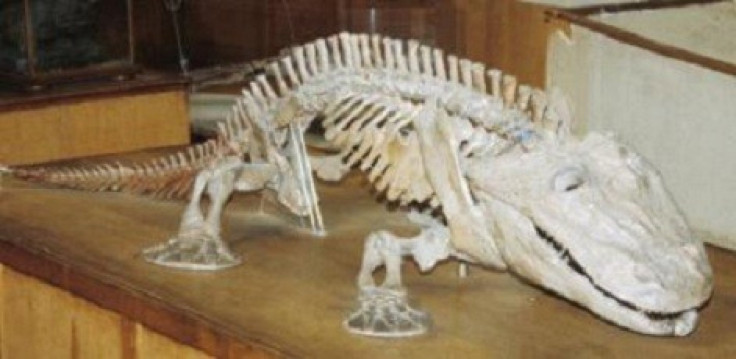
Aquatic creatures that started to survive out of water had surprising help from their bony skin, according to a new study.
Aquatic animals that moved from water to land struggled to rid their bodies of carbon dioxide. Bony structures under their skins gave aquatic creatures a way to mitigate the effects of carbon dioxide and to prolong the length of time out of water, researchers found.
Carbon dioxide, a waste gas, built up in the early-land creatures that had primitive lungs and immobile ribs, researchers said. Carbon dioxide mixes with water in the body and forms an acid that can cause intense pain. Bony structures acted as antacids, lessened the acidic effects and allowed the animal to remain on land longer.
This would likely be a temporary solution, sort of like storing up the acid until you could go back to the water and get rid of it via diffusion there, Christine Janis, lead author and professor of evolutionary biology at Brown University, told Discovery News. But the dermal bone would allow the animals to stay out on land longer than they would otherwise be able to do, so you can see it would have a cumulative adaptive advantage.
Dermal bone is formed from connective tissue instead of cartilage. The human skull is made from dermal bone, while arm and leg bones are made out of cartilage.
The pitted bones of early-land creatures, known as tetrapods, indicate a blood supply, researchers said. The animals probably stored acid-neutralizing chemicals, such as calcium, in the bones and released them when acid levels became too high.
Now we know that dermal bone can do this, and it's something we didn't know before, that gives us a basis that maybe this is why tetrapods had this feature, which previously we didn't have a good explanation for, Janis told LiveScience.
Researchers found that the tetrapods known to spend more time out of water had more complex dermal bones than those that spent more time in the water. In addition, the researchers tracked the evolutionary history of the bone and found that it supports the hypothesis as well.
When [the dermal bone] gets lost, it gets lost in the lineage leading to modern reptiles when they start getting more mobile ribs, Janis told LiveScience.
Some reptiles, such as alligators, have dermal bones that allow them to stay underwater without carbon dioxide building up, according to the study. Researchers intend to sample the dermal bones of modern animals and search for a chemical or structural element that gives it the ability to neutralize carbon dioxide buildup. Then, by looking for a similar signature in tetrapod fossils, it may be possible to confirm the findings, researchers said.
Some scientists questioned whether the study's findings are correct, and said proving the findings is a difficult task.
Their idea really requires a smoking gun, Jason Anderson, an associate professor in the University of Calgary's Faculty of Veterinary Medicine, told Discovery News. Much more research would need to be done to establish that it even occurs in living animals, as they propose.
The journal Proceedings of the Royal Society B published the study on Tuesday.
© Copyright IBTimes 2024. All rights reserved.
-

School's Out: How Climate Change Threatens Education
-

Hong Kong Demands Online Platforms Remove Banned Protest Song
-

2023 'Year Of Record Climatic Hazards' In Latin America: UN
-

Crypto Community Buzzes As Grayscale Withdraws Ethereum Futures ETF Application
-

Mongolia's Wildlife At Risk From Overgrazing
-
Milking Venom From Australia's Deadly Marine Animals
-

TikTok Challenges Potential US Ban In Court
-

Boeing Probed In US Over Possible Falsified Records On 787
-

99Bitcoins Presale Hits $1M, Signaling Massive Interest In Learn-To-Earn Crypto
-

Crypto Industry Lost $71M To Security Incidents Last Week: Blockchain Security Firm


