

Little evidence for Iraq WMDs ahead of 2003 war: U.S. declassified report
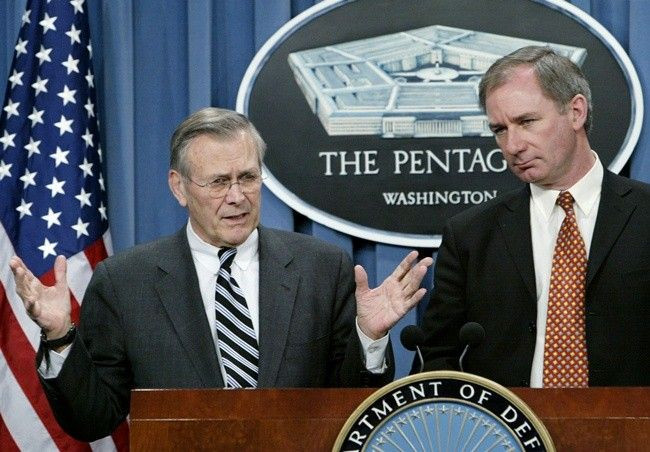
Six months ahead of the 2003 invasion of Iraq, the United States had little hard evidence and relied heavily on analytic assumptions and judgment in assessing what it knew about Iraq's Weapons of Mass Destruction Programs, according to declassified U.S. intellilgence report.
The September 5, 2002 report from the Glen Shaffer, the Director of Intelligence - which was initially classified as secret - at the time showed the U.S. knew about Iraq's internal expertise in building nuclear weapons, biological weapons, chemical weapons and ballistic missiles.
Click here to see full document.
The letter, which was declassified on January 6, 2011, was available on the website of former U.S. Defense Secretary Donald Rumsfeld, who is releasing a new book titled Known and Unknown, which includes Rumsfeld's views on his life and career.
In a memo by Rumsfeld on September 9, 2002 at 9:47 a.m., Rumsfeld informed the Chairman of the Joints Chiefs of Staff Richard Myers about the report.
Please take a look at this material as to what we don't know about WMD. It is big, Rumsfeld said.
At a February 12, 2003 press conference, Rumsfeld said Iraq was engaging in the development of weapons of mass destruction, according to a transcript from the Defense Department.
On March 20 in 2003, the United States and a coalition of allies invaded Iraq.
President George W. Bush said two days later in his weekly radio address that the cause the coalition was pursuing was the security of the nations we serve and the peace of the world.
And our mission is clear, to disarm Iraq of weapons of mass destruction, to end Saddam Hussein's support for terrorism, and to free the Iraqi people, he said.
September 5, 2002 Report
Shaffer wrote on September 5, 2002 that he had been asked by Rumsfeld what the U.S. did not know in terms of percentage about Iraq's WMD program.
We've struggled to estimate unknowns, and the attached briefing sumps up our best J2 sense, he said. J2 is an intelligence group supporting top level U.S. defense officials.
We range from 0 % to about 75 % knowledge on various aspects of their program, he said.
The group did not know the status of any nuclear enrichment facilities, centrifuge program development, or attempts by Iraq to purchase a nuclear weapon or know with confidence about the location of any nuclear weapon-related facilities.
Our knowledge of the Iraqi nuclear weapons program is based largely - perhaps 90% - on analysis of imprecise intelligence, the report states.
The report said we believe Iraq had 7 mobile biological weapons production plants but cannot locate them.
On chemical weapons, the U.S. could not confirm the identity of any Iraqi sites that could produce the final chemical agent.
Our overall knowledge of the Iraqi CW program is primarily limited to infrastructure & doctrine. The specific agent and facility knowledge is 60 -70 percent incomplete, the report stated.
U.S. intelligence could confirm the identity of most facilities that contributed to ballistic missile production, the report states.
February 12, 2003 Rumsfeld Press Conference
During the press conference, Rumsfeld said Iraq was coming closer to a time when they will have those weapons developed in a form that is more threatening than it had been the year before or the year before that.
Rumsfeld also noted that terrorist networks exist, that, in fact, they -- we now know from the intelligence we've gathered that they've had a very active effort underway to get chemical, biological and radiation capabilities.
And we know that Iraq has those and does not wish much of - many of its neighbors well, if any, he said.
A reporter asked Rumsfeld if there was any evidence to indicate that Iraq had attempted to or was willing to supply terrorists with weapons of mass destruction. In addition, the reporter told Rumsfeld that there were reports abou no direct link between the government and those terrorist networks.
Rumsfeld replied that such reports were interesting to me, because as we know, there are known knowns; there are things we know we know. We also know there are known unknowns; that is to say we know there are some things we do not know. But there are also unknown uknowns - the ones we don't know we don't know.
And so people who have the omniscience that they can sy with high certainty that something has not happened or is not being tried, have capabilities that are ... they can do things I can't do, he said.
© Copyright IBTimes 2026. All rights reserved.