Online Gamers Solve AIDS Puzzle that Eluded Scientists
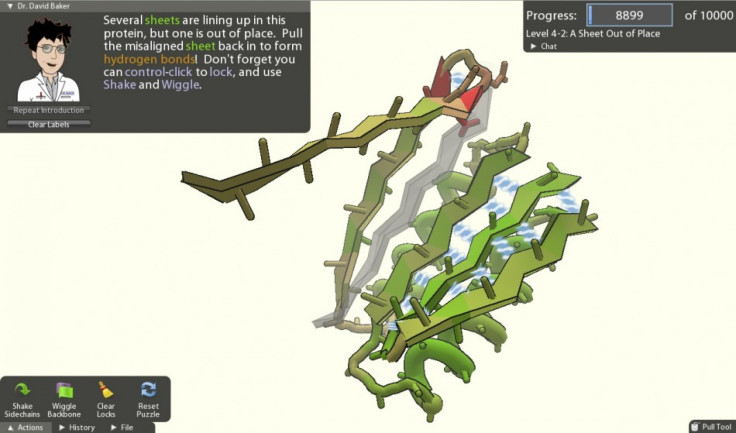
AIDS researchers struggling to unlock the structure of a key enzyme received a helping hand from an unlikley source: thousands of amateurs playing an Internet game called Foldit.
By using a game developed by researchers at the University of Washington, players were able to come up with a viable structure for a protein that is crucial to the early development of AIDS. Foldit allows users to assemble potential proteins out of different molecular building blocks, and video game players ended up accomplishing what scientists could not.
People have spatial reasoning skills, something computers are not yet good at, Seth Cooper, a University of Washington computer scientist who is Foldit's lead designer and developer, said in a news release. Games provide a framework for bringing together the strengths of computers and humans.
Few of the players had any background or training in biochemisty, but expertise is not required to excel in Foldit. Users who evinced good spatial reasoning skills were able to operate the game skillfully, and scientists improved upon the user-generated models.
A type of enzyme known as a retroviral protease helps AIDS to proliferate in its early stages. Now that scientists have a good idea of the enzyme's structure, it will be easier for them to develop treatments that can attack the enzyme.
This is one small piece of the puzzle in being able to help with AIDS, Firas Khatib, a biochemist at the University of Washington and lead author of a research paper on the project, told msnbc.
The success of Foldit hints at the possibilities of citizen science, a scientific method that involves recruiting large numbers of people to help solve scientific problems. The field encompasses everything from categorizing different types of galaxies to using games, like Foldit, that help users to rapidly gain expertise in a subject.
© Copyright IBTimes 2026. All rights reserved.
- MOST READ