

US austerity is really foolish: Stiglitz
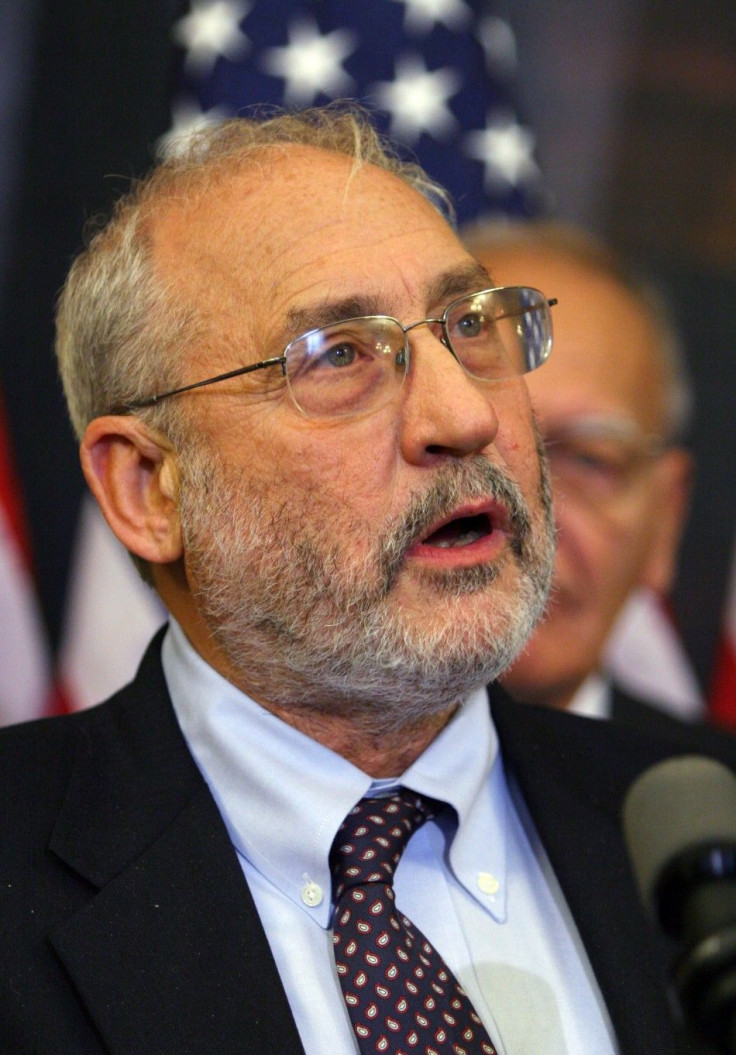
US “austerity is really foolish,” said famed economist and Nobel laureate Joseph Stiglitz in his office at Columbia University, in an interview with IBTimes.
Stiglitz, author of Freefall: America, Free Markets, and the Sinking of the World Economy, is a leading authority on the causes of the global financial crisis.
In the aftermath of the meltdown and the budget deficit problem that has been exacerbated by government fiscal stimulus, he thinks austerity, or cutting the size of government spending, is the wrong remedy for the US – especially if one cuts funding in all the wrong places.
Instead, he thinks America should tackle the budget deficit issue from the tax revenues side.
“What matters is debt relative to GDP. If we spend on investment, the economy goes up, tax revenues go up, and everything is better,” said Stiglitz.
Conversely, if America cuts back spending, the economy would grow slower, the unemployment rate would remain high, and the budget deficit would become less sustainable. About 10 years ago, Argentina went down this erroneous path of austerity and ended up defaulting on its sovereign debt, said Stiglitz.
Moreover, investment spending makes sense because America (unlike countries like Japan) is underinvested. Stiglitz said it is underinvested in technology, infrastructure, and particularly in education/research.
He said some of the most important technological advances in the US have come from government/university research. Biotechnology and the internet are examples. These advances, of course, created new industries (and jobs), improved productivity in existing industries, and provided huge boosts to the overall wealth and growth of the United States.
Even though universities in other countries are catching up, US universities are still “way above at the top.” The US government has also shown itself quite capable of advancing research when it comes to military technology, so it’s reasonable to assume it can do likewise in other areas as well.
Given these proven capabilities, investment in education and research is largely an issue of more funding, said Stiglitz.
In this regard, China may be a good example for the US to follow.
First, Chinese government funding for research is focused on commercial technology.
“They have an active government industrial policy. We (the US) have an industrial policy, but [it is] mostly buried in the military. While we have been developing smart bombs, they have been developing green technology,” said Stiglitz.
Second, the Chinese are spending more on education while the US is cutting back.
China “is committed to having ten global-rated universities in the next 10 years. We (the US) are on the path of making our first-rate universities second-rate,” he said.
Stiglitz, however, doesn’t indiscriminately support all kinds of US government stimulus measures.
On the monetary side, he’s against the Federal Reserve’s second round of quantitative easing (QE2).
Domestically, he thinks it’s not spurring much lending and hasn’t really lowered the interest rate – in fact, interest rates have actually gone up since QE2 began.
Abroad, this surge of liquidity has caused problems. It has led to the “fragmentation of the global financial markets” as emerging market economies put up all kinds of financial controls and barriers to deal with inflows from the US.
To read more Global Markets interviews, click here
Email Hao Li at hao.li@ibtimes.com
Click here to follow the IBTIMES Global Markets page on Facebook.
Click here to read recent articles by Hao Li.
© Copyright IBTimes 2025. All rights reserved.
- MOST POPULAR IN World


