

China must battle inflation, maintains growth: Zhou
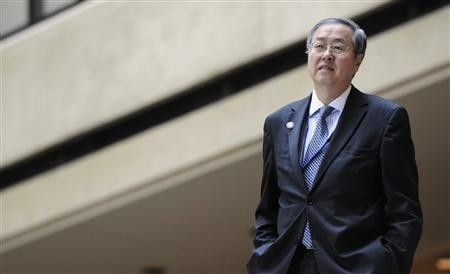
China's economic outlook is positive, but it must keep battling inflation and be ready to counteract any external shocks, the country's top central banker said on Saturday.
People's Bank of China Governor Zhou Xiaochuan said China should prevent rapid growth from overheating what many viewed as the world's leading economic engine, and called on Europe to aggressively deal with the region's worsening debt crisis.
It would be unrealistic for anyone to hope China could dramatically accelerate its growth rate, and such a rate would not be sustainable, Zhou said at a press conference during this week's meetings of the International Monetary Fund and the World Bank.
The reasonable expectation probably should be somewhere around 8 percent or 10 percent, he said.
China's economy grew at an annual rate of 9.5 percent in the second quarter, the slowest pace since the third quarter of 2009, but still faster than economists had expected.
Asked how he viewed the European debt crisis, Zhou said We have to see if the euro zone countries can implement the decisions taken on July 21 before China can decide its response.
Euro zone leaders agreed on July 21 to allow the European Financial Stability Facility (EFSF), a bailout fund, to buy bonds of distressed governments and give precautionary credit to governments before they are cut off from markets.
China also needed to stay flexible in its economic policies -- a signal that it could consider new stimulus measures, but Zhou stressed that battling inflation remains his top concern.
There is no very quick, immediate way to bring down inflation. It takes time, he said, adding that economic uncertainty outside of China could also affects domestic inflation.
Earlier on Saturday, Zhou said in remarks to the IMF's steering committee that the central bank will reduce inflation in the short term without major disruptions to the economy, while facilitating growth over the medium and long term.
At this week's meetings of Group of 20 major economies and the IMF, officials have called for China to boost domestic consumption to help maintain global growth amid turmoil in Europe and weakness in the United States.
Zhou said on Thursday that the major emerging markets should find ways to boost internal demand.
With $3.2 trillion in reserves, Beijing has ample firepower should it choose to spend more, but it would have to be careful to avoid side effects such as more inflation and overinvestment in some projects.
SPEND IT ON CONSUMPTION-IMF
Meanwhile, IMF officials said on Saturday that Beijing would be better served if any new stimulus spending is aimed at consumers, not increased investment and bank credit.
Anoop Singh, the director of the IMF's Asia and Pacific Department, said China had room for such spending, but this would likely only be needed if its growth was severely hit by a systemic crisis in Europe that also weakened U.S. demand.
Our sense is that China has room to return to greater fiscal stimulus if needed. Our sense is that it will help them if this is done through consumption, Singh told a news conference.
IMF officials said that spending it on reduced employment taxes and direct transfers to lower income people would avoid excesses that could result diverting it toward bank credit and investment projects. It also could be used to help build up more of a social safety net, which would increase consumption.
Even so, new spending would likely have less impact on the global economy than a previous round of nearly $600 billion in stimulus had in 2008, Singh said.
He added that Beijing's top priority was to address inflation and overheating pressures, including ensuring that credit quality does not deteriorate.
In China, it is very important that the People's Bank set a clear target for its growth of bank credit for this year, Singh said. And it's also very clear that China's addressing its inflation...remains the top priority.
He said that any new stimulus from Beijing, however, would likely have less of an impact on global growth than a previous round of spending in the 2008-2009 timeframe.
© Copyright Thomson Reuters {{Year}}. All rights reserved.