Jon Huntsman 2012: What Are His Positions?
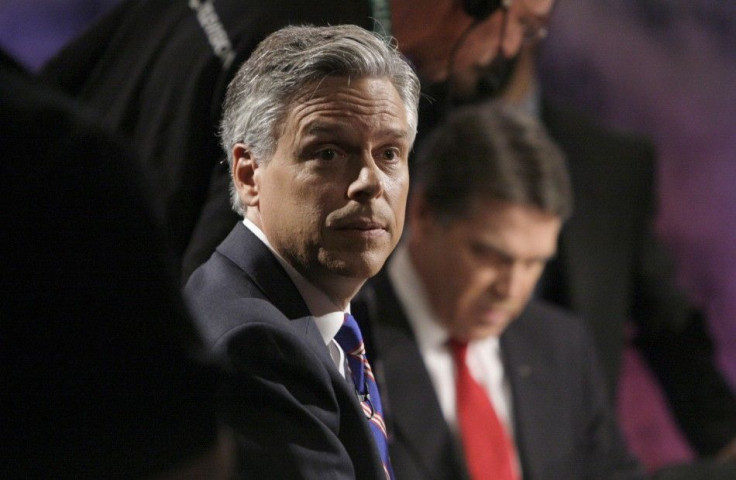
For most of the Republican nomination race thus far, Jon Huntsman has been considered little more than a side note. But while the former Utah governor remains below 3 percent in most national polls, he is on the rise in New Hampshire, where he has pooled almost all of his resources. There, he averaged 8.8 percent support from Nov. 15-28, good for fourth place behind Newt Gingrich, Mitt Romney and Ron Paul, and his numbers are edging slowly but consistently upward.
Many voters know Huntsman simply as the moderate candidate, because he has held high-level government positions under both Republican and Democratic presidents, and because his platform, though mostly conservative, is less thoroughly right-wing than those of most of his rivals.
But that is a simplistic view. Here is a more comprehensive look at Huntsman's positions on a variety of issues.
ECONOMIC ISSUES
Entitlements:
Huntsman's official economic plan does not mention entitlement programs like Social Security, Medicare and Medicaid, but he has discussed his proposals on the campaign trail on a few occasions. In September, he told CNN that he would raise the retirement age in order to reduce the government's Social Security and Medicare obligations, change the formula by which cost-of-living adjustments are determined and reduce benefits for high-income individuals. He did not specify what the new retirement age would be or how he would change the cost-of-living formula.
He has actually taken a more conservative stance than his opponents on Medicare, telling ABC News in May that he would have voted for the controversial budget plan proposed by U.S. Rep. Paul Ryan, R-Wis., which would have completely privatized Medicare so that the government didn't have to pay for any of it. I would've voted for it, he said, including the Medicare provisions, because the only thing that scares me more than that is the trajectory that our debt is taking. ... We've got to be bold, and we've got to have proposals on the table that perhaps in years past would've been laughed out of the room, and we've got to look seriously at them. We don't have a choice.
Health care:
Like every other candidate in the 2012 Republican race, Huntsman wants to repeal President Barack Obama's unconstitutional and unaffordable health care law. In terms of broad reforms, he wants to streamline the Food and Drug Administration's approval process to make it less expensive for biotechnology and pharmaceutical companies to develop health care products. But his economic plan includes few other proposals for addressing problems like the high cost of health care and the inaccessibility of affordable insurance for many Americans.
Some clues can be found by looking at the health care reform plan he developed as governor of Utah, which involves a health insurance exchange through which individuals and small businesses can purchase a private insurance plan of their choice. This, the conservative Heritage Foundation argues, put[s] downward pressure on health care costs while empowering consumers to make their own health care decisions. Huntsman said at a recent Republican debate that he would support a similar plan as president, but that he would leave it to the states to experiment and find breakthroughs in how we address health care reform.
Although he does not specifically mention the health care implications of his tax-reform plan, Huntsman's proposal to cut all credits and deductions from the tax code would eliminate the tax exemption for employer-sponsored health insurance, which totals $300 billion a year and incentivize[s] employers to purchase insurance for their workers, tax-free, instead of giving that money to employees as salary and letting them by insurance for themselves, Avik Roy writes in a Forbes blog post. This change, he argues, would help solve the problems inherent in the employer-based health insurance system: overspending on extraneous health benefits, the lack of price- and value-consciousness on the part of patients and the lack of health insurance portability that makes people afraid to leave, or lose, their jobs.
Job creation:
Huntsman's job-creation plan involves lowering tax rates for both individuals and corporations, thus encouraging investment and economic growth. In particular, he argues that lowering the corporate tax rate from 35 percent to 25 percent would discourage outsourcing and so keep more jobs in the United States.
Like his Republican competitors, he also criticizes what he sees as excessive federal regulations on businesses that would otherwise create jobs: namely, regulations set by Obama's health care law, by the Environmental Protection Agency and by the Food and Drug Administration. He wants to repeal Obamacare and the Dodd-Frank financial regulatory bill; streamline the U.S. Patent Office and FDA approval processes to encourage product development, especially by biotechnology and pharmaceutical companies; and prevent the EPA from imposing job-destroying environmental regulations.
He has also proposed privatizing the government-sponsored Fannie Mae and Freddie Mac mortgage companies in order to let the housing market settle, expanding free-trade policies and authorizing energy projects in Alaska, Canada and the Gulf of Mexico, according to his Web site.
Taxes:
Two of Huntsman's tax-reform proposals are near-universal among the Republican candidates: he would reduce the maximum corporate income tax rate from 35 percent to 25 percent and eliminate taxes on capital gains and dividends, which he, like most Republicans, characterizes as double taxation on most individuals who choose to invest since they first had to earn that money and pay income tax on it, according to his Web site. The purpose of these reforms is to encourage investment and spur economic growth.
He also proposes a flatter, fairer, simpler income tax system for individuals, but not a completely flat tax as proposed by Herman Cain and Rick Perry. His plan would set three rates of 8 percent, 14 percent and 23 percent, and eliminate all deductions and credits in order to create a simpler and more efficient tax code, decreasing the burden on taxpayers and saving $400 billion per year in compliance costs. He would also eliminate the alternative minimum tax, which was enacted in 1969 to ensure that high-income individuals who took advantage of exemptions would still have to pay at least some taxes, but which Huntsman says unfairly burdens small businesses that file as individuals.
Lastly, he would switch to a territorial system of taxation, meaning that multinational corporations would not pay taxes on income earned outside the United States, and implement a tax holiday for these companies to repatriate existing income tax-free -- the idea being to encourage multinational corporations to invest more in job creation domestically.
FOREIGN POLICY
Afghanistan:
Huntsman differs from most other Republicans in that he has called directly for a withdrawal of United States troops from Afghanistan, where they have been fighting for more than 10 years now. He says on his Web site that, while the war in Afghanistan began as an important mission against al-Qaida and has been instrumental in weakening both al-Qaida and the Taliban, it has evolved into an ill-advised counter-insurgency campaign which continues to carry heavy costs in terms of blood and treasure. Counter-insurgency efforts that have worked reasonably well in Iraq have not worked in Afghanistan, he says, largely because of the role of Pakistan: the northwest region of Pakistan provides a refuge for the Taliban, and the government of Afghan President Hamid Karzai is unable or unwilling to fight Pakistan's influence.
It is unclear that any amount of time or resources committed to the conflict by the United States would render our efforts in Afghanistan effective, and so, Huntsman says, we should withdraw our troops, commit a small number of Special Forces and intelligence teams to thwart efforts by terrorists to re-establish a presence in Afghanistan, and turn our attention to training the Afghan military and police. In terms of Pakistan, he proposes a hard quid pro quo in which all U.S. aid is contingent on efforts by the Pakistani government to combat terrorism and stop the proliferation of its nuclear weapons program.
Iran:
Huntsman is clear on his Web site that the United States cannot allow Iran to obtain a nuclear weapon and that Iran's support for terrorist organizations like Hezbollah poses a serious threat to Israel and to the stability of the Middle East as a whole. However, beyond broad statements that robust sanctions, diplomatic pressure and military deterrence must be continued in the near term and that the United States must work in partnership with serious members of the international community to ensure that Iran does not acquire nuclear weapons, he does not identify specific policies that he would pursue with regard to Iran.
He has gone into more detail in speeches and debates. In a foreign policy speech in October, he said that he would be open to a military attack if it seemed there was no other way to stop Iran's suspected nuclear weapons program. I cannot live with a nuclear-armed Iran, he said. If you want an example of when I would use American force, it would be that.
In fact, he indicated in an interview with CNN on Nov. 16 that, while he supported continued efforts to make sanctions work, he believed military action in conjunction with Israel would be the only option in the end: My sense is that their ultimate aspiration is to become a nuclear power, in which case sanctions probably aren't going to get you there. And that means likely, we're going to have to have a conversation with Israel at some point. He made that point even more adamantly at a Republican foreign policy debate last week: Sanctions aren't going to work. I hate to break it to you. They're not going to work because the Chinese aren't going to play ball and the Russians aren't going to play ball.
Iraq:
Huntsman supports the withdrawal of most U.S. troops from Iraq, but he opposes the planned withdrawal of all troops by December. President Obama's decision ... to not leave a small, focused presence in Iraq is a mistake and the product of his administration's failures, he said in a statement after Obama announced the complete withdrawal last month. The president's inability to reach a security agreement leaves Iraq vulnerable to backsliding, thus putting our interests in the region at risk. An ideal arrangement would have left a small troop presence that could have assisted with the training of Iraqi security forces and vital counter-terror efforts.
In an interview with The American Conservative in August, Huntsman demurred on exactly what the next steps in Iraq should be, saying that the goal was to achieve stability, ensuring the government functions, that when we leave it doesn't balkanize into Shia, Sunni, Kurdish and secular factions. He also noted that, in an unintended consequence of overthrowing former Iraqi President Saddam Hussein, the United States has become the main obstacle preventing Iran from attacking Syria, and when the troops come home, the removal of that obstacle could have serious consequences.
National security:
The locations of terrorist threats are no longer as easily identifiable as they were in the past, Huntsman says on his Web site, and so the United States must develop strategies that target not only the Middle East, but also Yemen, the Horn of Africa, Pakistan and the Asia-Pacific. He also emphasizes the need for a diverse strategy in addition to a diverse range or targets: Whether employing technical means such as cyber attacks and the targeting of critical infrastructure, or crude one-man shooting sprees in crowded public venues, we must be as flexible in our prevention as they are in their execution. Above all, we cannot allow these groups to acquire and employ weapons of mass destruction.
The strategy outlined on his Web site involves coming up with more creative ways to combat global terrorism, such as targeting terrorists' financial networks. He also expresses opposition to the Guantanamo Bay detention center on principle but says that it will remain necessary until we can come up with an alternative facility that will imprison terrorists and allow for the collection of intelligence without sacrificing the spirit and letter of our Constitution through controversial and questionably legal practices like waterboarding.
Above all, he believes it is necessary to adapt our counter-terrorism strategies in response to terrorists adapting their own strategies, and he supports building stronger partnerships with allies like Israel and making aid for countries like Pakistan contingent on their support for the United States' counter-terrorism goals.
SOCIAL ISSUES
Abortion:
Although Huntsman is widely seen as a moderate Republican, his position on abortion is solidly conservative. As governor of Utah, he signed several anti-abortion bills, including a ban on second-trimester abortions, a requirement that doctors inform women seeking abortions of the pain an abortion will cause to their unborn child, and a measure to establish a fund for the legal defense of a proposed law that would ban abortions in Utah altogether. He also signed a bill that would automatically outlaw abortion in Utah if the Supreme Court's 1973 Roe v. Wade decision were overturned.
In August, he said he would support a constitutional amendment to ban abortion in the absence of a reversal by the Supreme Court on Roe v. Wade. Governor Huntsman supports a federal amendment that would ensure legal protections for the unborn, his spokesman, Tim Miller, said, according to The Salt Lake Tribune. He's proud of his record in Utah and will continue to advocate for life on a national level.
In explaining his opposition to abortion, Huntsman points to his seven children, two of whom he and his wife adopted from abroad. I do not believe the Republican Party should focus only on our economic life, to the neglect of our human life, he said in a speech in June. That is a trade we should not make. If Republicans ignore life, the deficit we will face is one that is much more destructive. It will be a deficit of the heart and of the soul.
Immigration:
Huntsman believes that current border security is inadequate, but he has expressed some ambivalence about the measures that should be taken. He said at a campaign stop in May that the idea of building a fence along the United States-Mexico border repulsed him, because it clashed with the welcoming image that the U.S. has projected from the very beginning to the rest of the world. But, he added, desperate times call for desperate measures, and the situation is such today that I don't think we have a choice, and before we begin the conversation of processing 11 or 12 million undocumented workers, we've got to secure the border.
He supports a number of measures that are anathema to the staunchest opponents of illegal immigration. He agrees with Texas Gov. Rick Perry that the children of illegal immigrants should be eligible for in-state tuition at colleges and universities, because, he told CNN, I believe that young kids, when they're dragged here to the United States, have no say over their journey. As governor of Utah, he also signed a bill in 2005 that created the Utah driving privilege card, which allows illegal immigrants to drive but cannot be used as identification.
Most controversially, he believes that mass deportations are unrealistic and supports an amnesty-like program that would allow illegal immigrants to obtain legal residency. President Reagan, when he made his decision back in 1987, he saw this as a human issue, he said at a Republican debate in September. And I hope that all of us, as we deal with this immigration issue, will always see it as an issue that revolves around real human beings. Yes, they came here in an illegal fashion. And yes, they should be punished in some form or fashion. [But] if President Reagan were here, he would speak to the American people and he would lay out in hopeful, optimistic terms how we can get there, remembering full well that we're dealing with human beings here.
Same-sex marriage:
Huntsman is more moderate than his opponents when it comes to gay rights. He opposes gay marriage -- he told CNN in August, I believe in traditional marriage. I don't think you can redefine marriage from the traditional sense -- but he supports civil unions. As governor of Utah -- a state where, in 2009, 70 percent of people opposed any recognition of same-sex partnerships -- he proposed a bill that would have legalized civil unions in the state.
I think this country has arrived at a point in time where we can show a little more equality and respect, he told CNN's Piers Morgan. I think it's a state issue that ought to be driven by discussions in various states, and you've got the Defense of Marriage Act that basically is a safeguard that allows that to happen. The Defense of Marriage Act, passed under President Bill Clinton, prohibits federal recognition of same-sex marriage but allows individual states to legalize it, and Huntsman says he supports that.
© Copyright IBTimes 2026. All rights reserved.
- MOST POPULAR IN World