

Chinese Land Seizure Protests Lead to Arrests
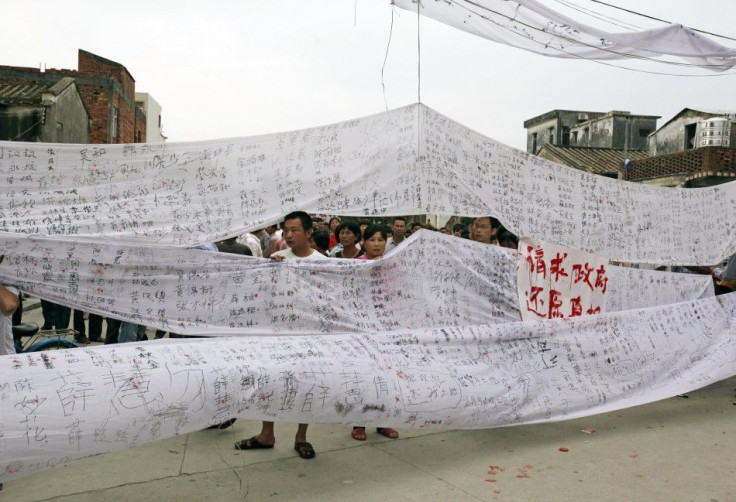
After a month of protests against local officials for taking away their land, residents of Panhe village in Zhejiang province have been arrested this past week. These detentions have put a stop to the local distubances for now -- however, such land disputes remain a serious issue in China, one that seriously shakes the notion of a harmonious society.
Around 200 Chinese have staged three different protests -- February 1, 3, and 5 -- against uncompensated land seizures by local Chinese officials.
A 51-year-old villager called Lü told the Global Times newspaper that plainclothes agents took away Lü Xisi, 49, and Lü Yanyu, in his 40s, between Wednesday night and Thursday morning.
In addition to the arrest of the Panhe villagers, two foreign journalists -- French reporter Baptiste Fallevoz and Dutch reporter Remko Tanis -- were also put in jail.
Local officials taking away land and failing to compensate past residents has been a primary factor of social unrest in China, a country where the huge population puts great pressure on the land and natural resources.
In Panhe's case, village authorities began taking away villagers' land bit by bit and selling it off to 12 companies starting in 2006.
Officials from the village sold land. This land originally belonged to the villagers. After it was sold, the [villagers] were not given any money for it. The villagers are upset, and after all, this land was passed down through their family business. They rely on the land for their livelihood, but now it has been sold, villager Lu Yueqin told New Tang Dynasty (NTD) Television.
Since last summer, the villagers have attempted to elect representatives to stop the gradual land seizures and also get compensation for the land already taken. However, their efforts have failed.
The local government had supposedly offered compensation of 16,00 yuan ($2,540) per mu (0.067 hectare). The money was supposed to be paid to the village on Thursday, the Global Times reported.
The compensation was never made, according to a local villager, and the payment process was never actually mentioned to the villagers themselves.
The Panhe protests have caught the attention of the media as a sort Wukan 2.0 movement. In Wukan, a Guangdong village in Southeast China, villagers were able to successfully force out Communist local officials for a duration of two weeks.
However, the escalating number of arrests in Panhe have put an end to such staged protests for now.
In China, no individual can own land. The land belongs to the state, so historically only state-owned enterprises (SOEs) could truly own land.
There are two types of lands -- allocated land use rights and granted land use rights.
Under allocated land use rights, the Chinese government has already assigned a specific purpose for a certain amount of land, such as for hospitals or schools.
Granted land use rights allow individuals or businesses to lease land for a certain time period. These land use rights, however, are applied differently depending on whether the land is considered urban or rural.
Rural land is what the villagers of Panhe live on.
Rural land rights are much more restricted. Essentially, an individual only has the right to farm on this land. However, as China develops, more and more rural property is being transformed into urban land by the Chinese government. As a consequence, villagers living in rural areas can have their land reclaimed by the state in the name of urban redevelopment and urbanization.
Generally when this happens, proper compensation, in the form of funding or a replacement living situation, is supposed to be given to displaced villagers.
However, the protests erupting in China are often due to the lack of proper compensation by corrupted local officials.
© Copyright IBTimes 2024. All rights reserved.
- MOST POPULAR IN World


