

U.S. Just Had Warmest Year On Record: NOAA Report
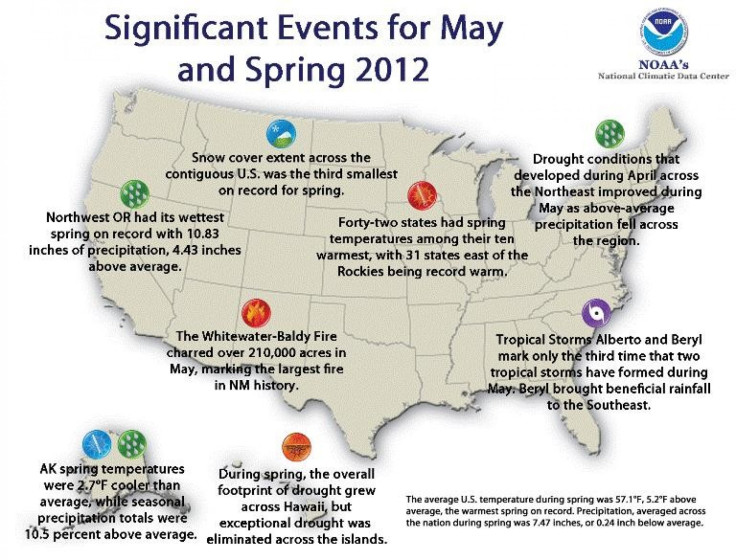
For anyone who has thought temperatures have been warmer than usual in recent months, a new report from the National Oceanic and Atmospheric Administration will confirm those suspicions.
In fact, the United States apparently just emerged from the hottest spring on record.
The period between June 2011 and May of this year was the warmest on record since NOAA record keeping began in 1985. Aside from Washington, every state experienced higher-than-average temperatures during that period, which also featured the second-warmest summer and fourth-warmest winter in almost 28 years.
The nation's average temperature during those 12 months hovered at 56 degrees Fahrenheit, reportedly 3.2 degrees above the long-term average, surpassing the previous record, which was just set in April, in an analysis of temperatures between May 2011 and April 2012. The warmer-than-average conditions persisted through the winter and spring, resulting in a limited snowfall that the Rutgers Global Snow Lab reports was the third-smallest on record for the contiguous U.S.
The rising temperatures may have altered precipitation patterns as well, according to NOAA. While the country as a whole actually experienced a drier spring than usual, the West Coast, Northern Plains and Upper Midwest regions were simultaneously wetter than average.
On a more concerning note, the prevalence of natural disasters, such as the disastrous tornado in Joplin, Mo., and the massive, hurricane-caused flooding in Vermont, that plagued the country over the past year were also far form usual. The U.S. Climate Extreme Index, which tracks extremes in temperatures, precipitation, drought and tropical cyclones, reached 44 percent this past spring. That's twice the average value.
The NOAA report is not the only recent analysis to note the prevalence, and consequences, of rising temperatures. On Thursday, NASA reported that scientists have discovered unprecedented blooms of plant life beneath the waters of the Arctic Ocean. While that certainly does not seem like cause for concern, NASA noted it was likely caused by a thinning of the Arctic Ocean's three-foot thick layer of ice, allowing the sun to penetrate that ice to foster plant life under the sea.
A continuous rise in summer temperatures is expected to triple the number of heat-related deaths in the U.S. by the end of the century, the Natural Resources Defense Council reported last month. In an analysis of peer-reviewed data, the organization said summer temperatures could rise by 4 to 11 degrees Fahrenheit by that time due to human-induced climate change, which could increase the number of summer heat-related deaths from 1,300 to 4,600 a year.
© Copyright IBTimes 2024. All rights reserved.
-

Microsoft Expands Its AI Empire Abroad
-

Oil: 'Mother Of Corruption' In Venezuela
-

'Extreme' Climate Blamed For World's Worst Wine Harvest In 62 Years
-

Macron Warns 'Mortal' Europe Needs Credible Defence
-

Bitcoin And Crypto Price Review - Another Myth Gets Busted?
-

Mass Cancellations Loom Despite French Air Union Cancelling Strike
-

Mired In Crisis, Boeing Reports Another Loss
-

Recycled 'Zombie' Misinformation Targets US Voters
-

Hackers Leak Part Of Source Code Of El Salvador's Bitcoin Wallet
-

Azerbaijan Says 'Closer Than Ever' To Armenia Peace Deal Amid Border Talks


