Behzad Peykari and the Humanoid Built Around the Human Body
The engineers had only ever seen her sitting. So when she rose inside the prototype for the first time, steady on her own two feet, the thought that moved through the room was strange in its plainness: nobody knew how tall she was. She had not stood since her injury two years earlier. Now she was upright, and she was crying. The team did too, in their own way. They realized they had been picturing her wrong the whole time.
Behzad Peykari remembers that moment as the one that reorganized everything. He had spent years on the machine that put her there, and what it gave back was not mechanical. It was something most people never think about until it is gone: the ability to stand, cross a room, and meet the world at eye level.
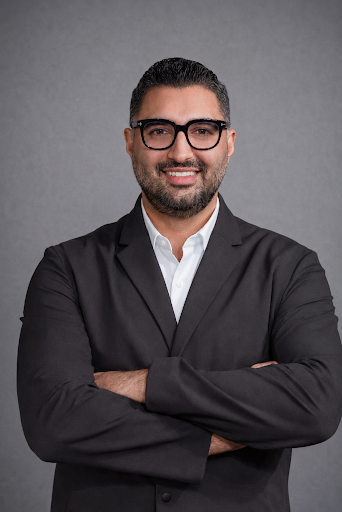
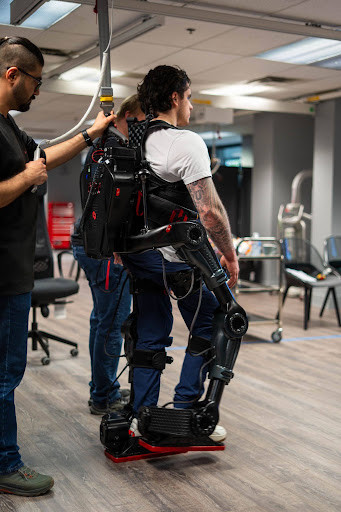
That machine is XoMotion, a self-balancing exoskeleton built to help people with mobility impairments stand and walk with their hands free. Peykari, now Chief Innovation Officer and Vice President of Engineering at Human in Motion Robotics, has led XoMotion's technical development since its earliest days across mechanics, electronics, controls, software and artificial intelligence.
A childhood spent taking things apart
His fascination with machines started at home. Broken objects were invitations, and his father, an engineer, fixed whatever stopped working.
His mother shaped a different part of the same instinct. She played piano, painted, and sketched in perspective, turning flat pages into rooms with depth. From her he absorbed another way of understanding how things are made, not by taking them apart but by first learning to see them.
As the first child in a family of makers, painters and musicians, he was handed his curiosity early, if not the toolbox. The sharp tools stayed in the garage. What he got instead was Lego, a hand-me-down set from an uncle, then newer kits he had to lobby his parents to buy.
He gravitated to the pieces with wheels and tracks, and to one section of the instruction book in particular: the part that showed how to build a walking humanoid. Years later he would build those concepts in metal. The line from that toy to his career is not a metaphor; it is literal. Robotics was the rare field that pulled together everything he loved at once, the mechanical and the electronic, the coded and the designed.
His first serious university project was a wheel-based search-and-rescue robot, autonomous and remote-controlled, the grown-up version of the machine he had wanted as a boy.
By then he had a record behind him, years in RoboCup, the international robotics competition, climbing the school and university leagues and winning medals. University gave him a machine shop, CNC equipment and bigger robots that needed research funding. It also handed him the question that would define his work: not whether robots could imitate people, but whether they could help them.
The problem nobody had solved
The exoskeletons that existed split into two camps. One was built for industry, to give workers something close to superhuman lifting power. The other was for people who had lost ordinary function: spinal cord injuries, strokes, cerebral palsy, the neurological conditions that take away the ability to stand. Peykari was drawn to the second problem, and to a harder version of it than anyone was attempting.
Most exoskeletons lean on the user, or on crutches, for balance. The device Peykari set out to build would balance itself. "It is a humanoid system that can walk on its own," he says, "and now we have a human inside it." Taking over the work of balance, and keeping a person upright while it does, is the single feature that separates his machine from nearly everything on the market.
The engineering underneath is unforgiving. A humanoid robot puts its actuators where its own joints go. An exoskeleton has a person already in that space, so every actuator, at the hip, knee and ankle, has to be rebuilt around the human body. The trouble is the axis of rotation: move a limb even slightly off its natural path with motors strong enough to lift a hundred-kilogram adult and you do not assist the joint, you break it.
The stakes climb higher because the people the device serves often cannot feel it. With no sensation below the injury, a user gets no warning that something is being forced the wrong way. "If something is going wrong, they don't feel it to give you feedback," Peykari says. "It's on us to protect them." His team solved the hardest part, the three-axis ball-and-socket motion of the human hip, with a patented mechanism, part of a portfolio of patents now protecting the design.
He also took on a complication most engineers would have refused. Rival devices are built to a fixed body. Peykari's is adjustable, sized for users from 150 to 190 centimeters and 55 to 110 kilograms, wide enough to fit both North American and Asian markets with one product. At nearly 192 centimeters himself, he became the worst-case test subject. Making a single machine fit an entire population took years.
Past the wheelchair
XoMotion is real, not a concept. It is cleared for sale in Canada, already in rehabilitation centers, while his team works the longer path to FDA clearance in the U.S. The version on the market today is built for clinics, where it also eases a quieter burden: the physical and mental load on therapists who otherwise move a patient's limbs and hold their balance by hand.
His vision extends well beyond the clinic. The device has to get lighter, cheaper and smarter, and safe enough for a world far less controlled than a rehabilitation center. In R&D, his team is shrinking it into something a person could own and use at home, every day. He is candid about what that means. "It's actually a replacement for the wheelchair," he says. The day he is working toward is the one where he stops seeing wheelchairs at all.
Teaching the machine to learn
For much of XoMotion's development, the exoskeleton was hand-coded. Every surface, slope and step had to be measured and programmed in advance. That holds up in a clinic and falls apart everywhere else, where grass, gravel, a crowd, a child running in, or a dog at the door arrive without warning. None of it can be fully written into code. So Peykari is moving the work toward artificial intelligence, and he is blunt that there is no alternative. Reinforcement learning lets the device learn the way a person does, through trial and reward, inside simulations where millions of virtual exoskeletons train at once with no human at risk. The team now trains it on grass, sand and uneven ground, and is adding vision so it can see the terrain ahead.
Engineering hope
This is where Peykari sees two fields converging. XoMotion borrowed its foundations from humanoid robots in the first place: balance, actuation, whole-body control. Now the reverse holds. What his team learned building a medical-grade machine that walks with a person inside it can feed the next wave of humanoids, the kind meant to work safely in homes, hospitals and factories.
He frames the goal in human terms. The machines should give back choices that injury, illness or age have taken away, take on the dangerous physical work, and go into the places too hostile for a person to be safe in.
He is careful not to oversell. Every technology, he notes, arrives in a form that invites doubt, the way the first mobile phones were bricks with long antennas. He doubted his own work early on, and so did some investors. The ones who stayed cared about the human side, not only the return. The users never doubted. They came to see prototypes, returned for more sessions, and sometimes brought gifts.
The device is aluminum, cold to the touch, until a person stands up in it and begins to walk, and sometimes to dance. "We sell hope," he says. "We don't sell cold metal."
The work itself is slow, precise and heavily regulated. What it produces is not. One machine carries a person inside it. Another may one day work beside them.
The destination has not moved since childhood. Only the stakes have. The machine Peykari once wanted to make take a single step is now helping people walk again, and the boy who lobbied for a better Lego set has become one of the robotics leaders shaping what the next generation of these machines can do.
© Copyright IBTimes 2026. All rights reserved.
- Recommended For You