

Hiring’s New Cheating Problem, and Why ACHNET Catches It Inside the Interview
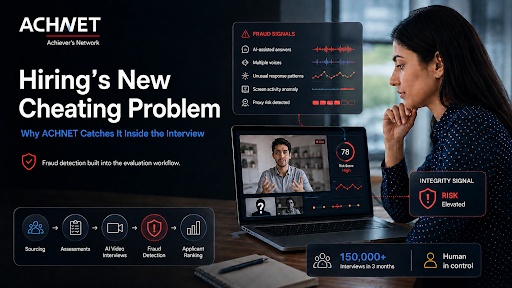
In remote hiring, recruiters can no longer safely assume that the person answering the question is always the same person who applied. Gartner predicts that by 2028, one in four candidate profiles worldwide will be fake. In a 2025 survey of 3,000 job candidates, 6 percent admitted to interview fraud, either posing as someone else or having someone pose for them. Because the figure is self-reported, the true rate may be higher.
Most employers have responded by adding a checkpoint. An identity check at the door. A proctoring tool is attached to one assessment. A follow-up interview to confirm what the first one showed. Each of those treats fraud as a separate step in the process. ACHNET is making a different argument: that the check belongs within the evaluation itself.
When a Polished Answer Stops Being Proof
Screening worked for years on a simple assumption. A strong answer signaled a strong candidate. Generative AI severed that link. Resumes are drafted by the same tools, interview responses are rehearsed with them, and in some cases, they are fed to a candidate live while the interview runs.
The consequence is not only that some candidates cheat. It is that a polished performance no longer provides enough proof on its own. When most applicants present equally well, an interview panel spends its time confirming whether the performance is genuine rather than judging whether the candidate is right for the role. The work shifts from evaluation to verification, and verification is slower.
Why Bolt-On Fraud Checks Miss What a Workflow Catches
A bolt-on check runs on a fragment of the process. It confirms identity at the start and then stops watching. It watches one assessment but not the interview that follows. Whatever it finds lands in a separate report, arriving after the ranking is already built, and someone has to reconcile the two.
ACHNET runs detection inside the same workflow that performs the evaluation. Its AI Super Agent iJupiter™ integrates sourcing, talent assessments, AI video interviews, fraud detection, and applicant ranking into a single process rather than five tools. According to the company, detection runs continuously across every AI video interview and assessment rather than at a single gate, reading response behavior, pattern anomalies, and signals that an answer was AI-assisted, alongside identity and other interview-integrity indicators.
The structural difference is where the finding goes. A flag raised inside the workflow is surfaced alongside the ranking and candidate record, rather than arriving later in a separate report. The company says its agent ran 150,000 interviews in three months, and at that volume, a manual reconciliation step between two systems is not realistic.
"A polished answer is no longer proof of ability. What our system checks is whether the performance in front of you is real, and it does that on every interview, before a candidate ever reaches a hiring manager," said Manouj Gupta, CEO and Founder of ACHNET.
What a Hiring Manager Does With an Integrity Score
The design choice that matters most is how a flag is presented. ACHNET keeps its integrity signal separate from the performance score, so a hiring manager sees two distinct things: how the candidate performed, and how much confidence to place in that result.
Blending the two would hide the reason. A candidate who scored lower due to a verification concern is a different case from a candidate who scored lower on skill, and the required response differs in each. One needs a second look. The other needs a decision.
The company also gives managers a live route in. Its Surveillance Mode lets a hiring team observe sessions as they run, and its Intervention feature lets a manager step directly into an AI-led interview. Final authority stays with the person, not the agent, which matters for any employer that has to explain a rejection later. The company states that it holds SOC 2 Type 1 and Type 2 attestation and ISO 27001 certification, and that the platform is designed to support customer compliance efforts under GDPR and the EU AI Act.
In many hiring stacks, fraud detection is still treated as a separate layer, procured separately, reviewed separately, and often consulted after the decision has already started to take shape. The best ACHNET is doing is making verification part of the evaluation record itself. On that reading, the question facing an employer is not which detection tool to add to the stack. It is whether the hiring system can tell a manager, at the moment the decision gets made, how much of what it is showing them is real.
© Copyright IBTimes 2026. All rights reserved.