Iran Received The U.S.’s Latest Ceasefire Counterproposal. Tankers Were Reportedly Hit In Hormuz Shortly After.
President Donald Trump denied reports claiming that he offered sanctions relief in exchange for nuclear concessions from Iran.


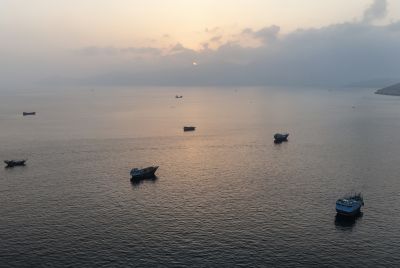
Three tankers have been reportedly hit in the Strait of Hormuz by unknown projectiles on Wednesday, shortly after Iran received the U.S.'s counterproposal on a ceasefire and a framework towards the end of the war.
The United Kingdom Maritime Trade Operations Centre (UKMTO) did not elaborate on the nature of the attacks. It did specify that the vessels targeted were an oil tanker, a LNG tanker and a third vessel.
Earlier, Iranian authorities said that at a cabinet meeting, Foreign Minister Abbas Araghchi presented the proposal for a seven day ceasefire to President Masoud Pezeshkian.
Another report detailed that efforts by Qatari mediators have not yielded much progress as neither side is willing to make significant concessions.
U.S. officials now think that it increasingly likely that President Donald Trump will order a return to hostilities after the midterms, Axios reported.
Trump also rejected a report from the outlet claiming he had offered sanctions relief in exchange for nuclear concessions. "I offered them NOTHING! Axios' story, like most others, is a HOAX, used only for purposes of satisfying their Trump Derangement Syndrome. They should withdraw this fake story, IMMEDIATELY!" Trump said in a social media post.
Oil prices are rising again following the developments. Brent crude, the international benchmark, climbed 1.71% and clocked in at $97.80 at 7:59 a.m. ET, while West Texas Intermediate, the U.S. benchmark, gained 1.39% and stood at $90.62 at the same time.
The Iranian economy keeps deteriorating in the meantime, further driving up the cost of everyday necessities and forcing households to dramatically reduce spending as restrictions on the country's oil exports squeeze a critical source of revenue.
While Iran's leadership has projected confidence in its confrontation with the United States, the economic consequences of the conflict are becoming increasingly difficult to contain. A U.S. blockade targeting Iranian oil exports has restricted Tehran's access to foreign currency while compounding years of inflation, sanctions and economic instability.
The result is an increasingly severe cost-of-living crisis affecting food, housing, medicine, transportation and other basic expenses. Consumers who once purchased goods in larger quantities are increasingly limiting themselves to necessities, according to Reuters reporting from inside Iran.
The worsening economic conditions could also become a factor in diplomacy. U.S., Middle Eastern and Iranian sources told Reuters that economic strains helped spur the latest diplomatic efforts aimed at finding a possible path out of the conflict. Iranian authorities have repeatedly expressed concern about domestic unrest as economic conditions deteriorate further.
© Copyright IBTimes 2026. All rights reserved.
- Recommended For You