

When Gold Has Two Masters: Demand Versus Rates And Inflation

Gold spent summer 2026 caught between two forces. Expectations of a more hawkish Federal Reserve raised the cost of holding a non-yielding asset, while conflict in the Gulf and persistent inflation preserved the case for protection. After rebounding in August, gold retreated in September and early October but couldn't sustain a break below 4,000 USD.
With this situation in mind, Exness' resident analysts Stanislav Bernukhov, senior trading content specialist, and Michael Stark, financial content lead, reach different conclusions. Michael thinks gold might gain in the next few months, while Stanislav reckons losses are more likely.
Gold isn't acting like a store of value
"The correction probably has further to run," Stanislav says. "Gold is not cheap simply because it is well below this year's record. After such an exceptional advance, the more important question is whether the market has finished removing the excess, and I don't think it has."
"Gold has recently been behaving less like a stable store of value and more like a high-beta risk asset. Its 260-day volatility rose to about 2.1 x that of the S&P 500, the highest ratio since 2007, while its 60-day correlation with the index reached roughly 0.70, the highest since 1975. Gold may initially fall with them as investors reduce risk or meet margin calls."
After the first-half surge above 5,500 USD, Stanislav doesn't consider a return to around 4,000 USD sufficient to complete the reset. He regards 3,000 USD as a credible medium-term mean-reversion level, although not his near-term base case.
"Government deficits, debasement and central banks' demand all remain supportive in the long run. But a sound long-term story can still be a poor entry when already reflected in the price. For the rest of 2026, rates and positioning matter more to me than the narrative."
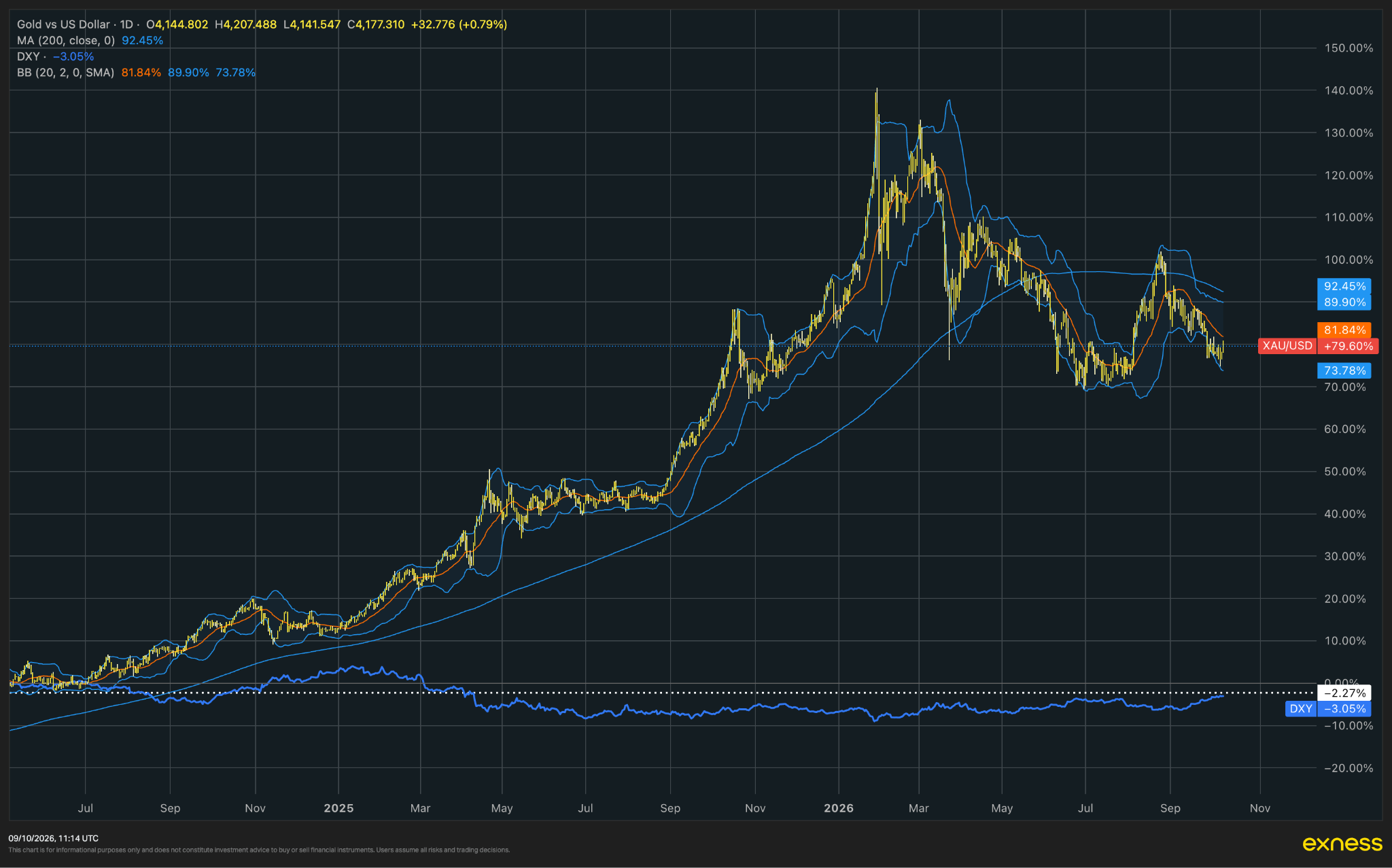
Relationship between gold and the US dollar index, daily chart. Powered by Exness Terminal.
Why higher rates hurt gold
For the average investor, savings with reasonable yields are an easy and mostly secure option. If real rates exceed inflation, cash becomes more attractive than gold because it can generate interest income. Holding large amounts of physical gold is also impractical, and professional custody usually carries a cost. Together, these factors can weaken demand for gold when savers can earn a positive real return from cash.
However, it's not normally this simple. Markets try to price in future rates months in advance, while gold's inverse relationship with the dollar can weaken as sentiment shifts.
This is why DXY belongs alongside gold in the analysis. Exness offers the tightest spreads for DXY on the market,1 giving traders a direct way to follow whether the dollar is reinforcing or resisting gold's movement.
Demand for protection outweighs short-term inflation and rates
"For there to be a clear downtrend for gold, I think we need to see rates a lot higher than they are now, which doesn't seem likely yet," Michael counterargues. He thinks that the fundamentals haven't changed significantly since early 2026 and probably won't reverse for a while.
"Protection against inflation is among the main reasons people invest in gold, but expected appreciation has also become an important factor in recent years. Demand has remained consistently high since it became clear in late 2023 that the Fed would pivot to cutting rates. I think August 2026's bounce shows that demand remains strong despite rates being likely to rise further."
"Even if the Gulf conflict is resolved immediately and inflation drops like a stone, both of which I think are unlikely, there'll still be some inflation and demand for a "safe" asset which is seen as likely to appreciate in the long term."
He concluded, "To me, this is further evidence that gold is more of an economic haven and, in general, the US dollar more of a geopolitical one. If a permanent peace starts looking imminent, I wouldn't be surprised to see the oil and the dollar declining and gold gaining."
Why uncertainty (usually) supports gold
Simply put, economic uncertainty often supports gold because investors expect it to preserve value better than riskier assets over time. However, the response is not always immediate.
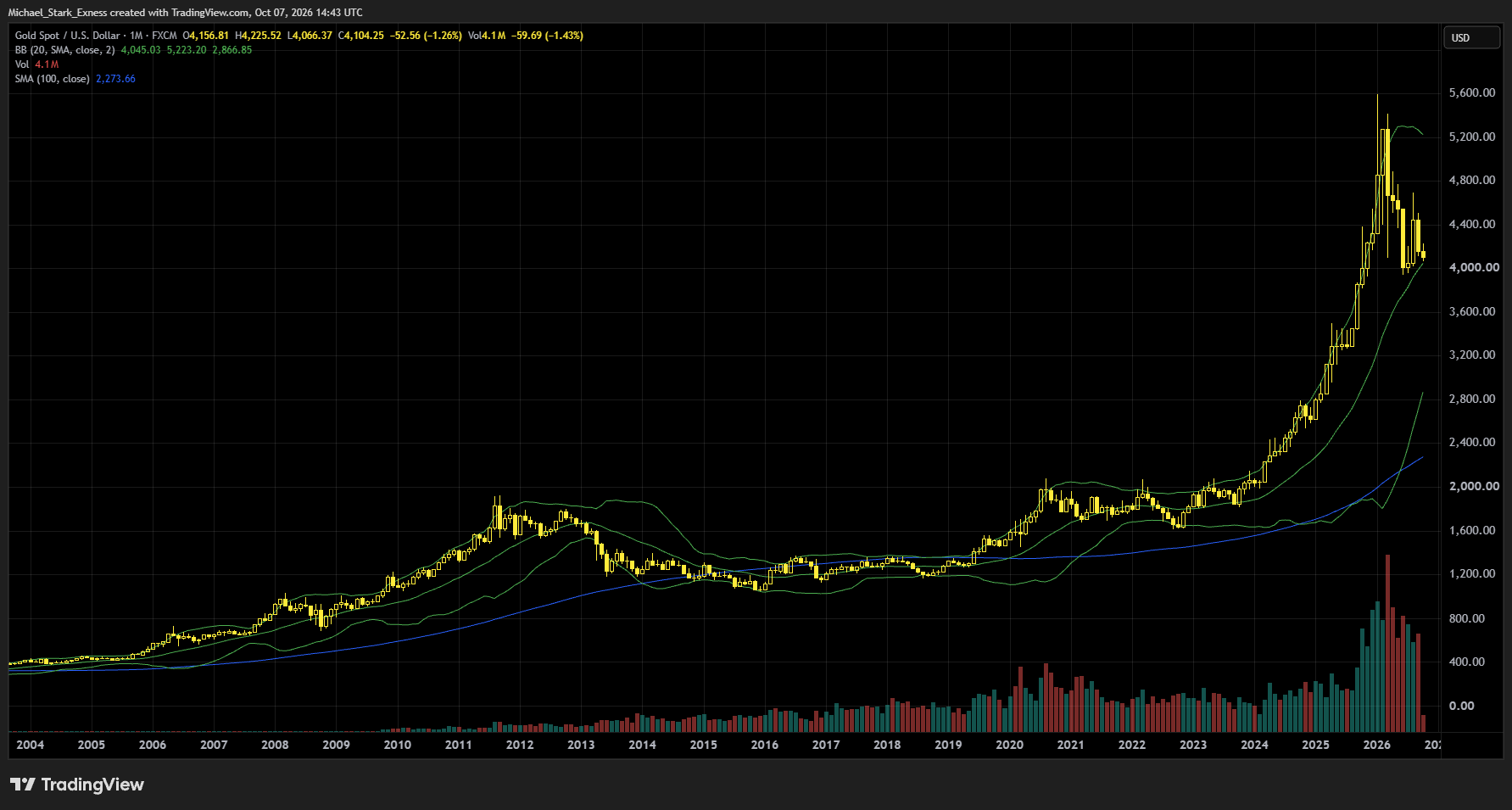
The monthly chart of gold over the last 20 years. Source: TradingView.
Gold initially declined during the 2008 crash with most other assets. Then it entered a strong uptrend, reaching a succession of new record highs over the next three years. It also moved strongly from late 2023 as markets increasingly expected a recession which never came.
Key factors driving gold in November and beyond
Beyond the obvious events like the Fed's meeting next month and upcoming NFPs and inflation, traders will continue to watch developments in the Gulf, bonds and stock markets. The ongoing reaction to American midterm elections might be important as the President's agenda shifts.
Much has been made of central banks' gold purchases as a source of demand. Despite being broadly bullish on gold, Michael doesn't consider them particularly useful for the timeframes he trades: "I do think that increasing national gold reserves, notably in China, are significant in the long term, just not for the timeframes relevant to me as a CFD trader. If I found an actionable signal from reserves, I'd use it, but I can't."
The right conditions to trade
The sharp reversal in August also shows where market analysis meets execution. As gold approached overbought territory near its highs, a trader anticipating a pullback might have placed a sell order slightly below 4,700 USD. Whether the idea worked would still depend on the market continuing lower, but the order fill price would ultimately shape the trade from that moment.
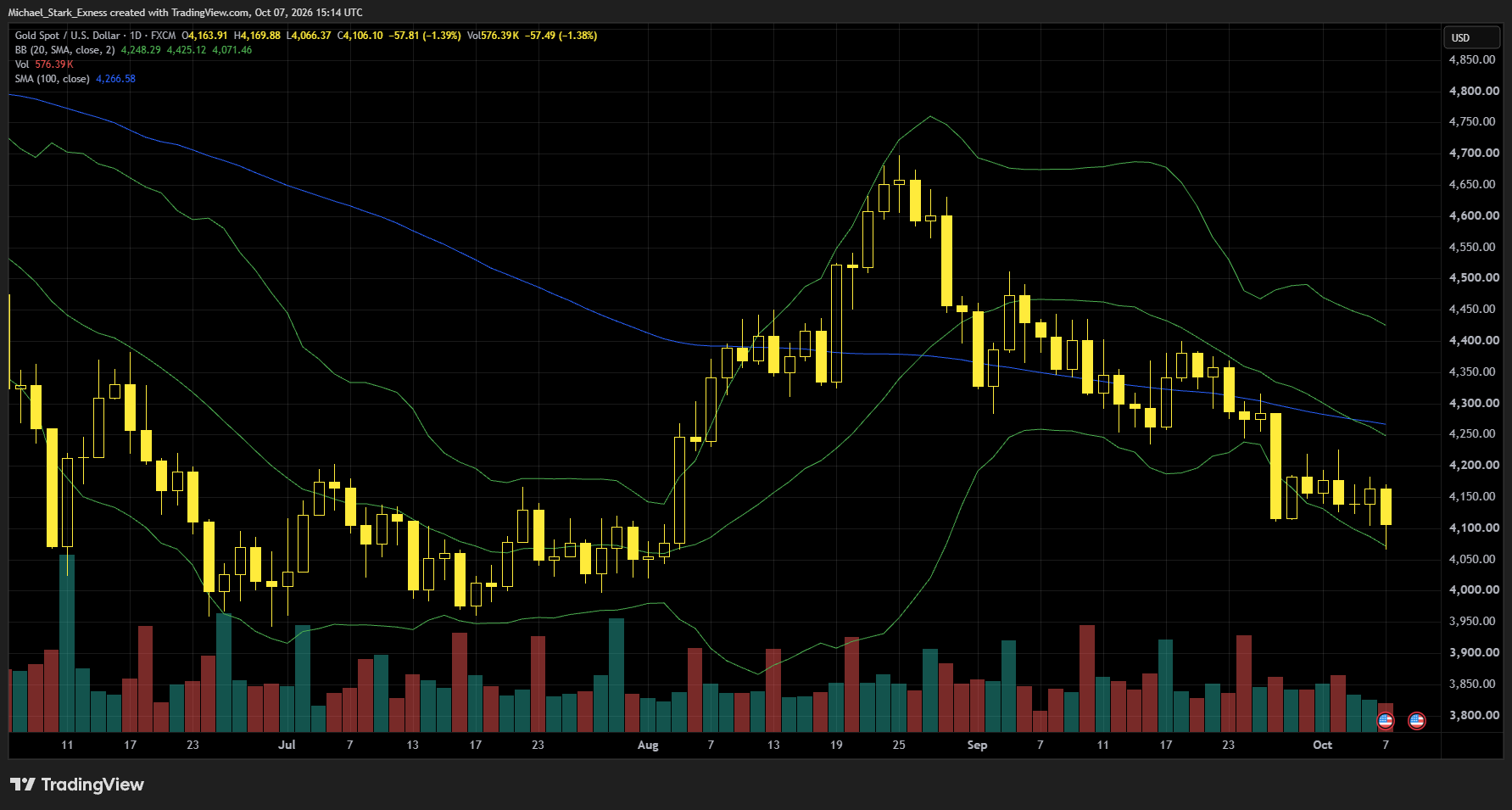
TradingView
This is where execution quality matters. Exness offers the most precise execution in the market for XAUUSD.2 It cannot make the analysis correct, and delays and slippage may still occur. However, its role is narrower: supporting the transition from a planned price to a live order when gold is moving quickly.
Gold's complexity drawing traders
Gold's popularity among CFD traders is easy to understand. It tends to move in strong trends much of the time, it usually has a clearly readable technical structure, and it can change direction quickly. The range and complexity of its fundamentals add intrigue and challenges.
Ultimately, both Michael and Stanislav might be right on different timeframes. Gold could decline for the rest of the quarter before recovering in 2027 depending on inflation, rates, and more.
Gold can behave as protection, a momentum asset, or an expression of interest-rate expectations, sometimes all within the same quarter. The useful question is not which identity is permanent, but which one the market is pricing now.
Footnotes
The opinions in this article are personal to the people quoted; they do not represent those of Exness.
This article does not constitute investment advice. Past performance is not indicative of future results. The information, data, prices, and market conditions presented in this article are accurate as of the publication date and may change over time. Your capital is at risk. Please trade responsibly.
1 Exness Pro has the lowest average spreads out of 10 brokers in the week of 29 March–4 April 2026, comparing tightest spread-only accounts across brokers.
2 "Most precise execution" claim refers to average slippage on XAUUSD pending orders from 17–31 August 2026, comparing Exness Standard with similar accounts from seven other brokers. Delays and slippage may occur. Execution speed and precision are not guaranteed.
© Copyright IBTimes 2026. All rights reserved.