Why One-Size Posture Correctors Fail — And How a Height-Adjustable Design Solves It
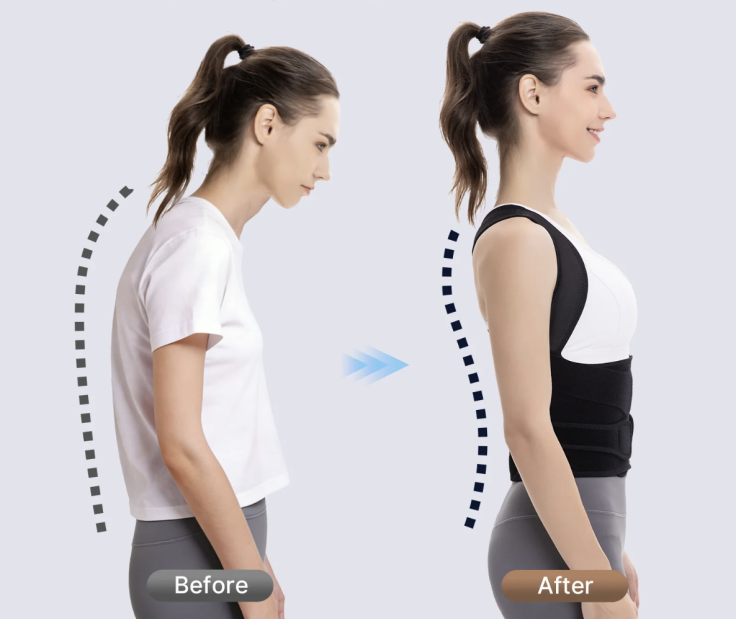
Most posture correctors fail for a reason that has nothing to do with motivation or wear time. They fail because the straps are cut for a single, generic torso length. When a brace doesn't match the distance between the wearer's shoulders and lower back, it either pulls from the wrong angle or rides up into the neck, which then ends up in the return pile. The newly released height adjustable posture corrector from Fit Geno, called the HeightFit, attacks that problem with a patented slide-and-lock mechanism that adjusts vertical length to the user's actual body.
The Core Defect: One-Size-Fits-Average
The standard posture corrector on Amazon and in big-box retailers comes in a one-size or S/M/L sizing scheme based on chest circumference only. That measurement ignores the vertical dimension that determines whether the brace's anchor points sit correctly. A person with a 40-inch chest who is 5'3" has a drastically different torso length than someone with the same chest measurement at 6'1". Yet the same brace gets shipped to both.
The result is a predictable set of complaints that repeat across thousands of reviews: straps dig into armpits, the lower back band rests too high, the brace shifts upward during the day, and the user never experiences the advertised shoulder retraction. Several studies in ergonomics journals note that improper strap geometry not only reduces effectiveness but can also cause skin irritation and muscle fatigue. The product isn't inherently bad; it's just mechanically mismatched. That mismatch is why many people give up on posture correctors entirely, assuming the category doesn't work, when in reality the brace never had a fair chance to do its job.
How Height-Adjustable Engineering Changes the Equation
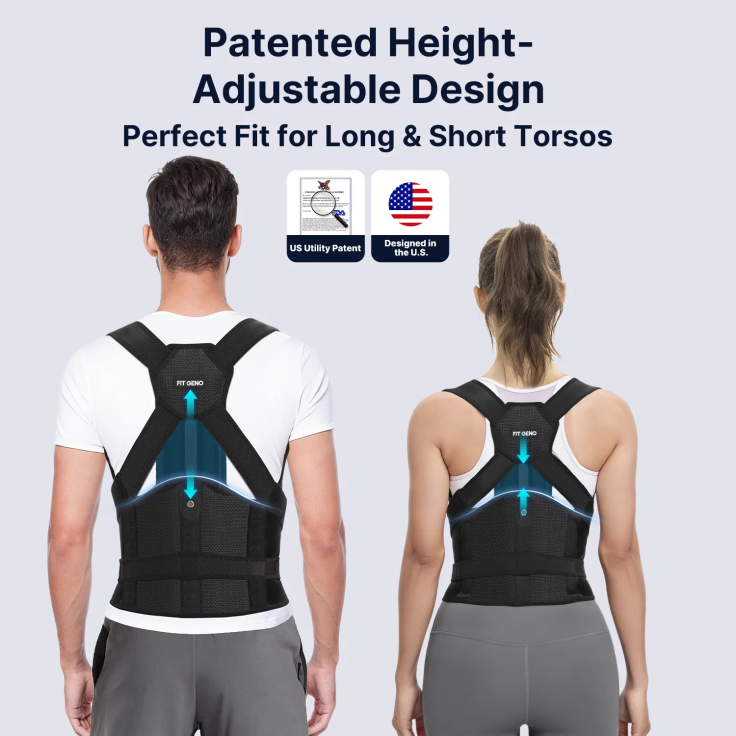
The Fit Geno HeightFit features a central back panel that telescopes continuously from 39 to 53 cm (about 15.4 to 20.9 inches) — roughly 5.5 inches of smooth, infinitely adjustable travel with no preset stops. The user simply unlocks the panel, extends or shortens it to the exact torso length needed, and locks it in place before putting the brace on. That adjustment shifts where the shoulder straps anchor and where the lumbar support sits, so the pulling force aligns with the natural curve of the upper back rather than pulling forward or upward.
This isn't a gimmick. For someone with a long torso, the added length prevents the brace from riding up into the neck. For a shorter torso, the reduced length eliminates the excess material that would otherwise bunch under the arms. The entire system stays anchored correctly for hours. Fit Geno's posture correctors hold strong ratings across thousands of verified reviews, and the HeightFit is backed by a 60‑day return policy and a low‑cost size‑exchange program, so the purchase carries almost no risk even for first-time brace users. A 1‑year workmanship warranty adds further peace of mind.
The HeightFit's adjustability also means that two people with different torso lengths can share the same device — provided they have similar waist measurements. A couple where both partners fall into the same waist‑belt size range can each dial in their own vertical setting without buying separate braces. That household use case appears repeatedly in the brand's review data — "I bought one for myself and my husband uses it too" — and it's a practical benefit that no fixed-length competitor can offer.
HeightFit vs. Conventional One-Size Braces
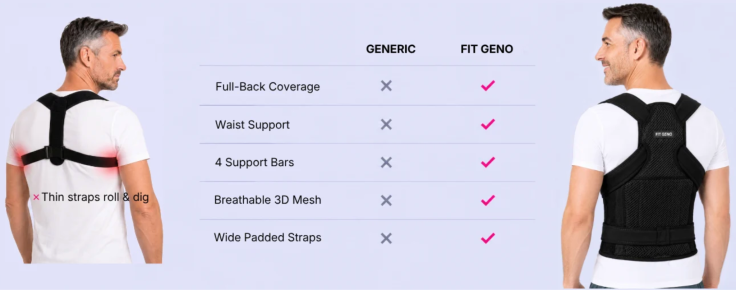
| Feature | Fit Geno HeightFit | Standard One-Size Posture Corrector |
| Torso length adjustment | Continuous telescoping back panel (39–53 cm, patented) | None; fixed length |
| Size granularity | Waist‑belt sizing (S≈35", M≈41", L≈48", XL≈56") + universal vertical adjustment | Chest circumference only |
| Armpit clearance | Stays clear of axilla across body types | Common chafe point for shorter/longer torsos |
| Lumbar panel position | Adjusts to sit at natural lower-back curve | Often rides too high on short torsos |
| Price | $49.99 | $19–$35 (typical) |
Who Needs a Height-Adjustable Corrector
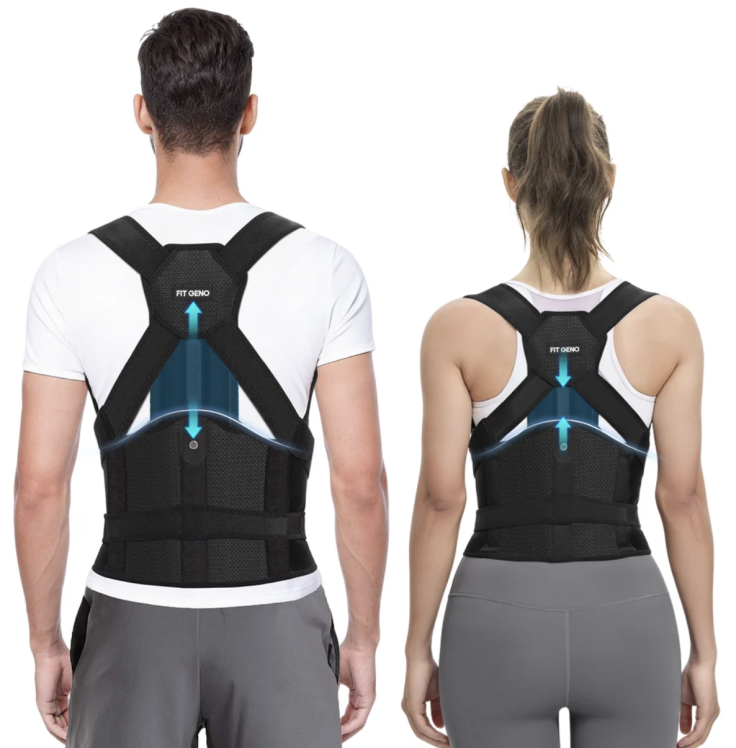
The HeightFit becomes the most logical purchase for anyone who has ever returned a posture brace because the straps were too short or the fit felt off. That group includes tall individuals who find that standard braces sit too high on the back, shorter users who experience the "up-to-the-neck" ride, and anyone buying a brace for a partner or parent whose proportions they don't know precisely. It also serves as a smarter default for first-time buyers who want to eliminate fit risk on the front end. Spending $49.99 once, with a 60‑day return policy and a low‑cost size‑exchange program, costs less over time than buying and discarding two or three $25 braces that never fit right.
Fit Geno built the HeightFit to work seamlessly with the rest of its posture line. Someone who wants a lightweight, packable option for travel can add the Lite version later. Women who need a brace that vanishes under a blouse can turn to the Invisilite or the posture bra. The HeightFit's role is to be the problem-solver, the brace you buy when you're tired of guessing and want one that fits like it was made for you.
Why the Market Hasn't Fixed This Before
Adjustable torso-length mechanisms add manufacturing complexity and per-unit cost. Most Amazon-native brands compete on price, so engineering a sliding back panel would push their retail price above the $30 psychological ceiling they target. Fit Geno operates direct-to-consumer through fitgeno.com, which allows it to invest in a patented design while keeping the final price below $50. The brand also produces complementary models — a standard Classic brace for those who don't need height adjustment, a Lite version for minimalist wear, and an Invisilite cut for discreet under-clothing use, so the HeightFit doesn't carry the entire product line's margin burden.
The result is a brace that would normally cost $80 or more in a clinical catalog, delivered to the door for $49.99. The pricing lands in that sweet spot where it's affordable enough to buy for a family member but substantial enough to signal real engineering behind it.
The Practical Outcome
An adjustable brace changes the daily experience from one of constant fiddling to one of passive support. Users report that by week two, they forget they're wearing it. The afternoon shoulder burn that defines desk-bound workdays fades as the brace retrains the muscles to hold a neutral position. Because the strap angle stays biomechanically appropriate, the retraining effect accumulates faster than with a poorly fitted alternative.
Fit Geno recommends starting with short sessions and building up to about 2 hours of daily wear. The combination of correct mechanical fit and a sensible ramp-up schedule bridges the gap between a product that merely pulls shoulders back and one that actually changes default posture over months. It's the difference between a temporary crutch and a genuine reset.
The Bottom Line
The posture corrector market has spent years ignoring the vertical dimension of human anatomy. The HeightFit's adjustable torso panel is the first mass-market solution to that oversight, and it delivers on the promise of a brace that fits like it was built for the person wearing it — because, in effect, it was. For anyone who has lost faith in the category because of poor fit, this is the device that earns it back.
IBT readers receive 10% off HeightFit and all Fit Geno products with code IBT10 at fitgeno.com.
© Copyright IBTimes 2026. All rights reserved.
- Recommended For You