

WPS at 25: Accountability, Action, and Bipartisan Commitment on Capitol Hill
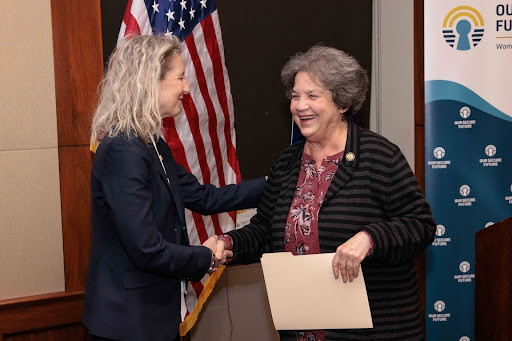
Congressional Women, Peace and Security Caucus Co-Chairs Representative Jen Kiggans (R-VA) and Representative Lois Frankel (D-FL) at the Our Secure Future WPS anniversary reception on December 16, 2025. Photo Courtesy of Our Secure Future/Capitol Hill Photo
On December 16, 2025, policymakers, advocates, and practitioners gathered on Capitol Hill for a reception commemorating the Women, Peace and Security (WPS) agenda. Hosted by Our Secure Future (OSF), an initiative dedicated to strengthening the WPS agenda, and the bipartisan Congressional Women, Peace and Security Caucus, which works to strengthen U.S. leadership and oversight on WPS implementation, the gathering provided an opportunity to reflect on key milestones while underscoring the sustained effort required to turn commitments into action.
Taking place twenty-five years after the adoption of United Nations Security Council Resolution 1325, and eight years after the passage of the Women, Peace, and Security Act of 2017, the evening recognized the significant progress made to date while reaffirming the continued work needed to advance women's meaningful participation in peace and security processes. Rather than marking a pause, the reception highlighted the momentum behind WPS and the responsibility to carry that work forward.
The event's setting mattered. Capitol Hill has been central to the American expression of the global Women, Peace and Security agenda since 2017, when the United States became the first country to pass standalone legislation codifying WPS principles. The reception treated the law as an active instrument that continues to shape how peacebuilding, conflict prevention, and security decision-making are understood and carried out.
Congressional members and their staff stood alongside civil society leaders and policy experts who have spent years working on Women, Peace and Security issues. The mix of attendees reflected the nature of the agenda itself. It has always existed at the intersection of policy, practice, and lived experience.
From Resolution to Law
United Nations Security Council Resolution 1325, adopted in 2000, marked a turning point by formally recognizing that women's participation is central to peace and security. For years, civil society groups worked to translate those principles into national policy. The Women, Peace, and Security Act of 2017 represented a decisive moment in that effort within the United States.
The law directs U.S. government agencies to promote women's participation in conflict prevention, management, and resolution, and to integrate WPS perspectives across peace and security strategies. It also gave Congress a defined role in oversight, appropriations, and sustained engagement with executive agencies.
In response to this mandate, the bipartisan Congressional Women, Peace and Security Caucus was formed to provide a dedicated forum for legislators to advance implementation, strengthen accountability, and elevate WPS priorities within Congress. OSF played a key role in supporting the Caucus's establishment, helping to bridge policy expertise and legislative engagement. Together, these frameworks have proven critical in translating WPS commitments into sustained congressional action and reinforcing the role of Congress as an active driver of the WPS agenda.
Speakers emphasized that legislation has impact only when it is implemented. While the WPS Act has remained in place for eight years with bipartisan support, the discussion underscored that its effectiveness depends on ongoing congressional attention. Implementation requires oversight of how agencies apply their mandates and how those applications shape security and diplomatic decisions.
Bipartisanship as Working Principle
Opening remarks by Our Secure Future Vice President Sahana Dharmapuri set the tone by emphasizing bipartisanship as a defining feature of the Women, Peace and Security agenda in the United States. The message resonated in a room shaped by collaboration across party lines. The bipartisan Congressional Women, Peace and Security Caucus has served as a steady model for that cooperation.
Representative Lois Frankel (D-FL) and Representative Jen Kiggans (R-VA), the WPS Caucus Co-Chairs, addressed attendees on behalf of the group. Their remarks focused on Congress's responsibility to advance the Women, Peace, and Security Act through oversight and continued attention across government agencies. The emphasis was on reinforcing the structures already in place and using them effectively.
Their statements reflected a shared understanding that WPS intersects with defense, diplomacy, and development. Congressional oversight, as discussed during the reception, functions as a bridge between statutory language and agency practice. That role has become one of the Caucus's defining contributions since the Act's passage.
Civil Society's Enduring Role
Beyond elected officials and staff, the reception recognized the sustained work of civil society organizations and advocates who have carried the Women, Peace and Security agenda forward over the past quarter century. These groups have been instrumental in translating Resolution 1325 into concrete policy frameworks, programs, and accountability measures at national and international levels
Their presence underscored a reality often noted in policy circles: progress on Women, Peace and Security has relied on advocacy, partnership, and persistence outside government as much as action within it.
Over the past decade, Our Secure Future has played a role in this ecosystem through research, policy engagement, and collaboration with partners. The organization's involvement in the reception reflected its strategic focus on strengthening the Women, Peace and Security community of practice by supporting coordination, knowledge exchange, and alignment across policy, research, and implementation. In line with its mission to advance peace and security through evidence-based analysis and partnership-driven approaches, OSF works to reinforce the effective use of WPS frameworks across legislative and policy processes. The evening provided space to recognize that continuity, linking earlier efforts to current legislative and policy work.
Shared Responsibility, Ongoing Work
As the reception ended, the discussion focused on shared responsibility. Policymakers, practitioners, and advocates were positioned as working toward the same objectives under Resolution 1325 and U.S. law. The emphasis remained on continued implementation, oversight, and engagement.
Our Secure Future formally thanked the Congressional Women, Peace and Security Caucus for its leadership, as well as the members of the broader WPS community who participated in the commemoration. The work that brought attendees together on Capitol Hill continues beyond anniversaries and receptions, anchored in law and reinforced through oversight and collaboration across sectors.
The December 16 reception stood as a reminder that the Women, Peace and Security agenda in the United States has moved from resolution to statute, and from statute to practice. Its endurance has depended on bipartisan commitment and civil society engagement. The day marked continuity, reaffirming that the principles adopted twenty-five years ago remain active guides for policy and action today.
© Copyright IBTimes 2026. All rights reserved.