

Social Media sites like Twitter deserve Nobel for pro-democracy protests in Egypt, Libya & China?
Even as the discussion over whistleblower website WikiLeaks' 2011 Nobel Prize run continues, there seems to be another internet-based contender emerging strong for the next year's Peace Prize race. Internet - specifically social media platforms such as Facebook and Twitter - have emerged as the global champions for facilitating the pro-democracy protests across the Middle East, North Africa and now in the Asian giant China between 2010-end and early-2011.
Social media helped advocates of democracy organize widespread protests across the Arab World, consequently attracting the ire of the authorities. As internet and electronic communication came under censorship across the protests-hit nations, there was a global uproar against the steps taken to gag freedom of expression.
In attempt to overthrow autocrats, Arab World raises concerns on freedom and rights Democracy, human rights, freedom of expression have all come to the forefront in the wake of the attempted communication blockade during the anti-government protests in Egypt, Yemen, Bahrain, Iran, Libya among other Arab World nations.
The latest country to join the wave of protests inspired by Tunisian 'Jasmine Revolution' is China, where the authorities managed to muzzle the uprising even before it took off.
Tunisia uprising began in 2010 and ended successfully with the ouster of President Zine El Abidine Ben Ali. The revolution sparked off a wave of anti-government protests in Egypt, Yemen, Bahrain, Iran, Libya among other Arab World nations. The Egyptian movement against President Hosni Mubarak also ended in success after less than twenty days of protests.
But before the resignation of the President came the ugly face of government crackdown which included the January 28 internet blackout in Egypt. Learning that the uprising was organized through platforms like Twitter and Facebook, the Egyptian authorities blocked internet, besides disrupting mobile phone services in a bid to thwart the dissidence. With the demonstrators of the other countries also following the footsteps of the Egyptian protests, all the other countries that were hit by the pro-democracy protests also imitated the Egyptian authorities. Iran sabotaged the opposition-fueled protests by slowing down broadband speeds, jamming mobile services, and blocking websites by keyword filtering. Iran, Yemen and Bahrain intensified the communication blockade by gagging the mainstream media as well.
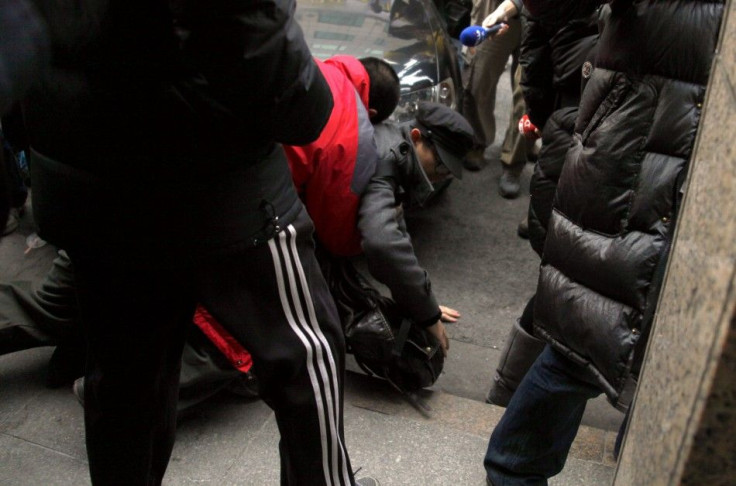
China joined the list of Tunisia-inspired countries on Sunday when activists called for a 'Jasmine' revolution, which was also planned and organised online. It was, however, suppressed within two hours after police and security forces descended at the discussed protest sites ahead of the demonstrators. Although the Tunisia-inspired revolt wilted, it intensified the concerns on the freedom of expression besides stringent security review of the internet in countries such as Iran, North Korea and China.
The Nobel Committee's beliefs: Democracy, Freedom of Expression takes center-stage
Democracy and related issues of freedom of expression and human rights have always taken the center-stage for the Norwegian Nobel Committee, which chose to award the 2010 Nobel Peace Prize to the Liu Xiaobo for his long and non-violent
struggle for fundamental human rights in China. Xiabo was awarded with world's top accolade despite strong opposition from the communist country which sees pro-democracy and human rights activists as dissidents.
The Norwegian Nobel Committee has long believed that there is a close connection between human rights and peace. Such rights are a prerequisite for the fraternity between nations of which Alfred Nobel wrote in his will, the Norwegian Nobel Committee said in a statement.
Keeping in line with these beliefs of the Nobel Committee, a Norwegian parliamentarian nominated anti-secrecy website WikiLeaks for the 2011 Nobel Peace Prize. Justifying his choice in a blog post, Snorre Valen said WikiLeaks was one of the most important contributors to freedom of speech and transparency.
It is always easier to support freedom of speech when the one who speaks agree with you politically. This is one of the tests on liberal and democratic values that governments tend to fail. For instance, western governments have a long history on tolerating oppressive regimes that are friendly-minded. Internet companies assist China in censoring search engines. And many countries respond to Wikileaks' obvious right to publish material that is of public interest, by seeking to shoot the messenger, Snorre Valen, a member of the Socialist Left party, begins his blog post, titled 'Why I nominated WikiLeaks for the Nobel Peace Prize'.
In fact, Twitter was considered for the honor in 2009 for its help in facilitating communications during election protests in Iran.
How social media championed democracy
Social media platforms like Twitter, Facebook, YouTube among others have been the backbone of the protests spanning across the Middle East, North Africa and Asia.
The Egyptian protest took opff with the April 6 Youth Movement on Facebook. In Bahrain, True Royal Democracy followed on Facebook, while in Iran, Activist Saeed Valadbaygi maintained a commentary on the protests on the social networking site, called Revolutionary Road by Saeed Valadbaygi.
Libyan protesters used Twitter to organize protests with hashtags like #Feb 17. Chinese organizers posted on sites such as Boxun.com as well as Twitter with hashtags like #cn220.
Popular video and photo sharing websites such as YouTube abd Flickr became the grounds for people to post reports on the ground realities of the protests. These outlets rose to prominence due to the fact that the authorities also tried to gag local and international media.
Social media, therefore, served two purposes by assisting the mobilization of the protests besides acting as a credible outlet for information from the countries while the consequent censorship brought up world-wide concerns on freedom of expression. Even the United States, which portrays itself as the biggest supporter of democracy and the protector of freedom of expression, mulled an 'internet kill switch' in the wake of the Egyptian revolt.
However, following the crackdown in Iran, the U.S. Secretary of State Hillary Clinton vowed to push for global Internet freedom.
There is a debate underway in some circles about whether the Internet is a force for liberation or repression. But as the events in Iran, Egypt and elsewhere have shown, that debate is largely beside the point, Clinton said.
In the wake of the Sunday unrest, even China has been forced to call for 'a system of public opinion guidance on the Internet.' In a speech, President Hu Jintao called on the nation to enhance and complete management of information on the Internet and to establish a system of public opinion guidance on the Internet.
Political rhetoric and motives aside, internet continues to play a dominant role in the fabric of society. Friend to the common-man, foe to the authorities, Internet and Social Media make a strong case for themselves for the 2012 Nobel Peace Prize.
© Copyright IBTimes 2026. All rights reserved.