Ireland Debates the Limits of Austerity
Aisling McNiffe's voice crackles when she talks about her son's school prospects.
Jack, a chirpy, fair-haired six-year old with a fondness for Toy Story movies, is the only person in the world known to have both Down's Syndrome and CINCA Syndrome, a degenerative disease that causes crippling headaches, severe arthritis, skin rashes, deafness and blindness.
If Jack had started school four years ago, he would have been assigned a dedicated special needs assistant to help him through a full day. But government cuts since Ireland's housing crash in 2008 mean he will only be able to attend for an hour a day, damaging his chances of learning to communicate through pictures or sign language.
What do they see my son as? asks the 38-year old former air hostess, struggling to be heard as Jack plays with a music box in the living room of their bungalow in the village of Ardclough.
He obviously doesn't mean anything to them.
In an age of austerity, Ireland is struggling to decide what is important. Dublin has pushed through nearly 21 billion euros ($29 billion) in spending cuts and tax increases, equivalent to more than 13 percent of Gross Domestic Product (GDP). Investors have been impressed by the calm in Ireland. In contrast to Greece, Britain and Spain, there has been little social unrest.
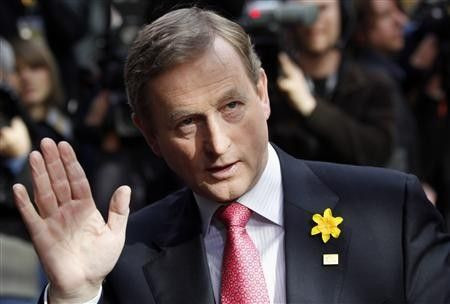
But as the cuts continue, it's getting harder to decide what should go next. The seven-month old coalition government, headed by Enda Kenny's center-right Fine Gael party, needs to find another 12 billion euros in savings or increased tax receipts between 2012 and 2015 -- probably more if global economic prospects worsen. The cuts are required by the European Union and International Monetary Fund in exchange for 67.5 billion euros in loans. Outgoing European Central Bank chief Juergen Stark told the Irish Times this week that the country should cut further.
In its initial rush to shore up public finances, the previous centrist Fianna Fail government went after easy targets such as assistants for special needs children like Jack. The problem, as new Finance Minister Michael Noonan recently put it, is that a lot of the low-hanging fruit has been picked.
As other European countries are discovering, the next stage will require not just tough decisions, but a complete rethink.
We are in a situation where right across the developed world, fiscal policy is tightening and the population is going to have to get used to getting less from the government and paying more for what they do get, says Eoin Fahy, chief economist at Kleinwort Benson Investors.
DISASTER ZONES
After four years of austerity, public patience in Ireland is wearing thin.
Teachers, nurses and council workers have ended up with huge mortgages which are now worth more than their homes, while property developers and bankers have held on to gold-plated pensions and luxurious overseas holiday homes.
Many ordinary Irish see scope for more cuts. But they are also angry that the lean times have not brought a much bigger change of thinking from the go-go years of the Celtic tiger economy, when public spending more than tripled in a decade, while basic services barely improved.
Take hospitals. Even on quiet days, emergency departments in large Irish hospitals can be chaotic. People on trolleys clog corridors, sometimes waiting days for a proper bed. Exhausted doctors dodge between them as they try to grab a few hours' sleep, like medics in a disaster zone.
Emergency departments have got even busier since the financial crash because fewer people can afford doctors' fees or private health insurance. Staff reductions have forced some patients to wait twice as long to see specialists for non-emergency procedures. If their condition worsens, they too end up in the emergency ward.
In Dublin, savings made on nursing homes mean elderly patients, who used to wait up to two months to be re-housed, can end up occupying hospital beds for longer than a year.
It's so unbelievably serious and it's only going to get much, much worse, said one Irish doctor, who declined to be named because he was not authorized to speak to the media. We're putting out fires constantly -- there are more people who are coming in acutely sick and there is much less room to practice any kind of preventative medicine.
Junior doctors' overtime allowances have been cut, but the doctor said that isn't the main problem. What galls us are the inefficiencies that are being paid for while there are very important things that are not being paid for, he said.
Hospital transport is just one example. A 2009 government-commissioned report into public expenditure recommended cutting 20 percent from the annual 50 million euro bill for non-emergency patient transport. But hospitals still pay for taxis and private ambulances.
Health Minister James Reilly, himself a doctor, has pledged to overhaul the health service. But health workers say he will struggle to overturn deeply entrenched trade union positions and navigate the politics. Changes have already raised hackles. Kenny's Fine Gael party expelled one of its lawmakers last month after he voted against a government decision to close a hospital in his constituency. A party colleague from the same region who voted in favor of the measure was spat at outside parliament, and an anonymous caller threatened to shoot him in the head.
I would have little to no confidence that these inefficiencies could be ironed out, the doctor says. No matter how good the politicians are, the labor unions are just too strong and the politicians are too afraid to take them on.
PAY RATES
One reason the electorate punished the previous administration was the years of profligacy that eventually led to the EU-IMF bailout. Between 1999 and 2009, Irish public spending more than tripled, much of it to fund pay rises rather than improve services. Average public sector pay levels increased by 35 percent over the period: in Germany, that rise was just 16 percent.
Conscious of this, Prime Minister Kenny has done away with the more lavish trappings of office, making his cabinet members come to some meetings in a minibus rather than their own saloon cars. Such gestures have so far helped keep his popularity rating high. He and his ministers are, however, still among the best paid in the world.
On average, public servants' pay has been reduced by 15 percent in total since 2009. Some argue it should be cut again.
If you compare the wages in the public sector with the wages in the public sector of other countries in the euro area, together with Greece, Ireland is still ranking top, Stark told the Irish Times.
He said civil service wages are significantly lower in other countries in the euro zone which provide financial support to Ireland.
The only way I can see realistically that you can make savings and maintain services is to cut pay, says Joe Durkan, associate research professor at the Economic and Social Research Institute (ESRI), an independent think-tank that is partly funded by the Department of Finance.
You need more flexibility and to row back on the big increases that went to higher-paid public servants throughout the '90s and 2000s. We did all these things when it looked like we had plenty of money. We can no longer afford them.
But the new government has vowed to honor a pledge by the previous administration not to target public sector pay again. It also wants to avoid forced redundancies, as long as unions agree to voluntary job cuts, longer working hours and to persuade their members to be redeployed.
Ireland's energy minister has rejected Stark's calls for more savings: You can come to a position where you have too much austerity, Pat Rabbitte told state broadcaster RTE on Monday.
Kevin Callinan, the deputy general secretary of IMPACT, the main public sector trade union, shakes his head at the idea of further pay cuts.
There's a view out there on the right that if the money isn't there you have to have job cuts, you have to have pay cuts. That's an okay view until you have to run a country, he said from his union's offices, a stone's throw from one of the country's main children's hospitals.
IMPACT even opposes wage reductions for the higher paid public servants, saying that before the cutbacks, only 15 percent of public workers earned more than 60,000 euros annually. Trade unions argue that the deal to protect public workers' pay has helped cushion Ireland from unrest.
Push them any further, says Callinan, and they could take to the streets.
This deal is a safety net for members. It's the glue that is holding a lot of this together, he said. If the agreement wasn't there or the other side reneged on the agreement it would be a very big mistake to take for granted that people would be as passive as they have been.
SOMETHING GOOD
That almost certainly means that the extra billions will have to come from services and social welfare payments, and tax increases.
Kenny has ordered a review of all state spending. That analysis, which wraps up later this month, will help form the basis of what the government says will be a complete overhaul of the public sector.
A moratorium on recruitment and promotions, and retirement packages that include a tax-free lump sum of one and a half times final salary, have already brought down the number of people working in the state sector by more than five percent since the end of 2008 to just under 303,500 at the end of March. The government wants to reduce numbers by a further eight percent by 2015.
But a progress report in June warned that slimming down public services was likely to hit the most vulnerable in society -- children, the elderly, the sick and unemployed.
Annie Matthews is about as vulnerable as you can get. Born with a rare neurological condition, schizencephaly, the two-year old has holes on either side of her brain and can have up to 100 seizures a day. She wasn't meant to make it to her first birthday, never mind her second.
She is immobile, she can't walk, talk or hold things. She can't swallow, she has no sucking. She is blind but generally she is a happy-go-lucky child, said Suzanne Matthews, cradling her daughter through yet another fit in their living room in the Dublin seaside town of Skerries.
Annie has perfect hearing and loves U.S. blues musician Joe Bonamassa. She also needs 24-hour care. Suzanne and her partner Carl Brennan have three other children, aged seven to 13, and would be lost without the nursing respite care they get from a local charity, the Jack & Jill Foundation.
But the foundation's state funding has been reduced and the 40 hours' weekly help Suzanne and Carl used to get is down to 32. It has left a strain on us, said Suzanne. If it was to be taken away from us altogether.... she trails off.
I wouldn't have been able to cope without them. I'd probably be in a mental institution if it wasn't for Jack and Jill.
Jack & Jill raises 80 percent of its funds privately, largely through donations of old mobile phones. At an annual 2.7 million euros, its budget is a touch less than the annual cost of furnishing Ireland's 227 senators and members of parliament with prepaid envelopes. The charity says it has supported more than 1,300 children with brain damage and it saves the government money by helping parents look after their children at home instead of sending them to live in hospital.
Founder Jonathan Irwin hopes the government will use the spending review to increase the use of private groups that can save the country money.
There is a lot of fat and duplication, he says. Let's get something good out of the recession.
REFORM AND RESENTMENT
That's a hope echoed by Ed Walsh, the founding president of the University of Limerick, and an influential voice in Irish education. He wants Ireland's European and IMF creditors to force through deep changes.
The whole public sector is ripe for reform, he says, suggesting the school system could be taken on first.
Ireland has dropped down the rich-country rankings in literacy and mathematics over the past decade; multinational companies, a key source of employment, want the country to improve education standards.
Teachers' salaries have been reduced by around 14 percent since the beginning of 2009 and they have agreed to work up to 36 hours extra a year for no additional pay.
But Walsh, who has served on Ireland's National Council for Curriculum and Assessment, believes wages need to be cut further to allow investment elsewhere. Newly qualified teachers earn less than the OECD average of just under $29,000. But experienced teachers are among the best paid in the world. Reuters calculations and OECD data put the top basic salary for an Irish teacher, at around $52,700, well above the OECD average of $48,000. Secondary school teachers spend some 173 days a year in the classroom, against an average of 184 days in the developed world.
The main teachers' union, the Irish National Teachers Organization (INTO), has rejected Walsh's calls for further pay cuts. Primary teachers along with other public servants had already taken a 14 percent reduction in pay, says Sheila Nunan, general secretary of the INTO. In addition to that they are dealing with the same increased taxation and health contributions as every other worker.
With unemployment rates around 14 percent and the EU and IMF demanding savings, Walsh believes there has never been a better time to reform.
A government would be applauded for taking a firm line in eliminating waste from the public sector, he said. It's not necessarily as difficult politically now as it might have been a few years ago.
Jack's mother sees things more fundamentally. As the voice on her son's music box sings Row, row, row your boat, Aisling McNiffe's desperation is obvious. The mother of two had hoped school would give Jack a chance to develop new skills, and her more time for his older sister.
The dark ages are gone when children with special needs would have been left in institutions rocking in a corner, she insists as her son plays on the floor.
Sometimes I wonder would they be delighted if Jack died. This is a human rights issue.
© Copyright Thomson Reuters {{Year}}. All rights reserved.
- MOST POPULAR IN Economy & Markets