Fannie, Freddie Executives Say They Need Big Paychecks to Protect Taxpayer Money

Top executives at Fannie Mae and Freddie Mac defended their lucrative pay before a House panel on Wednesday, one day after lawmakers approved the suspension of top executive compensation packages and the moving of the companies' thousands of employees onto a pay scale that lines up with federal financial regulators including the Federal Deposit Insurance Corp. and Office of the Comptroller of the Currency.
The uncertainty surrounding the timing and the form of government-sponsored enterprise reform makes it "very difficult to attract and retain employees with highly specialized skills and experience," said Michael Williams, chief executive at Fannie Mae, in defense of the high pay level that enraged lawmakers.
"This is particularly true as other financial institutions can offer long-term career opportunities and in many cases substantially more compensation," he added. "Attrition at our company this year has already doubled our historical experience. In the course of three months, I lost five senior vice presidents out of the company to financial services and other companies."
Edward DeMarco, acting head of the Federal Housing Finance Agency, acknowledged that the compensation arrangements are "large," but warned that pay cuts "could disrupt the functioning of the companies and thereby add even greater losses on the American taxpayer."
"I need to ensure that the enterprises have people with the skills needed to manage the credit and interest rate risks of $5 trillion worth of mortgage assets and $1 trillion of annual new business that the American taxpayer is supporting," DeMarco argued. "Others may believe that this sort of talent is easily and quickly hired at compensation far below that of competing private firms, but I do not."
On Tuesday, the House Financial Services Committee approved a bill by a vote of 52 to 4 to block future bonuses at Fannie and Freddie and suspend the pay packages for top executives at the firms.
"Awarding lavish pay packages to the heads of these companies that have accepted $170 billion in taxpayer cash can't be defended," said Rep. Spencer Bachus of Alabama, chairman of the panel.
The Senate is expected to take up a similar measure. Lawmakers said the legislation could be sent to President Obama by the end of the year.
The Troubled Mortgage Giants
Fannie Mae and Freddie Mac received the biggest federal bailout of the financial crisis. Since they entered conservatorship, the U.S. Treasury has provided $169 billion in aid, and the payouts are scheduled to continue with no end in sight. According to recent FHFA projections, Treasury assistance to the two troubled mortgage giants will total $220 billion to $311 billion by the end of 2014.
Just two weeks ago, Fannie Mae asked Treasury for an additional $7.8 billion in aid after reporting a third quarter loss of $5.1 billion. Freddie Mac asked for an additional $6 billion after reporting a $4.4 billion in net losses in its third quarter earnings.
Congressmen pointed out that such lucrative compensation packages may be appropriate for profitable companies in the private sector, but substantial questions exist whether they are appropriate for entities in taxpayer-funded conservatorship, especially those that are bleeding billions of dollars each quarter.
Filings show that Fannie Mae and Freddie Mac paid outside compensation consultants $655,000 in 2008 and $560,000 in 2009 to determine their own pay structure.
Fannie Mae CEO Michael William said following the change in pay structure, the company has slashed its target total compensations for executive management by over 50 percent, compared with the peak level prior to conservatorship, and reduced senior managers at the company by 30 percent. Meanwhile, compensation of Freddie Mac's senior team is down 40 percent from peak levels, said Charles E. Haldeman Jr., CEO of Freddie Mac.
"There would be more families hurt and the pain would last longer, if there was a breakdown at Freddie Mac," Haldeman added. "It seems to me that gradual change would be preferable to radical change in the operations of the company."
How Much Does It Take To Recruit The Right Talent?
The companies have been criticized for paying top executives generous compensation and having taxpayers foot the bill. The House Oversight and Government Reform Committee played a clip of Obama's comment at the beginning of the Wednesday hearing, in which the president said, "If these companies are in good enough shape to afford massive bonuses, they are surely in good enough shape to afford paying back every penny to taxpayers."
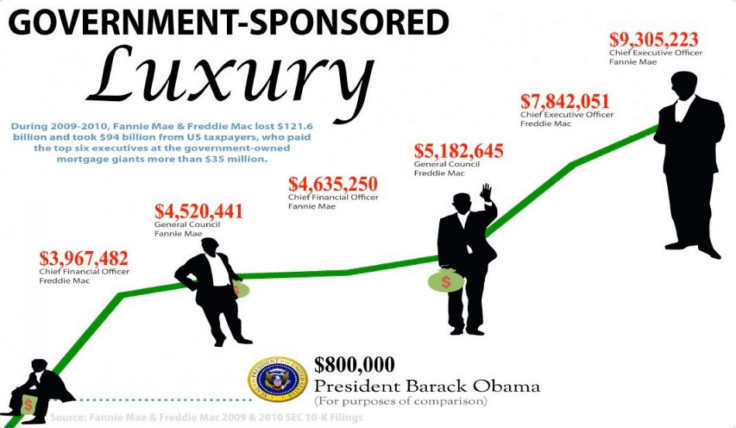
Filings show, in 2009 and 2010, the top six officers at Fannie Mae and Freddie Mac were given a total of more than $35 million in compensation. Of that amount, a total of $17 million in compensation was given to the CEOs of the enterprises. Additional bonus installments for 2010 may still be forthcoming, and the two CEOs stand to make a total of $12 million in 2011. In addition, one Fannie Mae executive, Susan McFarland, received a $1.7 million signing bonus upon joining Fannie in June 2009.
According to a report produced by the House Oversight and Government Reform committee, in 2010, Ed Haldeman, Freddie Mac's CEO, received a base salary of $900,000, and took home an additional $2.3 million in bonus pay. Haldeman stands to make as much as $6 million in 2011.
Meanwhile, Fannie Mae's CEO, Michael Williams, took home $900,000 in base pay in 2010, along with an additional $2.37 million in performance bonuses. He also may take home as much as $6 million in 2011.
"That sounds about the going rate to me in that sort of business," said Simon Peck, associate professor of marketing and policy studies at Case Western Reserve University Weatherhead School of Management, in an interview with IBTimes. Peck does research on executive compensation.
"Though some of these numbers do make you scratch your head, it kind of depends on what you want Fannie and Freddie to do," he added.
Peck said if Fannie Mae and Freddie Mac are seen as an extension of some government agency, largely going through routine procedures, then paying them like on the federal pay scale is probably best. However, if these organizations are considered as financial services companies overseeing vast sums of assets, and required to take decisions that can have significant effects on the value of these assets and the customers that hold them and ultimately taxpayers, then he would suggest a more "market-based" approach to pay is probably called for in order to attract and retain people with these sorts of skills.
According to DeMarco, Fannie Mae and Freddie Mac employees "are not government employees" and these "are not government agencies."
The side show and the big show
"To me, it [Washington's focus on executive compensation] seems to be more of a sideshow, and Congress should be focusing more on the big show, which is how to extricate the government from its extraordinarily dominant role in the mortgage market," David Reiss, professor of law at Brooklyn Law School, told IBTimes.
"While I am a longtime critic of Fannie and Freddie, it makes no sense to play politics with the current structure," he said. "Instead, Congress should be focusing on a sunset strategy that spins Fannie and Freddie off as private companies as was done with Sallie Mae. That way, if they were to fail again, taxpayers will not be liable for the many tens of billions of bailout dollars that this one required."
Reiss felt that the process has been going "very slowly."
DeMarco also stressed Wednesday that conservatorship is not designed to be a multi-year holding state.
The FHFA took Fannie Mae and Freddie Mac into conservatorship in 2008 as a result of mounting losses stemming from the financial crisis.
"The best way to address concerns with executive compensation is action by congress to restructure the nation's housing finance system and dissolve the conservatorships," DeMarco urged.
© Copyright IBTimes 2025. All rights reserved.
- MOST POPULAR IN World