

Women Ask for Raises, Promotions as Often as Men, but Receive Less: Study
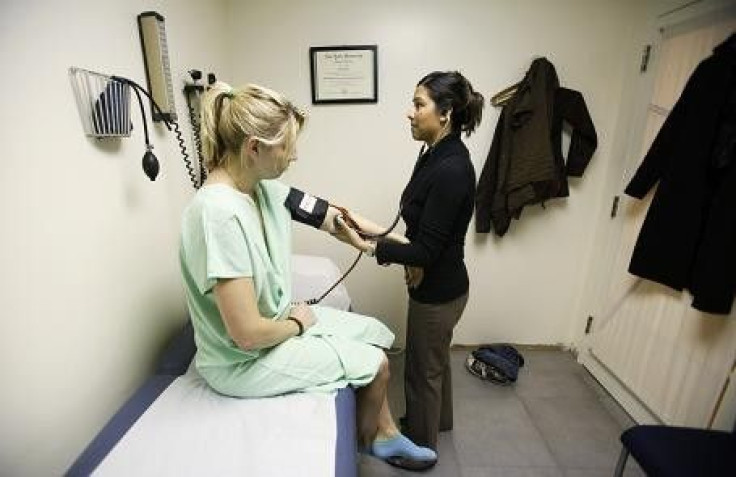
By now, it is common knowledge that while women have made stunning advancements in the American workforce in the past 50 years, they often take in lower salaries than their male counterparts.
Although the gender pay gap is often attributed to women's reluctance to simply ask for a raise or promotion, a recent study by the non-profit organization Catalyst reveals that women actually inquire about those opportunities as often as men, but get less in return.
The report, titled The Myth of the Ideal Worker, followed the career paths of more than 3,000 recent MBA graduates from top universities over a 10-year period as they transitioned into a traditional career path.
Of those, about half of the graduates tracked by the study authors exemplified a set of advancement strategies attributed to so-called ideal workers -- such as gaining access to influential administrators, making their achievements visible, and developing new skill sets through training courses and workshops.
However, while the study found there was no significant difference in the proportion of high-potential men and women who asked for increased compensation or a promotion after they moved on from their first post-MBA job, the rewards were vastly different.
In fact, women who either initiated such conversations or changed jobs experienced a slower rate of compensation growth compared to women who stayed at their original position. Meanwhile, men who changed companies or negotiated for higher salaries ultimately earned more than those who stayed put at their first job.
It has long been argued that 'women don't ask,' the report states. We found little evidence to support this claim when considering career advancement strategies that rely on asking for opportunities. Women were more likely than men to ask for a variety of skill-building experiences, to proactively seek training opportunities, and to make achievements visible, including asking for feedback and promotions.
Women Judged by Performance, Men by Potential
The results of the study are unsurprising to women's advocacy groups who have been fighting against the nation's formidable gender wage gap for decades. Terry O'Neill, the president of the National Organization for Women, told the International Business Times that the Catalyst study simply validated other reports that suggest the wage gap between men and women is rooted in discrimination.
It is abundantly clear that women are treated differently than men in the workplace. There's a general feeling that it's okay to discriminate against women, or offer them less, because they won't do anything about it, she said.
While workers are often encouraged to look out for opportunities at other companies to increase their chances for advancement, the study suggests that women are paid for their proven performance, while men are compensated for their perceived potential. On average, Catalyst found that men who moved on to their second post-MBA employer earned about $13,743 more by 2008 than those stayed at their first job. Meanwhile, compensation growth for female job-hoppers (those that changed jobs two or more times following completion of their MBA) was approximately $53,400 less than those who stayed with their first employer.
The study also discovered differences in men and women's negotiating skills depending on how many jobs they held after receiving their degree. For instance, men were considerably more likely to counter their first job offer by asking for a higher salary -- 50 percent compared to 31 percent. But, among men and women who had moved on from their first position, 63 percent of women asked for higher pay, compared to 54 percent of men, indicating that women's negotiating skills improve considerably with experience.
In fact, the study authors offer another theory -- the problem is not that women don't ask, but that men don't have to.
Are men being rewarded without even having to ask? Do women have to raise their hands and seek recognition to an even greater extent than men do to receive the same outcomes? the report asks.
That seems to be the case. According to the study, advertising their achievements -- by ensuring their manager was aware of their accomplishments and asking for feedback and credit -- was the only behavior associated with compensation growth for women.
In comparison, rather than making achievements known, men most effectively increased their salary by conducting external scans to stay on top of their market value, and indicating a willingness to work long hours.
Male/Female Pay Gap Persists
Although the Equal Pay Act of 1963 aimed to abolish wage discrimination based on sex, as of 2011 the U.S. Department of Labor reports that women still only make 81 cents on the dollar compared to men, while the Institute for Women's Policy Research estimates the wage gap is closer to 77 cents on the dollar.
When the Equal Pay Act was signed into law by President John F. Kennedy, women were earning 60 cents on the dollar. Meaning, in almost 50 years the wage gap has closed by a mere 17 to 21 cents on the dollar, even though the legislation clearly states that employers cannot discriminate between employees on the basis of sex by paying wages to employees in such establishment at a rate less than the rate at which he pays wages to employees of the opposite... for equal work on jobs, the performance of which requires equal skill, effort and responsibility.
While the legislation states that employees can take legal action to receive any back pay that is withheld in violation of law, it does not allow them to seek punitive damages.
According to O'Neill, social stereotypes that frame women as caretakers first, and employees second is possibly the biggest factor contributing to the gender wage gap.
The conservative answer to this problem [wage discrimination] tends to be, 'Oh, women don't want to work as hard, because they usually want more time off to take care of their kids or parents.' So, to them, its women's own fault, she said.
--
© Copyright IBTimes 2024. All rights reserved.
-

Senate Prevents Potential Air Travel Chaos, Reauthorizes FAA For Five-Years
-
Panama Papers Law Firm Boss Ramon Fonseca Dead
-

Pandemic Agreement Talks Go To The Wire
-

Low-cost MRI Paired With AI Produces High-quality Results
-

School's Out: How Climate Change Threatens Education
-

Hong Kong Demands Online Platforms Remove Banned Protest Song
-

2023 'Year Of Record Climatic Hazards' In Latin America: UN
-

Crypto Community Buzzes As Grayscale Withdraws Ethereum Futures ETF Application
-

Mongolia's Wildlife At Risk From Overgrazing
-

Milking Venom From Australia's Deadly Marine Animals


