

Greece Bailout Deal Finally Reached
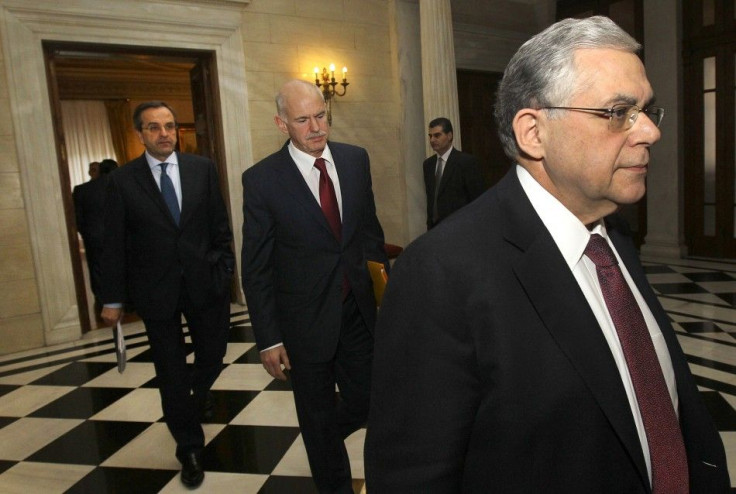
The Greek deal is finally done.
Following days of exhausting political drama, high-level brinkmanship and stern rhetoric in both public and private statements, red-eyed leaders of Europe's leading financial institutions reached a deal Thursday with Greece's governing coalition that will impose further austerity measures on that country in exchange for a €130 billion bailout ($172.56 billion).
The leaders of Greece's three coalition government parties, including Prime Minister Lucas Papademos, had for weeks been negotiating the deal amongst themselves and with the heads of the three supranational organizations expected to provide the country with financing: the International Monetary Fund, the European Union and the European Central Bank, commonly referred to as the troika.
The agreement is expected to provide the Greek government with enough financing to pay off upcoming sovereign bond redemptions in exchange for the imposition of new fiscal tightening measures on that country's citizens, including cuts to government pension funds, a slashing of the minimum wage, and establishment of new taxes.
A few minutes ago, I got a call from the Prime Minister of Greece saying that an agreement had been reached and has been endorsed by the major parties, European Central Bank President Mario Draghi told a news conference in Frankfurt Thursday morning, the first official acknowledgement of the deal.
2 a.m. Phone Calls
The dramatic dynamics behind how the deal was struck began last night when European officials, meeting with Greek political leaders in Athens, jetted off to Brussels after yet another day of seemingly failed talks.
Late last night, the negotiations -- which had been on edge since the Greek political leaders missed a deadline for agreement the European institutions had set for Monday morning -- appeared headed to yet another day of political gamesmanship.
Among the most contentious points, a reduction of the minimum wage to €586 per month and cuts to the country's pension funds amounting to €300 million. As Greece's finance minister, Evangelos Venizelos, left the capital last night, talks had stalled over the pension fund issue and the parties had retired for the day.
I leave for Brussels with hope that the Eurogroup will take a positive decision concerning the new aid plan, Venizelos said last night, according to Reuters. Immediately afterwards he boarded a plane to go negotiate with euro-area creditors, noting any outcomes will determine whether the country remains in the euro zone or whether its place in Europe will be endangered.
Then came a phone call from Prime Minister Papademos to one of his coalition partners, which caught the latter at home in the wee hours of the morning, and sealed the fate of the deal.
According to the New York Times, Papademos and the leader of another Greek party, Antonis Samaras, hashed out a preliminary plan that would allow them to accept the cut to the country's retirement funds -- the cut to the minimum wage was apparently agreed to earlier in the day -- by taking money away from other discretionary spending.
In making that agreement, Papademos and Samaras stealthily sidelined the third partner in their coalition, populist leader George Karatzaferis.
A spokeswoman for the prime minister's office, on condition of anonymity, confirmed to the Associated Press that a deal had been struck early this morning.
Another Day, Another Battle
It is unclear how the news will continue to develop Thursday. As of 10 a.m. New York Time, the Greek Prime Minister's office had not made any official statements on the matter. Neither had Karatzaferis, the sidelined coalition leader.
Greece's two major labor unions are still calling for a 48-hour strike beginning Friday to rally against the agreement.
The painful measures that create misery for the youth, the unemployed and pensioners do not leave us much room, secretary general of the ADEDY union, Ilias Iliopoulos, told Reuters. We won't accept them. There will be a social uprising.
Greece's political class must now also negotiate a second part of the deal with private creditors. Those dealings are not expected to be as contentious.
Outside of Greece, attention will now be turned to some of the other highly-indebted European countries that have either already received international assistance or are expected to need it in near future.
I think Portugal is likely the next shoe to drop in terms that it has too much debt, Eric Lascelles, chief economist at RBC Global Asset Management said about future potential developments, in an interview prior to the announcement of the new Greek deal.
Last night, already-bailed out Ireland, was also putting out an asking hand, with public officials suggesting a deal on Greece would boost their claims for some debt forgiveness.
If the ECB are prepared to make this kind of concession to Greece it would encourage me to think that they might be ready to make concessions on the promissory note to Ireland, Finance Minister Michael Noonan told a national broadcaster, according to Reuters.
Still, financial markets were happy on the news. Risky assets whose prices generally rise on expectations of economic growth, like oil futures, were up. The benchmark S&P 500 index of U.S. equities was up 0.14 percent to 1,351.90.
© Copyright IBTimes 2024. All rights reserved.
-

Bitcoin And Crypto Price Review - Another Myth Gets Busted?
-
Mass Cancellations Loom Despite French Air Union Cancelling Strike
-

Mired In Crisis, Boeing Reports Another Loss
-
Recycled 'Zombie' Misinformation Targets US Voters
-

Hackers Leak Part Of Source Code Of El Salvador's Bitcoin Wallet
-

Azerbaijan Says 'Closer Than Ever' To Armenia Peace Deal Amid Border Talks
-
How UK's Biggest Water Supplier Sank Into Crisis
-
Taiwan Hit By Dozens Of Strong Aftershocks From Deadly Quake
-
Gaza Health System 'Completely Obliterated': UN Expert
-

In Ecuadoran Amazon, Butterflies Provide A Gauge Of Climate Change


