Syria Revolution: Why Is Russia Supporting Syria?
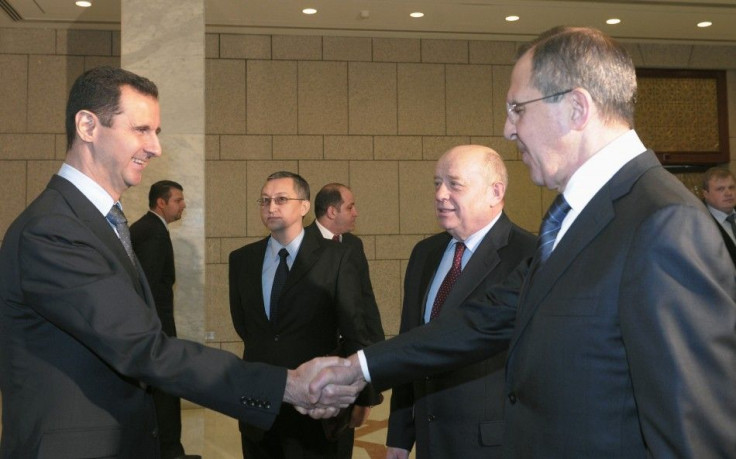
On Tuesday, a day after Britain and the United States pulled diplomats from Syria in a show of protest over the ongoing bloodshed, Russian Foreign Minister Sergei Lavrov emerged from a meeting with Syrian leaders saying that President Bashar al-Assad was ready to end the violence.
Assad has made similar promises before, and the Syrian army continued to bombard the encircled rebel stronghold of Homs. But Russia has continued to defy much of the international community in insisting on trying to broker a solution with the Assad government.
Russia faced a barrage of condemnations after it joined China over the weekend in vetoing a United Nations Security Council resolution calling for Assad to step aside. U.S. Secretary of State Hilary Clinton called the veto a travesty that would push Syria towards civil war, and U.N. Secretary General called the resolution's failure disastrous.
But Russia has stood resolutely behind its decision. During an interview with Charlie Rose, Russia's ambassador to the United Nations said Russia's approach was more successful than that of countries that were making a lot of noise and big loud statements.
We have a relationship with the government, we have a relationship with the country, Vitaly Churkin said. You cannot expect, or you can actually count on it if you are our ally, that we are not going to turn around overnight, he added.
Russia's Motivations
The motivation is partly economic. Russia is one of Syria's main arms suppliers, a relationship Russia has maintained despite other countries objecting that Syria could be funneling weapons to groups like Hezbollah and Hamas. The Stockholm International Peace Research Institute estimates that Russia furnished Syria with $162 million worth of arms in both 2009 and 2010, and the total value of Syrian contracts with the Russian defense industry is closer to $4 billion.
But such economic considerations are only one factor in a much larger calculation about how the cataclysmic events reshaping the Middle East, and the international response to them, will affect Russia. In one sense, the veto was an affirmation that Russia still has the ability to influence how things play out.
This shows that the veto still means something and gives Russia great power status, so don't ignore Russia and don't count them out, said Kimberly Marten, a professor of political science and Russian foreign policy expert at Barnard College, Columbia University. This is a stand Russia is going to take to show the West that it still has power.
Churkin, the U.N. representative, underscored that point when Rose read him some of the criticisms coming from Clinton and other world leaders. Attempting to isolate Russia could undercut Russian cooperation on issues like Iran and Afghanistan, Churkin warned.
They should think hard if they are trying to turn the Syrian situation into some sort of a Russia baiting exercise because I think that in many ways they need Russia more than we need them, Churkin said.
Russia Opposes Outwardly Imposed Regime Change
There is also a deep-seated aversion to outwardly imposed regime change among many Russian officials. The NATO intervention in Libya, which was positioned as an attempt to protect Libyan civilians but quickly became focused on ousting Col. Muammar Gaddafi, angered many in Russia. Prime Minister Vladimir Putin likened the U.N. Security Council resolution allowing the Libya airstrikes to a medieval call for a crusade.
They really did not like how things went with Libya, how a resolution to enforce no-fly zone became regime change, said Andrei Tsygankov, a Russia expert at San Francisco State University. Russians are fearful of a precedent. They are fearful that the same resolution will take place here [with Syria].
A senior Arab diplomat, speaking to The Washington Post, referred to the Russian veto as a Cold War curtain call. Tsygankov dismissed the idea that Russia was attempting to preserve its regional influence by building an axis of anti-Western interests in the Middle East. Russia is more concerned with developments close to home, Tsygankov said, where popular uprisings in Georgia, Kyrgyzstan and the Ukraine created governments that are less friendly to Moscow.
I think Russians certainly are very concerned about all of these changes, they are very concerned that this will affect other countries and that ultimately it will affect them as well, Tsygankov said. Remember, right before the Arab spring Russians witnessed some fundamental changes in their own region.
Russian Election Considerations
Putin and his ruling United Russia party are also contending with rising discontent at home, evidenced by a series of massive rallies and a weaker than expected showing in recent parliamentary elections. Putin has remained defiant, and most experts agree that he is still likely to win an upcoming presidential election. But Russia's leadership may still be rattled by the prospect of the popular uprisings that have swept across the Middle East toppling Assad.
I think they followed closely what has been happening in the Middle East, and they're obviously worried if this trend continues around the globe even in such parts of the world where we would feel authoritarian regimes are quite entrenched it might give additional hope for the Russian political opposition, said Olena Nikolayenko, a Russia expert at Fordham University.
Russia's relationship with Iran undoubtedly plays a role as well. Russia has closer economic and diplomatic ties with Iran than other Western nations do, and reports that Israel is preparing to attack Iran, a close ally of Syria, complicate the picture.
Part of the concern as well is that if Russia goes along with what the West wants in Syria then the next step would be what the West wants in Iran, and what's got to be looming over Russian consciousness in all of this is the possibility of a war with Iran, Marten said.
With the United Nations approach to Syria exhausted, Clinton called for an international coalition of countries that support the Syrian people's right to have a better future, and Turkish foreign minister Ahmet Davutoglu is planning an international conference to seek a solution. Russia removes itself from such efforts at its own peril, Marten said.
I think Russia is going to regret this, Marten said. It's going to cost Russia a lot of its reputation, not primarily in the United States but in the rest of the Arab world as well.
--
© Copyright IBTimes 2026. All rights reserved.
- MOST POPULAR IN World