

Peripheral debt crises threaten overall EU economy
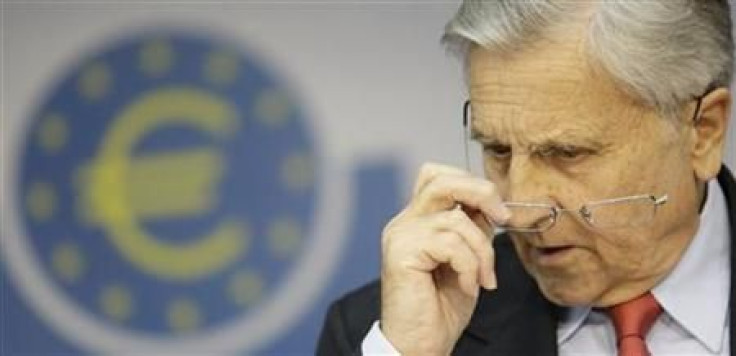
Just like how Federal Reserve Chairman Bernanke kept on assuring markets in 2007 that the subprime mortgage crisis would not bring down the overall economy, European Central Bank (ECB) President Jean-Claude Trichet is saying the same thing about peripheral sovereign debt crises in Europe.
However, Desmond Lachman, a resident fellow at American Enterprise Institute (AEI) said Trichet is glossing over and downplaying the risks posed by these crises in the peripheral European countries.
Trichet emphasized that Greece and Ireland, the two hardest-hit countries that already required bailouts from the European Union (EU), each only constitute less than 2 percent of the overall euro zone economy. Moreover, Spain, Portugal, Ireland, and Greece -- the countries in the worst fiscal shape -- make up less than 15 of the overall euro zone GDP.
However, Trichet downplays the fact that these countries owe extraordinarily high levels of debt, said Lachman. Furthermore, that debt -- totaling around $2 trillion -- are primarily held by European banks, whose exposure are equivalent to 20 percent of the euro zone GDP.
Moreover, Spanish banks are among the most exposed to Portuguese debt, according to Marc Chandler, head of Global Currency Strategy at Brown Brothers Harriman. Spain and Portugal are seen as the next vulnerable targets for sovereign debt scares (after Greece and Ireland already had theirs), so this connection adds a whole new dimension to the concept of contagion.
A wave of sovereign defaults in these peripheral countries would deal a serious body blow to the European banking system at the very time that the European banks are yet to fully recover from their 2008-2009 loan losses, said Lachman.
Indeed, European banks are still struggling with the aftermath of the global financial crises and have not restructured nor recapitalized as well as U.S. banks have, according to Nicolas Veron, a senior fellow at Bruegel, a Brussels-based think tank.
It was precisely the near-collapse of the U.S. financial sector that brought down the overall economy. Subsequently, the weakened financial system also held back the speed of the economic recovery and severely limited the effectiveness of stimulus measures.
The primary problem of U.S. banks was exposure to bad mortgages. In June 2008, their total exposure to subprime mortgages was $2.5 trillion, according to AEI calculations.
European banks' $2 trillion exposure to peripheral sovereign debt, then, will at best hamper their ability to facilitate economic recovery and at worst trigger another economic downturn.
Many analysts are not optimistic about a relatively painless resolution of the peripheral sovereign debt problem and the banks' exposure to them.
The EU's bailout of Greece and Ireland has stopped the bleeding temporarily, but private investors continue to shun their debt.
Private creditors have been using the exceptional support provided by the EU/ECB/IMF to exit their Greek exposures rather than co-invest with the official sector, said Mohamed El-Erian, co-CIO of PIMCO, in a Reuters op-ed.
One fundamental problem is that the policy of bailouts may not be sustainable. It would be unreasonable to assume Germany will keep paying for them and that peripheral countries will keep accepting additional austerity measures, said Lachman.
Another problem is that these austerity measures, implemented at a time when the economy is already fragile, increases the risks of a double-dip recession. Poor economic performance means meager tax revenues, so the chances of these countries paying down existing debt and new EU debt is diminished.
A third and final problem is that austerity measures are difficult to implement. Greek citizens have rioted against theirs. The Irish are calling for the election of a new government, which may not even accept the bailout package and austerity measures negotiated by the outgoing government.
All these obstacles stand in the way of peripheral European countries repaying the debt they owe to European banks and thus put the whole euro zone financial system and economy at risk.
Email Hao Li at hao.li@ibtimes.com
© Copyright IBTimes 2024. All rights reserved.
-

Microsoft Expands Its AI Empire Abroad
-

Oil: 'Mother Of Corruption' In Venezuela
-

'Extreme' Climate Blamed For World's Worst Wine Harvest In 62 Years
-
Macron Warns 'Mortal' Europe Needs Credible Defence
-

Bitcoin And Crypto Price Review - Another Myth Gets Busted?
-

Mass Cancellations Loom Despite French Air Union Cancelling Strike
-

Mired In Crisis, Boeing Reports Another Loss
-

Recycled 'Zombie' Misinformation Targets US Voters
-

Hackers Leak Part Of Source Code Of El Salvador's Bitcoin Wallet
-

Azerbaijan Says 'Closer Than Ever' To Armenia Peace Deal Amid Border Talks


