

Why The European Union Deserved Its Nobel For Peace

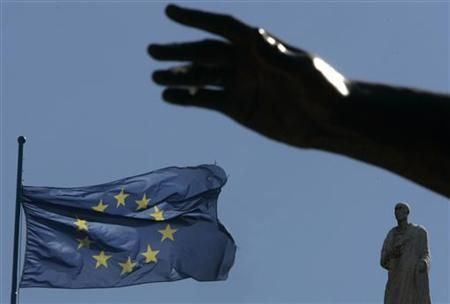
Nobody expected it, much less Europeans. The news on Friday that the European Union had won the Nobel Peace Prize surprised observers from Washington to Beijing, but none were more surprised than the 500 million citizens of the Union itself. After all, when the institution that rules a large part of their lives makes headlines these days, it’s mostly about scary stuff: international rows over money, diplomatic impotence in the face of an unruly world, ugly disputes about ethnic minorities. But peace? It’s not the first thing that comes to mind when thinking of the dreary EU buildings in Brussels and the widely maligned Eurocrats who work in them (not too hard and for lavish pay, says the conventional wisdom.)
“It would have been more fitting to give it to Hannibal Lecter,” tweeted my friend Paolo Pagani, a Milan-based journalist who, like many Europeans these days, has soured on the EU as the organization stumbles through a continent-wide recession, failing to solve a financial crisis that has destroyed incomes from Portugal to Finland. But like those other critics across the Atlantic, he missed the point: awarding the Nobel for peace to the European Union makes perfect sense. A lot more sense than most such prizes have in the recent past, in fact.
If there is one thing the European Union has managed to do supremely well throughout its history, it is precisely keeping the peace, in the world’s formerly most-bellicose continent, and for an unprecedented stretch of 67 years and counting. Since the defeat of the Axis in 1945, and with the exception of the wars among ex-Yugoslavian nations (none of whom, surprise!, were EU members), the only shots fired by European armies at each other have been blanks, in joint exercises.
It would be impossible to overstate the magnitude of that achievement. The history that European kids learn in school is filled with years of war, etched grimly in collective memory. Ask any high-schooler on the continent, and they will reel them off: 1618 to 1648, the Thirty Years’ War that devastated Central Europe with famine and pestilence. The decades of Napoleonic wars, ended at Waterloo in 1815. The abyss of trench warfare from 1914 to 1918. And then 1939 to 1945, the worst one of them all, which left the continent in rubble.
Paradoxically, it was the brutality of World War II that sparked the ideas from which the European Union eventually came. Preoccupied with putting the raw materials for war under joint control, to kill any future conflict at the root, the French and Germans together with Belgium, Italy, Luxembourg and the Netherlands created the European Coal and Steel Community in 1952. The French and the Germans, who had been fighting for a century exactly over those two things, learned through that early union to live with each other.
With stability secured at the core of the continent, and with booming economies thanks to postwar reconstruction and to the peace guaranteed by America, the budding organization gave rise in 1958 to the European Economic Community. Through ever-closer political integration, the European Union was formed in 1993, and in 2002 the European Monetary Union introduced the euro as the common currency for most of the EU’s nations.
I can hear the Euroskeptics pipe up at this point -- the euro! The artificial currency that ruined the Greeks, angered the Germans, nearly bankrupted the Spaniards, and left pretty much everybody else at each other’s throats! True, it has not been a resounding success. But let’s consider what the outcome of those economic conflicts used to be, before the Union: it used to be war.
Europeans know this from direct experience, not just from history books. My family provides a good, and by no means unusual, example: my paternal grandfather, an Italian soldier captured by Germans, spent years in brutal conditions in a war-prisoner camp. My great-grandfather, also a soldier, was not so lucky: he was killed in 1917 in an Austrian assault on Italian lines. My other grandparents lived under near-daily air bombings in the city of Siena, by the British first and the Germans later. My great-uncle was killed in 1944 in a German ambush on the American patrol he, an Italian civilian, was guiding through the hills of Tuscany.
Could I imagine being in their place? Held behind barbed wire by Germans, whose poetry I learned to love, whose newspapers I read every day? Or killed by Austrians, whose country my class visited in middle school, at about the same age when previous generations of Europeans would learn hatred for nations that looked different from their own? No, I could not imagine a situation where I would be fighting a war against other Europeans. (Or against anybody else, for that matter: growing up where peace is the norm will teach you that.) Nothing could be further from my mind, or from the minds of the generations of Europeans born in a time of unprecedented harmony and prosperity. We know each other too well by now. The passports we carry are written in all of our many languages, and they all say the same thing on the cover, in golden letters: EUROPEAN UNION. We may be a bickering, embittered family, but a family none the less. And like all families, we want to kill each other. Metaphorically. Then we sit down together.
The lyrics to the Union’s stirring anthem, Beethoven’s Ode to Joy, begin with big German words: Freude schoener Goetterfunken, “beautiful joy issued from the gods.” But what the Union has really been about since its beginning is another big, and similar-sounding, German word: Friede, peace. This one not issued from the gods, but won by humans every day, through the patient effort of negotiation and understanding. And if sixty years of that constant -- and most of all, successful -- work to keep peace where there had always been war aren’t worthy of the Nobel, then nothing is.
Alberto Riva is the World news editor for the International Business Times.
© Copyright IBTimes 2026. All rights reserved.