

China Just Unveiled An AI Model That Rivals America’s Best. Silicon Valley Is No Longer Clearly Leading The Race.
Moonshot AI's Kimi K3 has posted benchmark results alongside leading U.S. systems while adopting an open-weight approach and lower pricing.

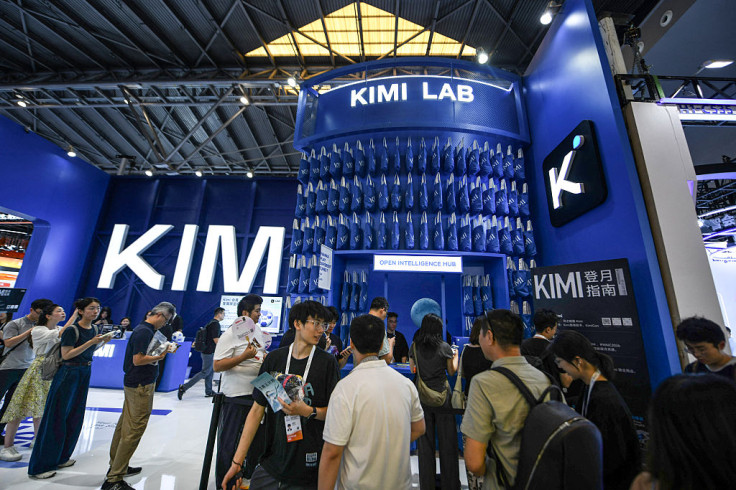
Chinese startup Moonshot AI has released a new artificial intelligence model that is performing alongside some of the leading systems developed in the United States, highlighting how quickly competition between the world's two largest economies has intensified in one of the technology sector's most closely watched races.
Kimi K3, unveiled Thursday by Beijing-based Moonshot AI, is being positioned as the company's flagship model and is set to become available as an open-weight system later this month.
The model has generated attention across the technology industry after posting strong results on several public benchmarks. Kimi K3 ranked ahead of Anthropic's Fable 5 and OpenAI's GPT-5.6 Sol in front-end coding evaluations conducted by Arena, while also placing ahead of Anthropic's Opus 4.8 in broader text rankings, according to Axios. The publication reported that Moonshot plans to release the model's weights publicly on July 27, allowing organizations to run and customize it on their own systems.
Moonshot said Kimi K3 contains 2.8 trillion parameters, making it the world's largest open-weight AI model currently announced. The system also features a one-million-token context window designed to process large amounts of text and code, according to Reuters.
The latest release marks another milestone in China's rapid progress in artificial intelligence. Earlier this year, several Chinese firms, including DeepSeek, Alibaba and Z.ai, released increasingly capable models that narrowed the performance gap with their American counterparts. As recently as April, U.S. government assessments estimated that Chinese frontier models remained six to 12 months behind the leading U.S. systems.
Moonshot AI was founded in 2023 and counts Alibaba and Tencent among its investors. The company has emerged as one of China's so-called "AI Tigers," a group of startups competing to build advanced foundation models, according to The Wall Street Journal.
The company's open-weight strategy also differs from the approach taken by many major U.S. AI developers. Unlike proprietary systems that operate exclusively through cloud-based services, open-weight models allow developers and enterprises to deploy the technology on their own infrastructure. Kimi K3 is expected to be priced below several competing U.S. offerings, with Business Insider reporting that Moonshot is charging approximately $3 per million input tokens and $15 per million output tokens.
The timing of the launch coincides with the World Artificial Intelligence Conference in Shanghai, where Chinese President Xi Jinping called for greater international cooperation on AI and criticized restrictions on technology sharing. China also announced the creation of the World AI Cooperation Organisation alongside several partner nations, according to Reuters.
Washington has spent several years attempting to limit China's access to advanced semiconductors through export restrictions. U.S. officials have argued that advanced AI systems have implications for national security, military planning and cybersecurity. At the same time, Chinese firms have continued to advance despite those restrictions, with several American companies alleging that some Chinese developers have used outputs from U.S. models as training data.
Anthropic has previously accused Moonshot and other Chinese AI firms of conducting large-scale "distillation" efforts using conversations generated by American systems, allegations that Chinese companies have denied, according The New York Times.
© Copyright IBTimes 2026. All rights reserved.