

Colombia Faced Its Strongest Earthquake In Recent History. Now Those Impacted Need To Rebuild.
The quake destroyed or damaged scores of buildings in cities including Cali, Pereira, Manizales, and Quibdó.
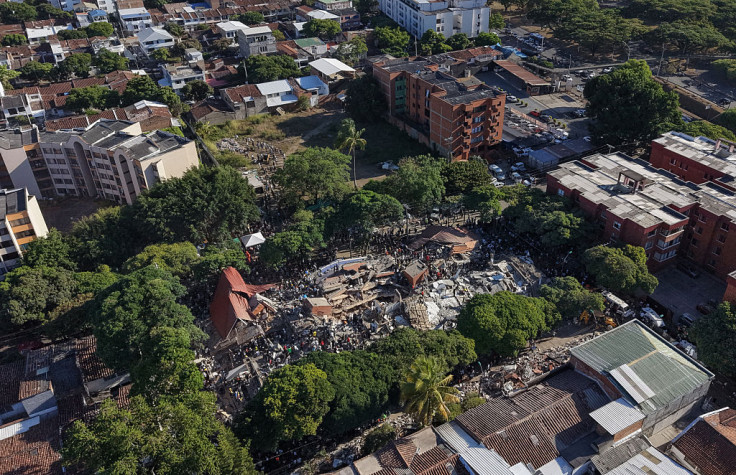
As the shift from rescue to rebuilding begins in Colombia following its devastating earthquake, thousands of people displaced from their homes now face the daunting process of starting anew.
The 7.4 magnitude earthquake was the strongest to strike Colombia in recent history, destroying or damaging scores of buildings in cities including Cali, Pereira, Manizales, and Quibdó. The epicenter of the earthquake was in San Jose Del Palmar in the Chocó region of Colombia, which is about 250 miles west of Bogotá.
As of Monday, the earthquake killed at least 287 people and injured 4,147 more, making it the deadliest earthquake in Colombia since a 6.4 magnitude quake struck the same region in 1999.
The destruction has shone a light on the stark inequalities in Colombian society. Much of the damage occurred in impoverished areas and neighborhoods of the country, which are abundant with informally-built homes that don't meet modern seismic resistance standards.
Karen Viviana Cardona Piedrahita said her Manizales home was a "'total loss," and that her daughter was hospitalized due to injuries suffered in the earthquake.
"We're really devastated," she said. "We have nowhere to live."
The Colombian government scrambled to adequately respond to a natural disaster that proved formidable even for a country prone and accustomed to them. An estimated 127,608 homes were damaged and 197 buildings fully collapsed. More than 300 health centers, 3,200 education centers and 4,000 community centers were impacted. As of Monday, Pereira's Matecaña International Airport had yet to reopen a full week after the earthquake.
The economic damage of the earthquake is still under assessments, but initial estimates have placed it in the billions of dollars.
In cities like Manizales, a city of just under 500,000 people nestled among the Andes Mountains and in Colombia's famous coffee-growing region, much of the humanitarian response has been organic and citizen-led.
Groups on WhatsApp quickly sprouted and organized around different needs. In one, a shared spreadsheet lists people in need of psychiatric help after the earthquake and professionals able to provide assistance. In another, volunteers help search for pets reported missing.
A hastily organized group of students and young people in Manizales set up a makeshift donation center where they sorted through clothing, food, and other necessities that were received and then shipped out to Manizales residents and people in other cities even more gravely impacted by the earthquake like nearby Pereira.
"For us to be here, to be able to meet and have a purpose on which to focus our minds in the midst of so much chaos, it has helped us," said Allison Gómez, among the group's volunteers. "Most of us didn't know each other on Tuesday, the day after the earthquake. I personally didn't know any of them, and here we are like a family."
In the face of difficulty, it's always "the community helping the community," said Tatiana Zapata, who was also helping at the site.
"Manizales is very privileged compared to other parts of Colombia — and even in Manizales, you don't see the support, the state aid, as it should be seen," she said. "I mean, you can see there are efforts being made, but there should be more."
The earthquake occurred just days after de la Espriella took power following a tightly contested election.
The far-right leader fielded criticism in the days following the attack, including for the apparent delay in his government's approval of rescue personnel from Mexico in the critical hours immediately following the earthquake.
De la Espriella also replaced the leader of the agency in charge of Colombia's response to national disasters with his own pick just two days after the earthquake, pointing to the corruption scandal that plagued the agency under his predecessor President Gustavo Petro.
For his part, de la Espriella has painted much of the region as long forgotten by the federal government and promised he would not do the same. He quickly declared an economic state of emergency and has stood as the face of the government's response, personally traveling within days of the earthquake to cities like Quibdó and Pereira.
De la Espriella promised residents affected by earthquake damage in the Risaralda department — as well as impacted businesses in the Caldas department — that they would be absolved of utilities payments for three months.
Meanwhile, international aid has poured into Colombia in the wake of the earthquake.
The United States quickly committed $15.5 million to support the earthquake recovery, along with $2.3 million from the European Union, and Colombia accessed $200 million from the World Bank.
De la Espriella also asked U.S. President Donald Trump to suspend what he described as "high tariffs" on Colombian products in an effort to help boost the nation's economy.
The aid will be critical in rebuilding.
In the days after the quake, many people and businesses waited for their buildings to be formally assessed to be told whether or not they could safely reenter. For some, their buildings had not yet been formally condemned, but large cracks caused concern and fear to return, particularly if an aftershock were to occur.
It came less than two months after twin earthquakes struck Colombia's eastern neighbor, Venezuela, resulting in more than 6,100 deaths and damage estimated in the billions of dollars.
Like in Venezuela, Colombians expect a long recovery — but are prepared to endure it.
"Amidst all the difficulties of university work, we're going to try to be here helping. This tragedy isn't going to end in a week or two — this is going to continue," Gómez said. "So the idea is to stay here, attentive to any help we can offer and, of course, receive."
© Copyright IBTimes 2026. All rights reserved.