Discarded SpaceX Rocket Expected To Crash Into The Moon. You Might Be Able To See The Aftermath
The Falcon 9 rocket carried two lunar landers as well as scientific instruments to the moon in January 2025

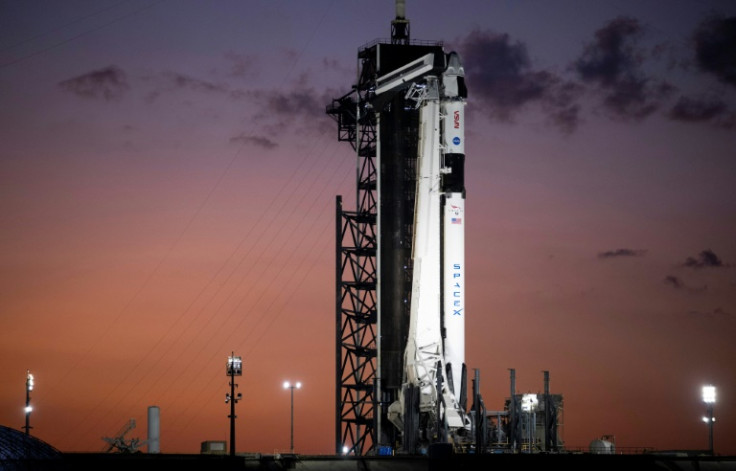
A discarded piece of a SpaceX rocket is expected to crash into the moon at a speed of 5,400 mph on Wednesday, creating a debris plume large enough that it might be visible from Earth with a telescope.
WIRED reported that a discarded piece of the SpaceX Falcon 9 is expected to hit the moon at around 12:34 CST on August 5. The website reported that if the impact occurs, it will make history as the first impact flash ever recorded on the sunlit face of the moon.
"It's like an empty eggshell, because it had all the fuel in it, and there is a rocket engine at one end that's denser," David Goldstein, an aerospace engineering professor at UT Austin, told WIRED.
The Associated Press reported that the Falcon 9 rocket carried two lunar landers as well as scientific instruments to the moon in January 2025. The upper stage of the rocket was not supposed to hit the moon after being discharged.
Although the initial flash will be difficult to see even with a telescope, scientists said it might be possible to see the plume the impact creates.
"The gravity on the moon is low and there is no wind to blow the dust away," Los Alamos National Laboratory's Benjamin Fernando told the AP.
"Part of the reason for our interest in this event is to figure out how much of a hazard debris impacts pose to future astronauts."
The impact is expected to happen near the Einstein Crater, creating a crater 90 feet across and 16 feet deep, Fernando told the AP.
The AP reported that scientists are not overly concerned about the impact, but the crash does highlight the increasing amount of debris floating around in space.
"Things are getting crowded up there," space tracking expert Bill Gray Gray told the AP.
On his website, Gray writes that although there is not much to worry about regarding this specific object, space debris is a growing concern.
"Junk can collide with junk, and with active spacecraft. The International Space Station has had to maneuver a few dozen times to avoid collisions. Obviously, the more junk you have, the more likely such collisions become, and the product of a collision can be still more smaller bits of junk," Gray said.
"The worst-case scenario would be the Kessler effect : we have enough junk in orbit so that a few collisions generate shrapnel that causes more collisions, generating still more shrapnel until just about everything is colliding. The current consensus seems to be that we aren't terribly close to that yet, but it's a reasonable concern as the amount of junk grows," he wrote.
© Copyright IBTimes 2026. All rights reserved.
- Recommended For You