Millions of Americans Report Feeling Trapped In Their Jobs. They Don’t Leave Because They Need The Health Insurance
A study found that 24 percent of American workers reported "job lock."


Millions of Americans say they are trapped in jobs because they are afraid of losing their health insurance, according to a new poll.
A study from the West Health-Gallup Center on Healthcare in America found that 24 percent of American workers, or about 23 million people, reported "job lock."
"Job lock is on the rise amid broader healthcare affordability challenges. About half of Americans report difficulty consistently paying for needed medical care or prescriptions, and 51% say they are worried about their ability to afford healthcare over the next 12 months, the highest level in five years," the study found.
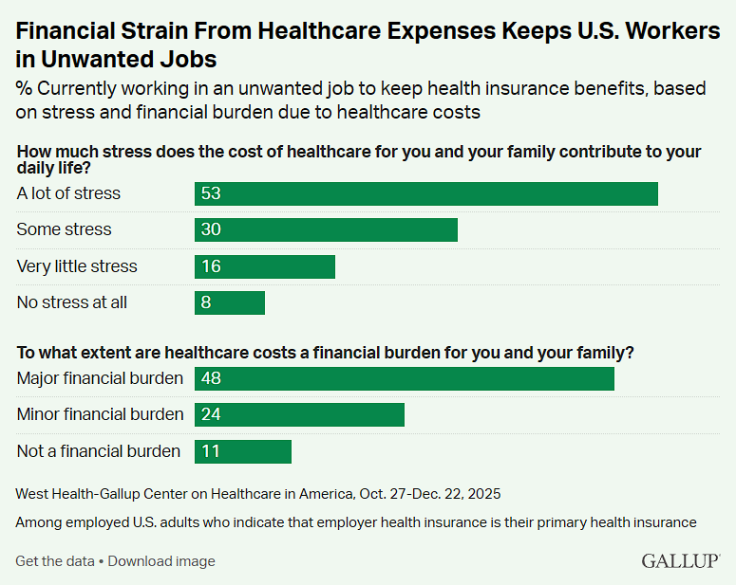
The study was conducted online and via mail from Oct. 27 to Dec. 22, 2025, with 5,660 U.S. adults. The analysis focused specifically on a subset of 2,322 respondents who are employed and rely on employer-sponsored health insurance.
It found that workers with financial strain tied to healthcare expenses are much more likely to report feeling like they are stuck in a job for the primary purpose of keeping health insurance benefits.
"Among those who report personal or household medical debt, 44 percent say they are staying in an unwanted job for insurance." For those who say that healthcare expenses are a major financial burden, the figure rises to 48 percent.
The rates of job lock appear to be higher for lower-income workers. According to the study, "rates of job lock peak at 27% among those in households earning $48,000 to less than $90,000 a year and tend to be lower among those earning higher incomes."
Unsurprisingly, workers who had chronic medical conditions, such as high blood pressure or high cholesterol, were more likely to report job lock. Of those with chronic conditions, 29 percent reported the situation. By comparison, only 17 percent of those without a chronic condition did so.
In fact, if a person reported having three or more diagnoses, the job lock percentage jumped up to 41 percent.
"The link between chronic disease burden and job lock is especially pronounced among individuals with conditions that often require ongoing or intensive care, including asthma (29 percent) and immune-compromising conditions (36 percent). This pattern also extends to mental health conditions, with 35 percent of individuals with depression and 33 percent of those with anxiety reporting similar experiences," the study found.
Women were more likely than men to report job lock as well. Of those surveyed, 30 percent of women compared to 20 percent of men reported job lock. "Compared with men, women are also more likely to report experiencing financial stress due to healthcare expenses," the study found.
© Copyright IBTimes 2026. All rights reserved.
- Recommended For You