

New Economic Gateways: How Capital Is Redrawing Asia’s Urban Map
As foreign capital shifts toward Southeast Asia, integrated urban ecosystems are emerging as a new gateway for investment, talent and economic growth.
Global foreign direct investment climbed back in 2025, and developing Asia captured roughly 40% of that total, around $644 billion, according to the UN Trade and Development's (UNCTAD) World Investment Report 2026.
The shift in destination is also notable, with Southeast Asia overtaking East Asia as the region's largest recipient subregion for the first time, while capital broadened out from a handful of established hubs into a wider set of markets across South and Central Asia as well.
Asia's Magnetism for Capital Enters a New Phase
That reallocation is not random. UNCTAD's report points to a 'new investment landscape' taking shape as multinationals rewire supply chains, hedge geopolitical risk, and chase sectors tied to semiconductors, digital infrastructure, artificial intelligence and energy transition.
The ASEAN Investment Report 2025, published jointly by the ASEAN Secretariat and UNCTAD, adds a regional lens: inflows into Cambodia, Singapore and Vietnam all reached record levels, and intra-ASEAN investment flows rose 45% year-on-year, evidence that Southeast Asia is increasingly investing in itself as much as attracting outside capital.
Vietnam sits near the center of that story. Foreign investors committed and disbursed capital into the country at a pace that outstripped much of the region through 2024 and into 2025, drawing on inflows from Singapore, Japan, South Korea, Hong Kong and China.
But the more instructive detail for investors is qualitative rather than quantitative. Capital is no longer flowing simply toward factories and export processing zones. It is increasingly connected to livability, toward cities and townships that can house a workforce, educate its children, treat its patients and entertain its visitors, all inside a single integrated urban development.
The Rise of the All-in-One Gateway
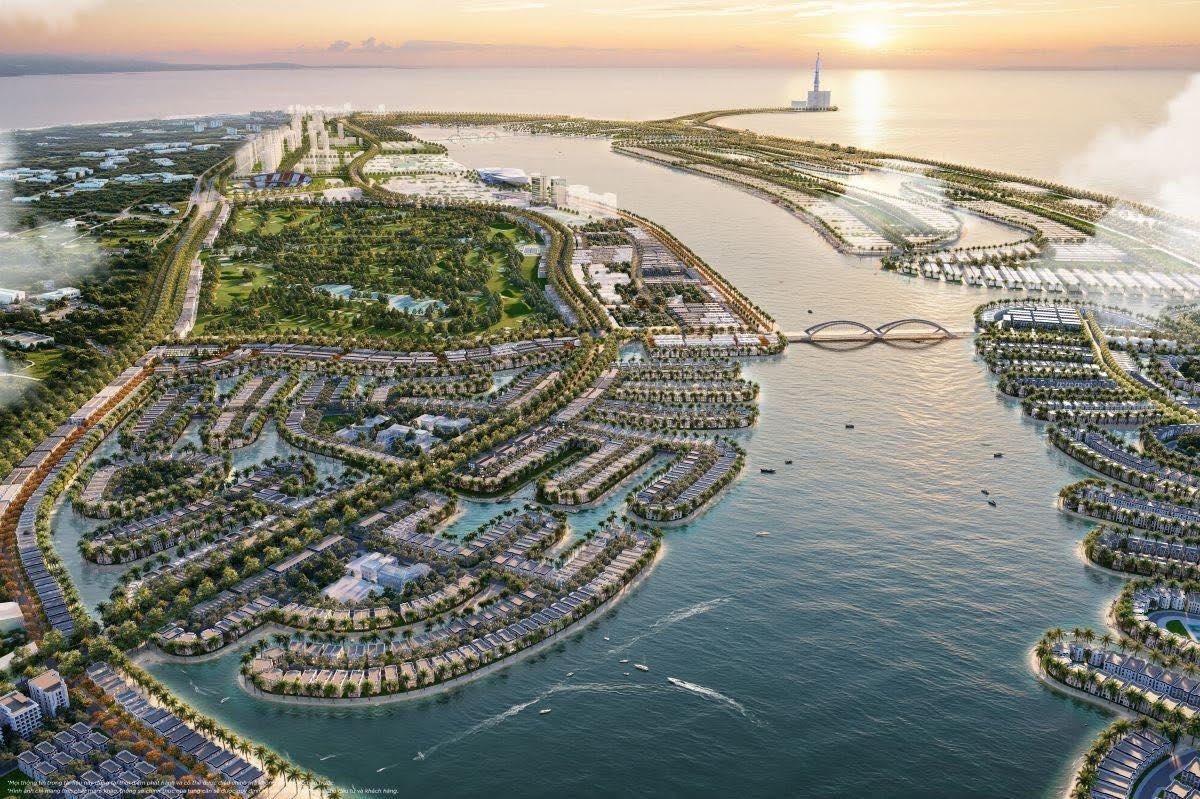
This is where Vietnam's large-scale urban developers have entered the conversation. Vinhomes, the residential and township arm of Vingroup, has spent the past year expanding a portfolio of what it calls 'mega-urban areas', integrated townships that bundle housing with commercial space, healthcare, education, green infrastructure and transport links inside a single master plan.
In 2025 alone, the company launched sales across four large-scale projects: Vinhomes Golden City, Vinhomes Wonder City, Vinhomes Green City and Vinhomes Green Paradise, a pace of simultaneous rollout that reflects both the depth of its land bank and its ability to manage capital flows across multiple sites at once.
The commercial logic behind that model is increasingly what economists mean when they talk about a 'new economic gateway', not simply a port or a free-trade zone, but a self-contained urban node attractive enough to draw foreign visitors, residents and investors on lifestyle terms as much as industrial ones.
At Vinhomes Royal Island, events such as the K-Food Fair and the Light Up The Dream Music Night drew hundreds of thousands of visitors over the year, turning the township into both a retail draw and a proof point for the commercial vitality developers need to justify further investment in on-site infrastructure.
The company's digital platform, Vinhomes Market, gives a sense of the scale of that ecosystem: roughly 7,000 average daily visits, more than 200,000 a month and 1.6 million account sign-ups over the year, supported by 91 active sales agent accounts, with the platform now expanding from primary sales into secondary-market transactions to improve liquidity for owners.
Vinhomes has also started testing the model beyond Vietnam's borders, with early-stage studies and groundwork for integrated township projects in markets including the Democratic Republic of Congo, India and Uzbekistan, an indication that the same 'gateway' template, combining housing, commerce, healthcare and education under unified planning, is being positioned as an exportable urban development product.
None of this changes the underlying macro picture: capital concentration remains high, with the ten largest developing-economy recipients, eight of them in Asia, still absorbing the bulk of global flows, per UNCTAD. But it does suggest a narrowing of the gap between where foreign capital lands and where people actually choose to live, work and spend.
As Asia's economic gateways evolve from ports and industrial parks into fully built urban ecosystems, developers capable of delivering that livability at scale, Vinhomes among them, are positioning themselves at the intersection of two trends investors are watching closely: Where the money is going, and where the people are following it.
© Copyright IBTimes 2026. All rights reserved.