

Silicon Valley Is Building Armed Robots For The Battlefield. Washington Is Clearing The Way For Their Use
The Pentagon is reviewing policies governing autonomous weapons as technology companies push for a greater role in military applications.

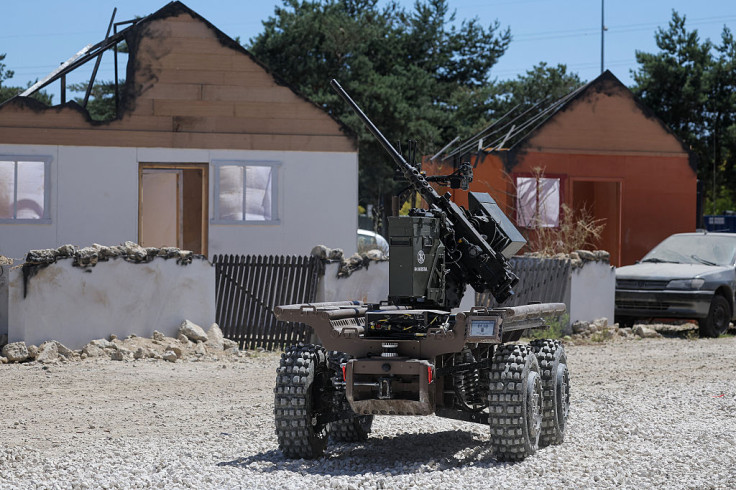
The use of autonomous weapons has moved from the realm of science fiction to active policy discussions in Washington, with technology companies and defense officials increasingly examining how robots and artificial intelligence could be deployed on battlefields in the future.
Several startups backed by Silicon Valley investors are now developing robotic systems designed for military applications while the Trump administration has directed the Pentagon to revisit its policies governing AI-enabled weapons.
Among the companies at the center of the debate is Foundation, a San Francisco-based startup launched in 2024 by entrepreneur Sankaet Pathak. In May, the company released footage of its Phantom MK1 humanoid robot loading a mortar, with Pathak arguing that autonomous systems could improve battlefield precision and help protect civilians and military personnel, according to The Washington Post.
Pathak told The Washington Post that countries such as China and Russia are continuing to advance military technologies and that the United States cannot assume other nations will adopt similar restrictions on armed robotics. Foundation says it currently holds a $24 million Pentagon contract and has tested robotic systems in Ukraine.
The discussion around autonomous weapons has gained urgency in recent months following the use of AI-assisted military technologies during the conflict involving the United States and Iran. U.S. officials have highlighted how AI tools helped accelerate targeting and operational planning, while missile defense systems already rely heavily on automation to intercept incoming threats.
The next stage under consideration involves systems that would initially be activated by human operators but could independently identify and engage targets within predefined parameters. The Defense Department is currently reviewing its policies on such systems after President Donald Trump signed a national security memorandum directing officials to account for advances in AI capabilities.
The Senate is also considering legislation that would encourage greater adoption of autonomous military systems while maintaining human oversight of the use of force. The current version of the National Defense Authorization Act directs the Pentagon to "maximize" the use of AI and autonomous technologies while ensuring that commanders retain responsibility for lethal decisions.
The debate extends well beyond the United States. Governments have spent more than a decade discussing potential international rules governing autonomous weapons through the United Nations Convention on Certain Conventional Weapons. Earlier this month, U.N. Secretary-General António Guterres called for a legally binding treaty prohibiting systems capable of making life-and-death decisions without meaningful human control, according to Reuters.
"Some decisions must remain forever human," Guterres said during remarks in Geneva cited by The Washington Post. Pope Leo XIV has similarly voiced concerns over autonomous weapons and their implications for international humanitarian law.
The issue has also created divisions within the technology industry. Anthropic CEO Dario Amodei reportedly sought assurances from the Pentagon this spring that the company's Claude model would not be used to power fully autonomous weapons, citing concerns over reliability. OpenAI has stated that it prohibits the use of its systems in applications involving force without appropriate levels of human authorization, according to OpenAI's published usage principles.
The Pentagon already deploys highly automated defensive systems, including the Close-In Weapon System (CIWS), which is designed to intercept incoming missiles. Defense experts note that automation has long been part of military operations, although fully autonomous offensive systems remain significantly more controversial.
Michael Horowitz, a former defense official during the Biden administration, told The Washington Post that human accountability remains central to existing Pentagon policy, even as military technologies continue to evolve.
Others remain unconvinced. Ryan Gariepy, co-founder of Canada's Clearpath Robotics, has advocated against autonomous weapons for more than a decade, arguing that robotics systems continue to fail in unexpected ways and should not be entrusted with life-and-death decisions.
© Copyright IBTimes 2026. All rights reserved.