

Somali Pirates Have Returned To The Seas. A Turkish Vessel Was Seized This Week.
As the Iran war continues to catch the attention of U.S. military assets, piracy in the Red Sea and the Gulf of Aden is again on the rise.

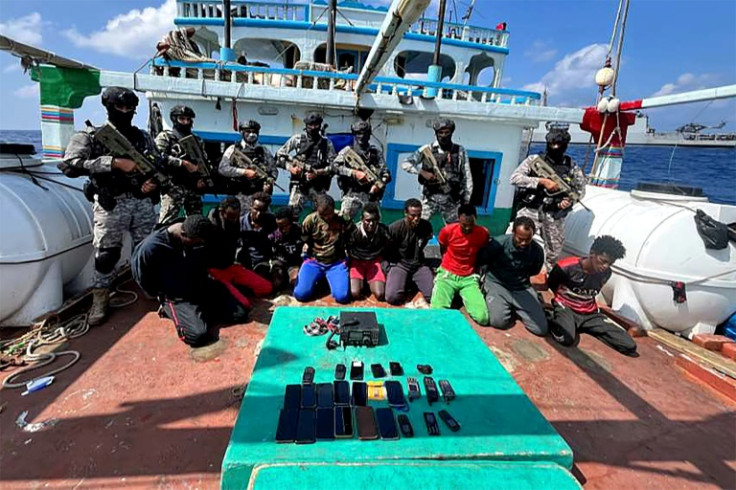
As the Iran war continues to get the attention of U.S. military assets, piracy in the Red Sea and the Gulf of Aden is again on the rise.
CNBC reported that the issue of Somali pirates peaked in 2010, with the threat receding thereafter thanks in large part to efforts by the U.S. Navy. Now, pirates are making a comeback while U.S. forces are focused on the continuing war with Iran.
"The piracy issue is definitely adding to acute uncertainty and making those who have already decided to avoid the Red Sea stay firm in their decision," Ian Ralby, CEO of I.R. Consilium, a maritime and resource security firm, and a maritime law and security expert, told the outlet.
ABC News reported that this week a Turkish vessel, the M/V LUTUF, was seized by pirates. The network reported that the ship carried weapons and was headed for a Turkish military training facility.
According to Windward, an organization that tracks maritime piracy, activity began to increase in April. According to Windward, between April and May there were six maritime security incidents involving Somali pirates and four confirmed hijackings.
Three of the four hijacked vessels from the spring remained under pirate control as of mid-May. The website reported that ransom demands by the pirates for one of the vessels was $10 million.
The organization stated that the uptick in activity was "unprecedented" in the post-suppression era. Somali piracy peaked between 2009 and 2011, with more than 230 attacks. However, by 2013, no commercial vessel was successfully hijacked off Somalia, and by 2017 the threat "was reduced to occasional flashes," the website states.
Things improved so much that in January 2023 the International Maritime Bureau formally lifted the Indian Ocean High Risk Area designation. However, starting in April of this year, the relative safety of the region again came into question. And, according to experts, the worst might yet be to come.
"If the Al-Shabaab and the Houthis formalize a relationship where they take control of the Red Sea, the Bab-el Mandeb, and the Gulf of Aden, and have the Somali pirates be a part of that militant organization, it would fundamentally change the dynamic in the region," Corey Ranslem, CEO at Dryad Global, a global maritime cybersecurity and risk intelligence firm, told CNBC. "It could mean Houthi technology, including missiles, drones, and drone capabilities, becomes available to the Somali pirates, and then risks grow disproportionately."
© Copyright IBTimes 2026. All rights reserved.