Google’s cloud-based Chromebook comes with a lot of promises as it has started to ship, but the Chrome OS vision leaves a lot to be desired in reality.
IBT Staff Reporter
Jun 20, 2011
A hungry black hole far out in the cosmos, about 4 billion miles from Earth, got into an unusual feeding spree when a massive Sun-like star crossed its path, or to be accurate, passed by its gravitational sphere. The massive star was ripped apart, shredded into pieces as the giant black hole devoured it, unleashing some of the most powerful gamma ray flashes astronomers have ever seen. For the black hole,
Jijo Jacob
Jun 18, 2011
An exciting discovery by ESA's Herschel Space Observatory reveals a young sun-like star shooting jets of water into space at a speed of 124,000 miles per hour.
Monami Thakur
Jun 18, 2011
The lunar eclipse on June 15 put all skygazers on awe and wonder as they have witnessed an event of their lifetime.
Manikandan Raman
Jun 16, 2011
Skygazers on June 15 were treated with an event of their lifetime, In what, astronomers term as a spectacular show, the white moon turned blood red as the longest lunar eclipse in a decade unfolded Wednesday night.
Manikandan Raman
Jun 16, 2011
The sun may be heading for a rest period as the sunspot cycle seems to be fading and entering towards its maximum, and there are indications of weakening magnetic activity near the poles.
Manikandan Raman
Jun 16, 2011
On June 15, 2011, the earth witnessed the longest lunar eclipse in history in which the white light of the moon turned to blood red.
Manikandan Raman
Jun 16, 2011
Scientists are forecasting a prolonged period of lull in sunspot activity.
Hao Li
Jun 15, 2011
The weakening activity and fading sunspots in the sun and the activated volcanoes suggest that history truly repeats itself - the Little Ice Age is coming back.
IBT Staff Reporter
Jun 15, 2011
Studies announced at the American Astronomical Society suggested that solar activity will enter into a prolonged period of lull. The big question is this: will it lead to lower temperatures, similar to Europe’s Little Ice Age from 1550 to 1850?
Hao Li
Jun 15, 2011
Today, all across the Eastern (and parts of the Western) Hemisphere, sky gazers will be treated to a rare and beautiful sight, a total lunar eclipse.
IBT Staff Reporter
Jun 15, 2011
The first total lunar eclipse in 2011 will take place on Wednesday, which is one of the longest eclipses of the moon and will last just over 100 minutes, the duration of which rivals only three other eclipses in the last 100 years.
Satya Nagendra Padala
Jun 15, 2011
New data released Tuesday at the annual meeting of the solar physics division of the American Astronomical Society in Las Cruces, New Mexico, may suggest that we are headed towards a solar event that hasn’t happened in hundreds of years.
IBT Staff Reporter
Jun 14, 2011
NASA has released a new image and scientific findings from the first spacecraft to orbit Mercury, the innermost and smallest planet in the Solar System.
Manikandan Raman
Jun 13, 2011
The biggest solar flare in four years is moving towards Earth at a rate of at 1400 km/s and is expected to reach early June 9.
Manikandan Raman
Jun 09, 2011
The strongest solar flare seen in five years erupted from the Sun on early Tuesday, and is heading towards the Earth which could cause radio, satellite interference and auroral displays on Thursday.
Balasubramanyam Seshan
Jun 09, 2011
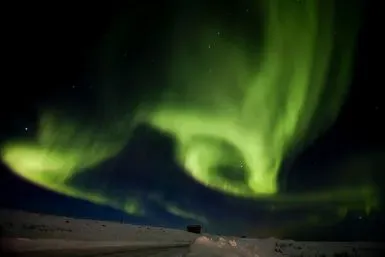
New Yorkers may or may not get to see the Northern Lights in the Big Apple's skies tonight or tomorrow night, but the solar flare that is increasing auroral activity has already produced some breathtaking images, as this video shows.
IBT Staff Reporter
Jun 08, 2011
The biggest solar flare in four years erupted from the sun on Tuesday and is heading towards Earth in an event that could disrupt power grids and satellites.
IBT Staff Reporter
Jun 08, 2011
Because the Sun experienced the biggest solar flare in four years yesterday, New Yorkers may get to see the Northern Lights tonight or, possibly, tomorrow night.
IBT Staff Reporter
Jun 08, 2011
A solar flare that erupted on Tuesday in the Sun is heading towards the Earth and could disrupt power grids and satellites. The flare, which is backed by a small radiation storm and a spectacular coronal mass ejection (CME), might stimulate auroras on Thursday.
Balasubramanyam Seshan
Jun 08, 2011
High-latitude sky watchers should be on alert for auroras on Wednesday and Thursday evenings, when coronal mass ejection (CME) from solar flare observed on Tuesday glance at Earth's magnetic field, NASA said in a statement.
Sanskrity Sinha
Jun 08, 2011
The sun unleashed an unusual solar flare on early Tuesday, a small radiation storm and a spectacular coronal mass ejection (CME) from a sunspot complex on the solar surface. The flare peaked at 1:41 a.m. ET, according to NASA’s Solar Dynamics Observatory (SDO).
Satya Nagendra Padala
Jun 08, 2011


![Lunar Eclipse on June 15: the most beautiful and historical blood moon stars worldwide [PHOTOS]](https://d.ibtimes.com/en/full/33839/lunar-eclipse-june-15-most-beautiful-historical-blood-moon-stars-worldwide-photos.webp?w=385&h=257&f=a94fd0e6c54c28099e793aa6b7a61937)
![Lunar Eclipse on June 15: the most beautiful and historical blood moon stars worldwide [PHOTOS]](https://d.ibtimes.com/en/full/33837/lunar-eclipse-june-15-most-beautiful-historical-blood-moon-stars-worldwide-photos.webp?w=385&h=257&f=160b091b8dde6616217ffea985989f44)