

Trump Says Cheaper Brazilian and Argentine Beef Is Coming Under 90‑Day US Tariff Pause to Cut Prices
President Trump defends beef tariff pause amid scrutiny over Brazilian billionaire's involvement and industry pushback
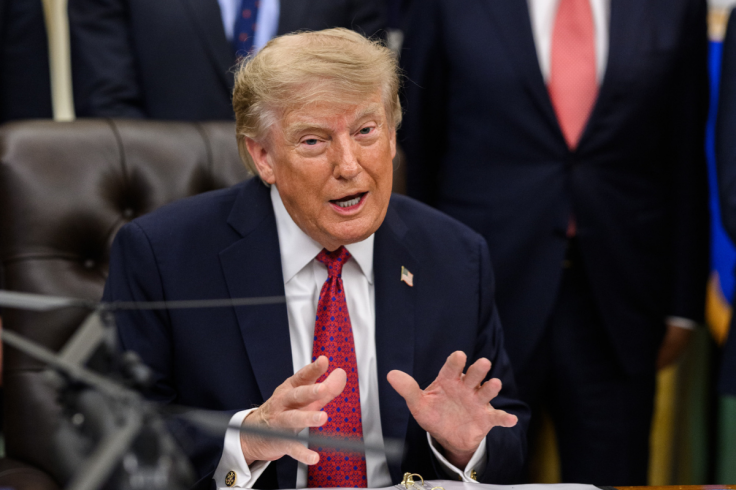
President Donald Trump said on Friday that beef is coming under his administration's beef tariff pause is coming primarily from Argentina and Brazil, part of a push to bring down grocery prices that have stayed stubbornly high all year.
Speaking at an Oval Office event in Washington, surrounded by ranchers and farmers, Trump said inspectors were already on the ground overseas checking the product. 'It's coming from Argentina. It's coming from Brazil,' he said. 'It's coming from a couple of other places. We have our inspectors down. It's very clean. It's very good.'
Trump announced in August that, for 90 days, the US would allow an additional 300,000 metric tonnes of lean beef trimmings to enter at the lower in-quota tariff rate.
The measure encourages the imported beef to be sold at a 25 per cent discount from the prevailing import price. He framed the move as a way to ease costs for shoppers while giving American ranchers room to rebuild their herds after years of tight supply.
The plan drew immediate pushback from cattle industry groups and Republican lawmakers, who argued that cheaper groceries should not come at ranchers' expense.
Beef Tariff Pause Draws Fresh Scrutiny Over Brazilian Billionaire's Role
The beef tariff pause has faced scrutiny following a Wall Street Journal report that Trump met with Joesley Batista, who shares control of JBS, the world's largest meatpacker, the day before the announcement.
The report said that Batista lobbied Trump to drop the 26.4 per cent import tax as a way to ease rising beef prices. The report does not establish that the meeting determined the administration's decision.
In 2020, US authorities announced Foreign Corrupt Practices Act penalties involving the Joesley and Wesley Batista, J&F and JBS, arising from a bribery scheme linked to the company's US expansion. The SEC penalised the brothers and JBS, while J&F separately pleaded guilty to an FCPA conspiracy charge brought by the Justice Department.
Trump did not directly address the Batista meeting on Friday, but he defended the scale of the import pause. 'We're doing it in a very limited fashion because our ranchers can handle it, but our ranchers really needed a little bit of help, and our ranchers want the prices to be down too,' he said.
The tariff pause also comes after a recall of nearly 30,000 pounds of Argentine beef distributed in Texas and Florida because it entered without the required import reinspection, a separate episode occurring just as the administration leans into imported meat.
What the Two New Executive Orders Actually Do
Trump signed two executive orders at the Resolute Desk on Friday.
One directs federal agencies to make it easier for ranchers and farmers to butcher, process, package and sell their own products directly, cutting out a step that has long frustrated smaller operations. The other instructs agencies to review country‑of‑origin labelling for foreign beef and to consider steps to remove grey wolf protections, among other provisions.
Neither order rewrites law on its own. Agencies now have to study the changes and, in the labelling case, Congress still has to act.
Asked about a timeline for mandatory labelling, Trump said the ball is already rolling. 'We're putting it in front of Congress right away,' he said. 'It should be no problem.'
That confidence may be tested. Country‑of‑origin labelling for meat was mandatory once before, until Congress repealed it in 2015 after a World Trade Organisation panel found it discriminated against Canadian and Mexican beef.
Trump also took aim at what he called the four-company monopoly in US beef processing. The four largest processors are Tyson Foods, JBS S.A., Cargill and National Beef Packing Co.
'I've heard all about it. I've been listening to it, and they say they're a very nasty group, very difficult to deal with,' he said. 'And they cost our farmers a lot of money, and they cost our ranchers a lot of money, and they cost the public a lot of money and grief, and we're not going to let it happen any longer.'
For an administration that campaigned hard on rural support, threading the needle between cheaper beef and happy ranchers is proving messier than a single Oval Office signing can fix. Whether any shipments from Argentina and Brazil actually move the needle at the meat counter is something shoppers, not press events, will end up deciding.
Originally published on IBTimes UK
This article is copyrighted by IBTimes.co.uk, the business news leader