

The U.S. Is Doubling Down On Economic Economic Pressure Against Iran. Its Currency Just Hit a New Low.
A U.S. dollar is now worth more than 2 million rials.

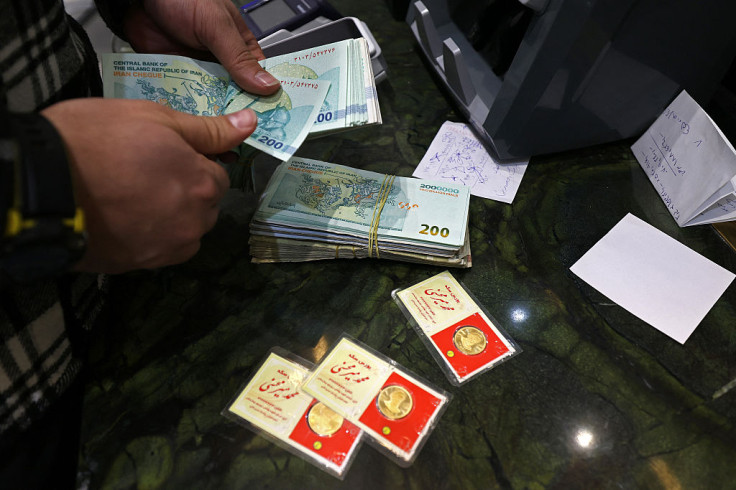
The Iranian rial hit a new low on Monday as the U.S. doubles down on economic pressure against the country.
The Associated Press detailed that the rial dropped to 2.02 million to the U.S. dollar on Monday on currency markets. The country's central bank stood at about 1.5 million, but the outlet noted that most people pay the market rate.
Economic malaise was already causing unrest in Iran even before the U.S. and Israel attacked the country in late February. In fact, it had led to massive protests that the regime repressed violently, with unofficial figures claiming that tens of thousands of people were killed in a matter of days.
The U.S. said on Monday it is unleashing an "economic D-Day" against Tehran, calling it the "greatest financial offensive ever marshaled against an adversary."
"The Islamic Republic has subsisted by dressing extortion as security guarantees. It has drawn strength from a calculus that regards Iranian retaliation as certain and American enforcement as negotiable. Under President Trump, that era is over. And those who fear the danger of defying Tehran ought not to discount the cost of testing Washington," Bessent claimed in a social media post.
Iranian officials appeared to acknowledge the impact of the ongoing economic pressure, which includes a naval blockade of the country's ports. Parliament speaker Mohammad Bagher Qalibaf said last week that "no matter how much military power we have, if people are hungry and we don't have financial circulation, economic growth and domestic production, we will not endure."
He went on to say that economic stability and security are inseparable. "If we establish security but do not sustain it through the economy, it will not last," he added, also accusing the U.S. and Israel of conducting what he described as "cognitive" warfare.
In the same line, Iranian President Masoud Pezeshkian called for an end to the war, saying the country should pursue the goal while on top. "It is better to end the war today, when we are powerful and respected and the whole world acknowledges our victory," he said.
However, on Monday Iran warned neighboring countries against joining the economic measures. Top Iranian commander Mohsen Rezaei, who recently became the new secretary of Iran's Supreme National Security Council, said any country "that becomes a partner in creating economic restrictions against us will be regarded by us as an enemy."
Elsewhere, Iran's state-controlled Persian Gulf Strait Authority said vessels warning its transit rules through the Strait of Hormuz could face "fines, seizure, or confiscation" in the future.
© Copyright IBTimes 2026. All rights reserved.