

NYU’s Nouriel ‘Dr. Doom’ Roubini: Social Unrest Will Spread
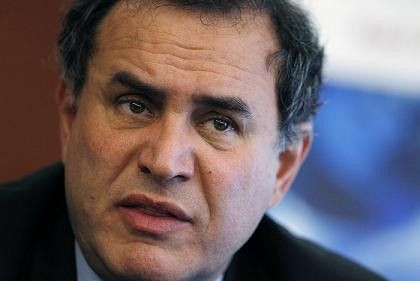
The popular demonstrations and social unrest seen in the Arab World, in Israel, in Greece and most recently, in the United Kingdom, will not end there -- soon enough, they will hit other advanced economies and emerging markets, so says economist Nouriel Dr. Doom Roubini.
Roubini, the New York University professor who four years ago accurately predicted the global financial crisis, said the current global economic system -- capitalism -- will remain in a crisis --- a crisis economist Karl Marx predicted more than a century ago -- until major systemic reforms are implemented.
Roubini said social unrest and demonstrations are all being driven by the same thing, a crisis period for capitalism -- the economic system's most serious crisis since the Great Depression of the 1930s -- one that stems from globalization, financial intermediation run amok, and a destructive redistribution of income and wealth from labor to capital.
All of the nations that have seen social unrest and demonstrations are all driven by the same issues and tensions: growing inequality, poverty, unemployment, and hopelessness. Even the world's middle classes are feeling the squeeze of falling incomes and opportunities, Roubini said.
Are Capitalists Weakening Capitalism?
So Karl Marx, it seems, was partly right in arguing that globalization, financial intermediation run amok, and redistribution of income and wealth from labor to capital could lead capitalism to self-destruct (though his view that socialism would be better has proven wrong), Roubini wrote on economomonitor.com. Firms are cutting jobs because there is not enough final demand. But cutting jobs reduces labor income, increases inequality and reduces final demand.
In other words, one of economist Karl Marx's critiques of capitalism is playing itself out in the global financial crisis.
Marx, among other postulates, argued that capitalism had an internal contradiction that would cyclically lead to crises, and that, at minimum, would place pressure on the economic system.
Companies, Roubini said, are motivated to minimize costs, to save and stockpile cash, but this leads to less money in the hands of employees, which means they have less money to spend and flow back to companies.
Now, in the current financial crisis, consumers, in addition to having less money to spend due to the above, are also motivated to minimize costs, to save and stockpile cash, and pay-down debt -- magnifying the effect of less money flowing back to companies.
No Easy Fixes to End Financial Crisis
Further, Roubini said there are no quick and simply or easy fixes to the current crisis. Officials have tried them all, and they have run out of rabbits to pull out of their hat.
Regarding fiscal policy, Roubini said that although there is a clear need for large fiscal stimulus short-term, national governments are in austerity mode -- which means fiscal policy will be a drag on economic growth.
Concerning another round of bank bailouts, Roubini said it is politically unacceptable and economically unfeasible: most governments, especially in Europe, are so distressed that bailouts are unaffordable.
Regarding monetary policy, that won't help much either, Roubini said. The U.S. Federal Reserve's quantitative easing (QE and QR2) is constrained by above-target inflation, and currency depreciation is not an effective strategy, if all key nations pursue it at the same time. One nation can not reap the benefits of a currency depreciation, if its competitor nations do the same thing -- no export advantage on price is gained.
Also, the euro-zone's new financial system back-stop, the new European Financial Stabilization Facility (EFSF) is €440 billion or $627 billion and could be depleted by the end of 2011 or in early 2012, he said. Unless the fund is tripled -- Germany will likely oppose this -- the only option left would be an orderly but coercive restructuring of Italy's and Spain's debt, as was the case with Greece, Roubini said. Coercive restructuring of insolvent banks' unsecured debt would be next, which means the process of deleveraging has barely started, if countries cannot grow, or save, or inflate themselves out of their debt problems.
To Fix Capitalism - Need Balance Between Free Market and Public Goods
Against that sobering backdrop, Roubini added that policy solutions are available to end the crisis, but don't misunderstand: the solutions do not involve simply companies hiring a few more employees, or one country or two, like the United States, lowering its tax on capital gains, or lowering income tax rates.
Countries, Roubini said, need to return to the right balance between markets and provision of public goods. That means moving away from both the Anglo-Saxon model of laissez-faire and voodoo economics and the continental European model of deficit-driven welfare states. Both are broken.
The right balance requires:
1) creating jobs partly through additional fiscal stimulus aimed at productive infrastructure investment
2) more-progressive taxation; more short-term fiscal stimulus with medium- and long-term fiscal discipline
3) lender-of-last-resort support by monetary authorities to prevent ruinous runs on banks
4) reduction of the debt burden for insolvent households and other distressed economic agents
5) stricter supervision and regulation of a financial system run amok and
6) breaking up too-big-to-fail banks and oligopolistic trusts.
In addition, long-term, advanced economies will need to invest in human capital, skills, and social safety nets to increase productivity and enable workers to compete, be flexible, and thrive in a globalized economy, Roubini said.
The alternative is -- like in the 1930s -- unending stagnation, depression, currency and trade wars, capital controls, financial crisis, sovereign insolvencies, and massive social and political instability, Roubini said.
Public Policy/Economic Analysis: Roubini is not saying that socialism is better than capitalism: capitalism has registered a better performance.
But understand what Roubini is saying: the free market, alone, is not going to end the global financial crisis.
What's more, short-term, conditions are going to get worse, and popular demonstrations / social unrest are soon enough going to appear in other advanced economies and emerging markets. Further, absent a return to the right balance between markets and public goods, conditions are likely to get substantially worse.
Also understand what statement the above analysis makes on the ideas and policy recommendations forwarded by the very-conservative Tea Party faction in the United States, which is currently dominating the Republican Party and which nearly paralyzed U.S. Government operations, not once, but twice. The Tea Party's belief that the free market is perfect, self-correcting, self-regulating, and capable of addressing all human needs and social concerns is deeply flawed and will not only not end the financial crisis -- it will make it worse.
The Tea Party, and other conservatives are, by-and-large, in addition to their opposition to more, short-term fiscal stimulus, also opposed to vital investments in human capital, skills, and the social safety net to increase productivity that enable workers to compete, be flexible, and thrive in a global economy.
By extension, the stance of the Tea Party, a major stakeholder in the current economic system, has to change, if its goal is to continue the current economic system.
Finally, the view from here argues that while no one should expect an imminent collapse of capitalism, or even the American version, corporate capitalism -- capitalism and the free market are much too nimble and capable of adapting for that -- to say that the current economic order is not experiencing a crisis would not be accurate.
© Copyright IBTimes 2026. All rights reserved.