

Occupy Wall Street Protest: ‘Lost Generation’ Still Lost?
Opinion
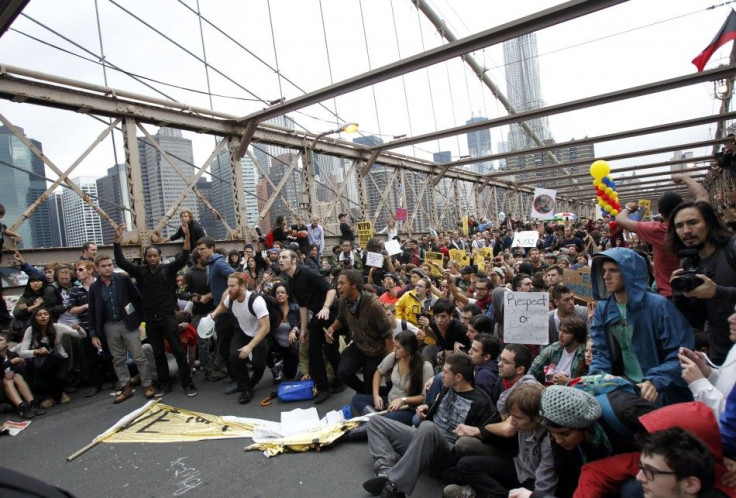
Critics of the Occupy Wall Street protests aren't condemning the group for organizing. Rather, they are criticizing protestors for not knowing exactly what they are organizing for.
Many believe that the protestors are conducting a haphazard petition for change. Messages run the gamut from ending capitalism, to global warming, to racism. Many don't believe they have a coherent plan of action.
Protestors have been told to chant one declaration. They have been told to wear a polo and khakis so as to connect more with those who're watching them.
Despite all of this, the Occupy Wall Street protest is gaining traction and spreading far past the geographical perimeters of Wall Street itself. Protests have popped up in San Francisco, South Carolina, Boston, and Chicago. Even Canadians are answering the call. Organizers from a group called Occupy Toronto plan to descend on the city's financial district at 10 a.m. on Oct 15.
How's it possible that this group of haphazard misfits is growing and becoming more powerful? If you listen closely enough there's a similar battle cry amongst them. This is the cry of the Lost Generation.
Take Rosemary O'Neil, a 2011 graduate who graduted summa cum laude from Fairfield University with a B.A. in English. I think the unemployment rate is very discouraging for my generation... I know a lot of people who had big dreams who have had to settle for temp jobs, part time jobs, and those who have been searching for over a year after they graduated, she told IBTimes.
When O'Neil first saw the Occupy Wall Street protest she laughed. Now, she is giving them a second glance; and even considering joining the pack one day herself.
The unemployed youth is the power behind this movement. Joblessness is a persistent theme.
When 700 people were arrested Saturday on the Brooklyn Bridge, Erin Larkins was there. Larkins, a Columbia University graduate student at who says she and her boyfriend have significant student loan debt, told The Associated Press that a friend persuaded her to join the march and she's glad she did.
I don't think we're asking for much, just to wake up every morning not worrying whether we can pay the rent, or whether our next meal will be rice and beans again. No one is expecting immediate change. I think everyone is just hopeful that people will wake up a bit and realize that the more we speak up, the more the people that do have the authority to make changes in this world listen, she wrote in an e-mail.
The Lost Generation was a term coined by Ernest Hemingway (who intially heard the remark from Gertrude Stein) referring to the generation whose youth coincided with the opening of the twentieth century and their lives were the bifurcated by WWI.
Lives became divided into before, during, and after categories. Their individual worlds were collectively defined by specific dates. The same can be said for the Lost Generation of the twenty-first century - their lives before, during, and after the recession.
Recent federal statistics point to more than 50 percent of college students under the age of 25 being unemployed or working jobs that don't require a college degree. On Friday, the September job statistics will be released and this number will be brought up to date.
Youth unemployment leads to the likelihood of scarring. Being out of the labor force for an extended period of time means that individuals don't get the necessary entry level experience during that pivotal post-graduation timeframe. Thus, they become scarred.
And youth unemployment is at an all-time high around the globe. America's rate is at 18.4 percent. That figure is even higher in countries such as the UK with 19.1 percent, France with 22.5 percent, Hungary with 26.6 percent, and Spain with 41.6 percent.
Skills aren't utilized; motivation falters; and once a job is secured there's the potential of being looked down upon by fellow employees because of being unemployed. This damage is said to last 15 years or more.
The graduating class of 2011 is the most indebted group of graduates ever, with an average debt of $22,900 each.
As youth unemployment persists, the likelihood of deepening economic crises increases.
And so they march. They march on Wall Street, and across the Brooklyn Bridge. The march in the South and in the West. They march through the streets of Canada and beyond. Though this haphazard group doesn't don the same uniforms or preach the same words, they march for one purpose - employ the youth or watch the foundations of society tremble.
© Copyright IBTimes 2026. All rights reserved.