

American Unemployment: the Scope of the Problem
ANALYSIS
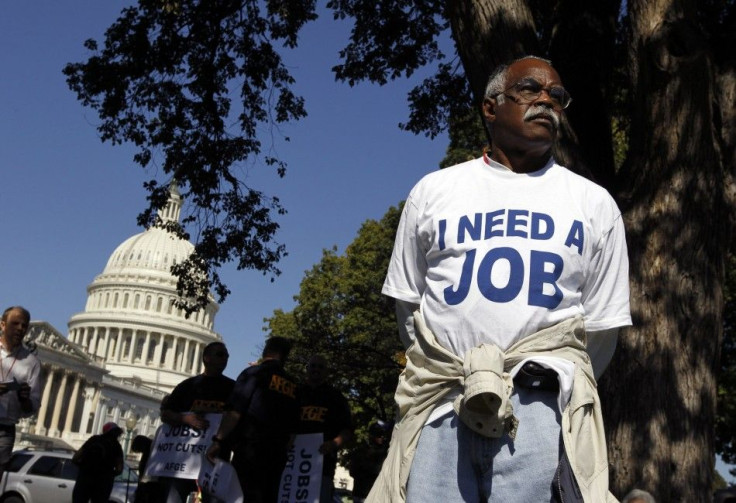
The full story of who works in America isn't told through the unemployment rate alone.
Hovering around 9 percent for the last few months, the statistic is the most commonly cited figure when politicians and journalists need to quantify the country's halting progress out of a recession. But economists are quick to acknowledge that it is only an indicator, and an imperfect one when it comes to conveying the full extent of the challenges encumbering the labor market.
The announced unemployment rate for September was 9.1 percent, a number that reflects the aggregate of responses from about 60,000 surveyed households. But the method for determining that number elides several factors that illustrate the breadth of labor market problems.
For one thing, the 9.1 percent statistic makes no distinction between full-time and part-time workers - for the purposes of measuring employment, a high school student with an after school job is equivalent to a lawyer or a CEO. That means the unemployment rate fails to capture the volume of American workers who are underemployed, relying on wages that aren't sufficient to support a family.
The unemployment rate also excludes people who have given up looking for work. The Bureau of Labor Statistics separates the active unemployed - those who are demonstrably seeking employment by sending out resumes and responding to job announcements - from the passive, who by virtue of not looking for work aren't considered to be part of the labor force.
The idea is they're not doing anything that could actually lead to them getting a job, said Tom Nardone, an assistant commissioner for current employment analysis with the Bureau of Labor Statistics. The underlying concept is that it has to be activity based.
That's not to say that everyone designated as not in the labor force doesn't want to work. In many cases, it would be more accurate to say that they've given up in the face of grinding long-term unemployment. That's reflected in the subset of people who are marginally attached to the labor force-- they want a job, are available to work and haven't been employed in the last 12 months. Within that category is what the Bureau of Labor Statistics labels discouraged workers who believe that they lack the proper qualifications or face some sort of discrimination (a provision in President Barack Obama's jobs bill that would prohibit employers from discriminating against people based on employment status speaks to the latter).
A separate measure commonly referred to as U-6 encompasses the nuances absent from the 9.1 percent figure - in addition to the unemployed, it considers people marginally attached to the labor force and people who want full time work but are forced to accept part-time jobs. In September, the U-6 rate stood at 16.5 percent, more than seven points higher than the conventional unemployment rate.
The percentage of long-term unemployed is not a number you can fit into a traditional unemployment statistic, said Andrew Reamer, a research professor at George Washington University and chairman of the Bureau of Labor Statistics Data Users Advisory Group. You have to look at several numbers to get a full picture of the current state of the labor market and the current situation of the labor force.
In September, 6.24 million of the people officially considered unemployed had been without work for six months or more. Obama's attempt to shield the long-term unemployed from discrimination speaks to the fact that these workers face a self-perpetuating problem - the longer they are out of work, the more their skills erode and the greater challenge they face in winning over wary employers.
Add to that the number of people not even measured by the unemployment rate, and a picture emerges of an economy unlikely to fully recover any time soon. Even if the economy were to strengthen and start adding a substantial number of jobs, the unemployment rate could rise as workers considered out of the labor force, encouraged by a sunnier outlook, flow back into the labor market.
How many people are long-term unemployed is a big problem and unlikely to change, said Tom Larson, a professor of economics and statistics at California State University, Los Angeles. With the severity and length of the recession, people with long term unemployment are going to have quite a bit of trouble re-entering.
Unemployment figures get even trickier when broken down by industry. Magnifying the unemployment picture has advantages, but some workers dissolve into the background.
The Bureau of Labor Statistic's dissection of unemployment by sector is particularly useful for showing the ebb and flow of the American economy, and despite the 9.1 percent figure, some industries, like mining, are growing robustly. As a whole, around 5,500 mining jobs were added in the past year.
But, the official unemployment by industry statistics are just as opaque as the overall statistics.
As a general point if you don't have a job - you can't always be assigned to an industry, said Stephen Bronars, Senior Economist for Welch Consulting. For job losers it's the industry of their last job. Many unemployed workers today are just out of school, or trying to get a job for the first time in a while (after taking care of children or a family member).
For these jobless workers, there is no 'industry' assigned. Still others have been jobless for a long time, so even though the B.L.S. assigns them to an industry, it means less for someone who last worked two years ago.
The mining industry is an exemplar of this. According to the B.L.S., the unemployment rate in the supersector fell from 8.2 percent to 6.2 percent between September 2010 and September 2011. Mining engineering schools are struggling to keep up with a growing demand for skilled workers, and starting engineers can make up to $90,000 per year domestically, and more in places like Australia and Canada.
Yet, miners are quick to point out that industry is hardly exempt from the recession. Job creation and job loss varies between each different mining sector. While the metals and materials industry is growing, thanks to a boost in the commodities market, tens of thousands of workers are unemployed in the aggregates sector, which is responsible for the sand and gravel used for construction projects.
The aggregates industry has lost about 30 percent of its workforce because of the lack of federal commitment to invest in infrastructure, said John S. Hayden, Director of Public Affairs and Government Relations for the Society for Mining, Metallurgy and Exploration. Big aggregates have downsized quite a bit. There are lots of employees on sidelines waiting for the industry to pick-up.
That means that despite the 5,500 new mining jobs added between September 2010 and 2011, there are still at about 30,000 unemployed workers in an area that's only getting weaker.
There's no way construction is going to rebound anytime soon, Hayden added. Even if there were new government projects, it would be a long time until those companies got back above 2008 levels.
Payroll figures can also, in theory, show the future of the American economic landscape. While some industries grow, others are shrinking, potentially approaching zero. The types of jobs being created and being lost also provide a valuable projection of the types of jobs that will be available in the future.
The blue collar worker has borne the brunt of this recession, said Art Papas, CEO and Co-Founder of recruiting software company Bullhorn. I.T. jobs are in high demand, but, manufacturing, industrial, construction are really lagging.
People who lost their jobs are also faring worse than in any recession of the last three decades, according to a paper by Princeton economist Henry F. Farber. He found that the rate of people finding new work was under 50 percent, substantially lower than in previous downturns, and found that a higher proportion of those who did find work were forced to accept part-time positions. People who returned to work also faced curtailed wages, earning on average 17.5 percent less than in their previous jobs.
It is clear that the dynamics of unemployment in the Great Recession are fundamentally different from unemployment dynamics in earlier recessions, Farber wrote, adding that durations of unemployment are unprecedentedly long.
On a national level, there are available jobs that simply can't be filled in the current economy. The housing collapse has trapped many people in cities without work, and the death of manufacturing combined with the rise in technology has shifted the employment focus from one skill set to another.
It sounds odd, but in Texas there's a hiring boom, but companies are having trouble hiring because people can't move to Texas, said Papas. People in Michigan can't get out of their mortgages to go to Texas.
© Copyright IBTimes 2024. All rights reserved.
-

Microsoft Expands Its AI Empire Abroad
-

Oil: 'Mother Of Corruption' In Venezuela
-

'Extreme' Climate Blamed For World's Worst Wine Harvest In 62 Years
-

Macron Warns 'Mortal' Europe Needs Credible Defence
-

Bitcoin And Crypto Price Review - Another Myth Gets Busted?
-

Mass Cancellations Loom Despite French Air Union Cancelling Strike
-

Mired In Crisis, Boeing Reports Another Loss
-

Recycled 'Zombie' Misinformation Targets US Voters
-

Hackers Leak Part Of Source Code Of El Salvador's Bitcoin Wallet
-

Azerbaijan Says 'Closer Than Ever' To Armenia Peace Deal Amid Border Talks


