Orbital Solar Power Plants Touted for Energy Needs
The sun's abundant energy, if harvested in space, could provide a cost-effective way to meet global power needs in as little as 30 years with seed money from governments, according to a study by an international scientific group.
Orbiting power plants capable of collecting solar energy and beaming it to Earth appear "technically feasible" within a decade or two based on technologies now in the laboratory, a study group of the Paris-headquartered International Academy of Astronautics said.
Such a project may be able to achieve economic viability in 30 years or less, it said, without laying out a road map or proposing a specific architecture.
"It is clear that solar power delivered from space could play a tremendously important role in meeting the global need for energy during the 21st century," according to the study led by John Mankins, a 25-year NASA veteran and the U.S. space agency's former head of concepts.
The academy is headed by Madhavan Nair, former chairman of the Indian Space Research Organization. The study was billed as the first broadly based international assessment of potential paths to collecting solar energy in space and delivering it to markets on Earth via wireless power transmission.
The study said government pump-priming likely would be needed to get the concept, known as space solar power, to market. Private-sector funding is unlikely to proceed alone because of the "economic uncertainties" of the development and demonstration phases and the time lags, the study said.
Both governments and the private sector should fund research to pin down the economic viability of the concept, the study said, amid concerns about humankind's continuing reliance on finite fossil fuels that contribute to global pollution.
The study did not estimate a potential overall price tag for completing the project.
Space solar power is a potential long-term energy solution for Earth with "essentially zero" terrestrial environmental impact, according to the National Space Society, an advocacy group set to hold a news conference in Washington on Monday to publicize the academy's 248-page final report.
A copy of the study was obtained by Reuters ahead of its release.
TURN SUNLIGHT INTO ELECTRICITY
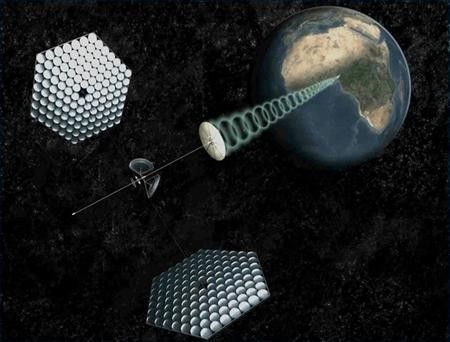
The idea is to put first one, then a few, and later scores of solar-powered satellites in geosynchronous orbit over the equator. Each as wide as several kilometers across (one kilometer equals 0.6 miles), the spacecraft would collect sunlight up to 24 hours a day, compared with half that, at most, for surface panels now used to turn sunlight into electricity.
The power would be converted to electricity on-board and sent to wherever it is needed on Earth by a large microwave-transmitting antenna or by lasers, then fed into a power grid.
Skeptics deem the concept a nonstarter, at least until the cost of putting a commercial power plant into orbit drops by a factor of 10 or more. Other hurdles include space debris, a lack of focused market studies and high development costs.
The study, conducted from 2008 to 2010 then subjected to peer review, found that the commercial case had substantially improved during the past decade, partly as a result of government incentives for nonpolluting "green" energy systems.
A pilot project to demonstrate the technology even as big as the 400-tonne International Space Station could go ahead using low-cost expendable launch vehicles being developed for other space markets, Mankins said in a telephone interview.
A moderate-scale demonstration would cost tens of billions of dollars less than previously projected as a result of not needing costly, reusable launch vehicles early on, said Mankins, president of Artemis Innovation Management Solutions LLC, a California consultancy.
"This was a really important finding," Mankins said, referring to a relatively modestly priced pilot project.
'IT'S A START'
His company has been awarded a NASA contract of a little less than $100,000 to pursue space-based solar power options -- small "but at least it's a start," Mankins said.
Ultimately, tens of billions of dollars would be needed to develop and deploy a sufficiently low-cost fleet of reusable, earth-to-orbit vehicles to launch full-scale commercial solar power satellites, the study group estimated.
The group said the necessary research and development work should be undertaken by countries and organizations in concert, including space agencies, companies, universities and nongovernmental organizations.
International interest in the concept has grown during the past decade, spurred in part by fears that in coming decades global production of petroleum and possibly other fossil fuels will peak and start to decline.
Adding to a quest for new energy sources are projected jumps in worldwide per capita demand for energy to fuel economic development and concern over the accumulation in Earth's atmosphere of fossil fuel-derived greenhouse gases.
The idea of harnessing solar power in space has been studied off and on for 40 years, including by the U.S. Energy Department and NASA.
U.S. and Indian business, policy and national security analysts in September called for a joint U.S.-Indian feasibility study on a cooperative program to develop space-based solar power with a goal of fielding a commercially viable capability within two decades.
The study group, co-sponsored by the Council on Foreign Relations think tank and Aspen Institute India, included former U.S. Director of National Intelligence Dennis Blair and Naresh Chandra, a former Indian ambassador to the United States.
Colonel Michael Smith, the U.S. Air Force's chief futurist as director of the Center for Strategy and Technology at Maxwell Air Force Base in Alabama, said the idea has the potential to send safe, clean electrical energy worldwide "if we can make it work."
"Isn't that what government and industry should be working to do?" he said in a telephone interview.
Jeff Peacock, who heads satellite-builder Boeing Co's ground-based solar cell product line, said in theory it could double the amount of solar power collected, compared with the Earth-bound technology equivalent.
© Copyright Thomson Reuters {{Year}}. All rights reserved.
- MOST POPULAR IN Digital Life