Richard Nixon’s Grand Jury Testimony: More Heat Than Light
Watergate was a mere office complex on the banks of the Potomac River in Washington D.C. before 1972. Then it became a name that defined a presidency, scandal and generation. The word eventually became so synonymous with inept malfeasance it spawned its own suffix: -gate. A congressman texting pictures of his privates? Weinergate.
Our national collective conscious became so taken by the Watergate Scandal we still, four decades later, swarm to any new revelations, quickly digesting and regurgitating every dose of information that arises.
So imagine the immediate swell of press attention (followed by an inevitable, and quicker dissipation) when a spanking-new hunk of Watergate's history finally saw the light of day on Nov. 10.
Rightfully so. For all of its ability to show the uglier natures of American politics, the Watergate Scandal proved the United States can still make a profit off of even the greatest of political crimes. Watergate has become its own cottage industry, making many ancillary players a quick buck by revealing their insider stories. Watergate has helped break lawyers, journalists and historians out of careers that otherwise could have been mired in anonymity. And it has filled more than one bank account.
So naturally, on Nov. 10, the media swarmed. It searched the contents of a 36-year-old grand jury testimony for a seismic revelation to plaster on front pages. Many left disappointed. All we got, in the end, was former President Richard Nixon in all his Tricky Dick glory -- and nothing more.
Declassified Nixon Docs: Victory for Public Record
But lost in the milieu of disappointment was a greater victory, one fought over the course of years, culminating in the grand jury testimony release. Nixon's words were not revelatory, sure. But their declassification represented a victory for scholars, historians, journalists, and every other inquisitor whose efforts have been halted by government's invocation of state secrets. If a President's secret deposition -- and White House recordings -- could come to light, perhaps the heavy doors of government confidentiality could be opened again, if only a crack. Watergate is as good a place to start as any. The story, by now, is familiar.
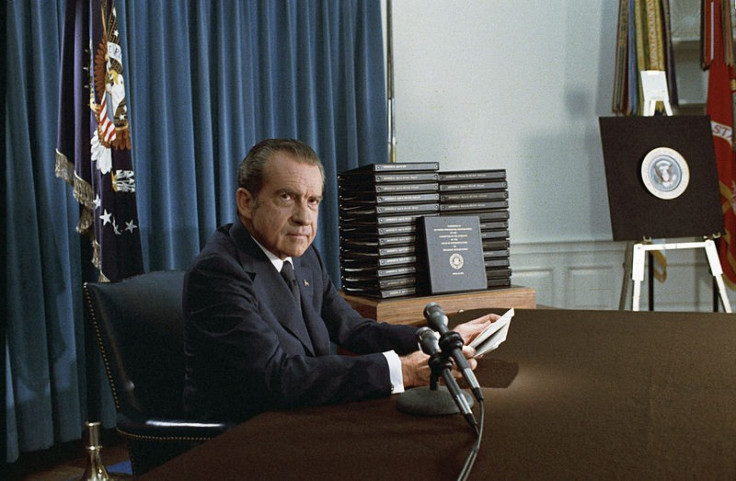
Nixon agreed to sit down for 11 hours of questioning over two days, on June 23 and 24 of 1975. He knew the prosecutors' questions in advance, and was on home turf in California after pleading frail health. Already immune to charges for past misdeeds thanks to a pardon by his successor Gerald Ford, his testimony offered a sense of closure for the Watergate Special Prosecution Task Force. The former President himself had nothing to lose.
The resulting 278 page, 26-folders worth of testimony, remained classified. It came to light only after D.C. Federal District Judge Royce C. Lamberth III granted a petition by Watergate historian Prof. Stanley Kutler and the interest group Public Citizen. It almost didn't happen, but perhaps luck intervened.
Judge Lamberth is a very conservative man; he's a Republican but you won't know what he's going to do, Kutler said. But he points out grand jury minutes are secret, but there are exceptions and he discusses them in terms of the law. [...] It turns out he's a Watergate buff.
Kutler may be better known as the man who fought to have Nixon's infamous White House recordings released to the public. The grand jury testimony's release offers another victory for the University of Wisconsin professor -- but little substance for the broader understanding of Watergate.
This doesn't reverse or change or undermine anything that we've already known about Richard Nixon, Kutler said. This was a blow against official secrecy.
On Tapes: Classic Nixon -- Tricky Dick
Within the testimony, a defiant, bitter but sharp politico emerges - classic Nixon. He stalls, bobs and weaves around prosecutor's questions. At times, he resorts to blunt humor that falls flat. The images of the Nixon we all know -- awkward, visibly uncomfortable, perhaps even sweaty, yet brusque -- emerges in his words.
His memory, which those who know him claim was his strong suit, fails time and again. He goes off on tangents, asserts his importance. He spends (or wastes) long droning conversations regarding procedure he knows well.
He knew he only had two days. You know what he did? He ran out the clock, Kutler said. It's a virtuoso performance by Nixon.
Rich Davis, now a partner at Weil, Gotshal & Manges, was a 29-year-old prosecutor when he stepped forward to question Nixon during his testimony. His task? Try to extract what actually happened to an infamous 18 ½ minute gap in the Watergate tapes. Put simply, he failed to open any new doors.
Our view was we had to be in a position where we could say we did everything we possibly could to run our investigation, Davis said.
Nixon's token response throughout the testimony, to put it succinctly: he was too damned busy as president to worry about the petty things. Besides, it is a damned dirty game.
In politics, some pretty rough tactics are used, Nixon said. We deplore them all.
The whole experience left an obvious mark on Davis, who looking back found it rewarding.
It probably took something off the lining of my stomach, he said.
Nixon: Huge Ego, Huge Insecurities
Nixon the man, in all of his preposterous bombast, emerges in all his glory. Prof. David Greenberg of Rutgers University, said the President in the testimony fits the archetype authors like himself have discovered.
I guess the way I would put it is there's a certain grandiosity to Nixon, he said. He always had this enormous ego that was paired with enormous insecurity, which is often in the case with people in great power.
This irony with Nixon is that as much thought and energy he puts into the performance, he's actually pretty bad at it and people can see through it. He comes across as transparent and phony. He's trying to be so smart with these prosecutors. Who's he fooling really?
Nixon was a man who served guests a good glass of wine, then uncork an even more exclusive bottle for himself, Greenberg said. And the President's assertions that he was busy during the time of the scandal?
The notion that he's too important for this or too important for that doesn't track with his actual behavior, Greenberg said.
But the performance itself may have been an ongoing ploy in Nixon's attempt to whitewash Watergate from his history, according to Kutler. The release of his recordings, as well as the depositions, registers as a resounding loss for the former President. But it could only happen posthumously.
It was a long litigation because the trickster was fighting, Kutler said. Make no mistake about it, if he was alive today, we still wouldn't have the tapes. Nixon spent his last years campaigning for history; and slipping out of Watergate.
The resurgence of interest in Watergate? Kutler lambasted any notion that the missing 18 ½ minutes of tape had any value.
Missing? What exactly is missing? Kutler said.
The new revelations, though, may not offer any big-picture morality lessons.
You're going to tell me there are lessons learned from Watergate? I used to think so, Kutler said. I'm not so sure now.
© Copyright IBTimes 2026. All rights reserved.
- MOST POPULAR IN World