Santorum’s Views on Environment, Climate Change Shaped By Christianity
One Side In a Larger Theological Debate
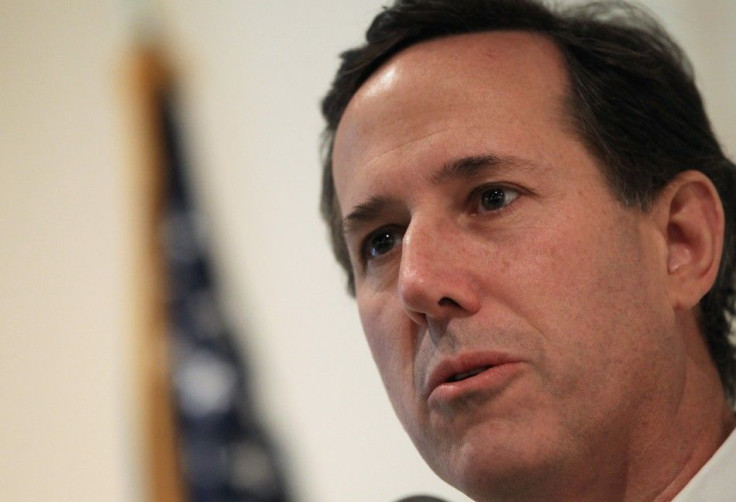
Faith has pervaded Rick Santorum's political career, informing his views on issues ranging from abortion to gay rights -- and also, it turns out, the environment.
We were put on this Earth as creatures of God to have dominion over the Earth, to use it wisely and steward it wisely, but for our benefit, not for the Earth's benefit, Santorum said during a recent speech at the Colorado School of Mines.
Santorum See 'Radical Environmentalists'
The former Pennsylvania senator and Republican presidential candidate has excoriated radical environmentalists who embrace a worldview that elevates the Earth above man and says that we can't take those resources because we're going to harm the Earth. In his view, humans have not just the ability but the obligation to tame nature and benefit from its resources.
We all know that man has a responsibility of stewards of the earth, Santorum said at a Monday rally in Steubenville, Ohio. We are good stewards and we have a responsibility to be good stewards. Why? Unlike the earth we're intelligent and we can actually manage things.
Santorum's view reflects a particular Biblical interpretation, stemming largely from a chapter in Genesis in which God instructs humans to rule over every living thing and to fill the earth and subdue it. God has given humans dominion over the environment so that they may flourish.
Man is the chosen agent. Not horses, not dogs, not chimpanzees but man, said Douglas Gregory, a research and communications specialist at the Cornwall Alliance, a coalition of religious figures and policy experts that advances a Bible-centered approach to environmental issues. If God tells us you are in fact the highest form of creation, as arrogant as that sounds to come from my mouth it's true nonetheless.
When man is free to do good he may make a mistake, but given the gifts God has given us, we have definitely benefited the planet, Gregory added. We don't starve, we don't die of pneumonia, we don't die of tuberculosis.
The Cornwall Alliance is deeply opposed to policies that would limit carbon fossil fuel emissions, contending that they would harm developing countries by driving up the price of energy. On its web site, the organization denies that humans are capable of significantly altering the climate or damaging ecosystems.
Earth and its ecosystems-created by God's intelligent design and infinite power and sustained by His faithful providence -are robust, resilient, self-regulating, and self-correcting, admirably suited for human flourishing, and displaying His glory, the website reads.
Santorum: Measures to Limit Climate Change Are Efforts to Centralize Power
Santorum has dismissed measures to limit climate change as an attempt to centralize power and to give more power to the government. He argues that human efforts to control the environment have resulted in a higher quality of life.
We are the intelligent beings that know how to manage things and through the course of science and discovery if we can be better stewards of this environment, then we should not let the vagaries of nature destroy what we have helped create, Santorum said.
Some theologians and environmentalists see a contradiction in such statements. The counterpoint to Santorum's interpretation holds that humans have an obligation to protect God' creation -- preventing environmental degradation becomes a sacred duty.
If you are in charge, then for whose sake are you in charge? said John Cobb, a professor emeritus at the Claremont School of Theology and a member of the Yale Forum on Religion and Ecology. We have come to think if you have dominion you can do whatever you want without any moral qualifications for those who rule. That's a horrible idea, but people do understand dominion that way sometimes.
Roman Catholic Church's Stance: Role for Environmental Preservation
There is considerable support for that view among Christian religious leaders. The Catholic Church has stressed balancing human interest with respect for nature and environmental preservation. Pope Benedict XVI focused on the environment in his 2010 World Day of Peace Address, warning against the neglect -- if not downright misuse -- of the earth and the natural goods that God has given us.
Evangelical Christians have also gotten on board. The recently formed Evangelical Climate Initiative recruited more than 300 prominent American evangelicals -- including Rick Warren, the socially conservative pastor who delivered the invocation at President Obama's inauguration -- to cast combatting climate change as a moral imperative. The coalition's statement notes that poor individuals and nations will suffer most from the resource shortages and extreme weather climate change is likely to unleash.
In the last 40 years, we've gone from a point where you couldn't get a religious congregation to discuss stewardship of the earth to now we have people of all denominations realizing that this is the issue of our day, said Brent Blackwelder, who worked with religious leaders while serving as president of the environmental organization Friends of the Earth.
There is still tension, and even outright antagonism, between some environmentalists and religious leaders. Dr. John Morris, president of the Institute for Creation Research, said he considers respecting the environment a Christian mandate, but he echoed Santorum's warning of valuing the Earth too highly.
I am environmentally sensitive but being an environmentalist, that is anathema, Morris said. The worship of the environment is soundly condemned in scripture - we worship the creator, not the creation.
But Blackwelder argued that environmentalism and Christianity share a common goal.
The basic message in the Bible is you're supposed to love your neighbor. You're not supposed to wreck and poison their lives, Blackwelder said. That's exactly what [Santorum] is doing by his ignorant dismissal of the broad-based movement to be responsible stewards of the earth and exhibit some creation care.
© Copyright IBTimes 2026. All rights reserved.
- MOST POPULAR IN World