Another European Country Has Accused Russia Of Being Behind An Attack As Hybrid War Expands
Estonian Prime Minister Kristen Michal said Russian security services ordered an attack against a defense company supplying military equipment to Ukraine.


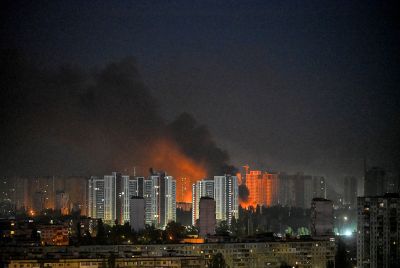
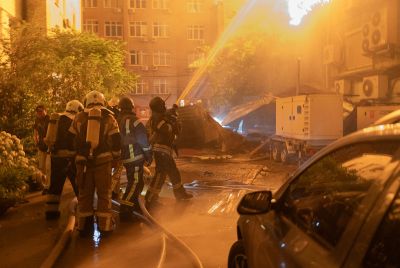
Estonia accused Russian security services of being behind a fire at a defense company that supplies military equipment to Ukraine earlier this year as claims that Moscow is conducting hybrid warfare in Europe continue to mount.
Estonian Prime Minister Kristen Michal said the country's internal security service, KAPO, gathered enough information for Tallinn to reach the conclusion. It did not reveal the evidence, saying it was confidential, but claimed it is consistent with similar actions carried out by Russia.
The Kremlin rejected the accusation, calling it unfounded. However, several European countries have been escalating their warnings about Russia's actions. Earlier this month, Germany said Moscow was behind an act of sabotage in the Leipzig airport last month.
"The attempted attack at Leipzig Airport on 4 August fits the established pattern of Russian hybrid operations in Europe," said Interior Minister Alexander Dobrindt on Tuesday.
He went on to say that, as a result of the investigation, the country concluded that "Russia is responsible for the hybrid attack," adding that Berlin expects further attacks of the kind.
Elsewhere, Danish intelligence recently warned of a "low but growing risk" that Russia will attack a NATO country in the coming months.
The Danish Defence Intelligence Service released a report noting that Russia has "intensified its use of sabotage, destructive cyber attacks and is attacking targets in Europe with drones," concluding that "hybrid war is escalating."
It went on to recall a foiled drone attack in Germany, which Berlin openly blamed on Moscow, noting that it has "become more willing to take risks." And warned of potential "sabotage on Danish soil against defence companies."
Elsewhere in the report, the agency noted that Russia is "under more pressure than it has been at any other point during the war against Ukraine," sustaining heavy losses on the battlefield and with the economy "on the brink of a major crisis."
The document then notes that Russia has no prospect of "achieving any major breakthroughs in the war against Ukraine over the next six months," and it's unlikely that President Vladimir Putin will "be willing to compromise on his fundamental objectives of war."
And considering that "Europe will gradually develop an autonomous military capability by 2030," which will "pose an increasing threat to Russia," the coming years will be a "window of opportunity" for Moscow. This context could lead Putin to conclude that "it is worth the risk attempting to drastically change the security order in Europe."
This scenario could likely involve intensifying hybrid war "by carrying out more frequent attacks against the West and NATO, with greater consequences for the targeted countries than in the past." Examples include "destructive cyber attacks that cripple critical societal functions as well as sabotage attacks that carry a high risk of casualties."
Another possibility is Russia deploying a "limited number of military forces, possibly without national insignia, into NATO countries bordering Russia." That would be preceded by a buildup of regular forces to counter a potential response.
The agency does not see indications of an "outright invasion of one or several NATO countries." Even if it does, it would likely take at least six months to prepare it. And while an attack would not seek to trigger a war with the alliance, Moscow can't now for sure what would.
© Copyright IBTimes 2026. All rights reserved.
- Recommended For You