

The Case for Running Towards the Storm: Brandon Bigelow on Why We Keep Losing to Conflict
On the American plains, cattle and buffalo respond to an approaching storm in opposite ways. Cattle run from it, and because they can never outrun the weather, they end up drenched and exhausted. Buffalo turn and charge straight into it, taking the worst of the discomfort early and coming out the other side faster and stronger.
Bigelow opens his book with that powerful image, and it has become the passage readers mention to him most often when they reach out. It is also a fair summary of his argument. Most of us behave like cattle when conflicts rage. We avoid, we delay, we build a case against the other person, and the storm catches us regardless.
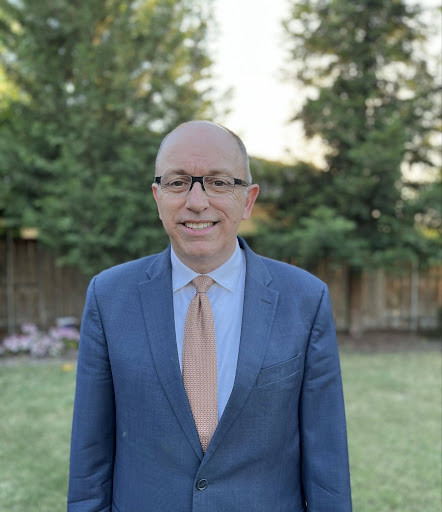
Bigelow is the founder of Fusion Conflict Strategies, a consultancy that helps organizations manage disputes, strengthen HR functions and mediate entrenched disagreements. He is also the author of Unity and Beyond: Five Simple Steps to Stop Letting Conflict Win, an Amazon bestseller that has quietly travelled well beyond its intended boardroom audience.
A framework forged in healthcare
Bigelow has spent the better part of thirty years in healthcare operations and executive leadership, an environment where dysfunctional culture carries a measurable price. He observed hostile management styles push employees towards the exit, saw retention collapse into a turnstile, and witnessed wrongful termination and harassment claims that better relationships would have prevented entirely.
He also noticed something about the operations that he directly oversaw. They were not perfect, but the outcomes were far more effectual when leadership remained close to their people. He made a habit of calling patients' families personally the moment a concern surfaced. The same problem, he observed, produces radically different consequences depending on whether the person in charge engages or goes radio silent.
That pattern followed him into formal study. Bigelow earned a graduate degree (MDR) in dispute resolution at Caruso School of Law, Pepperdine University, home to one of the most respected alternative dispute resolution (ADR) programs in the field today, and in 2022 he launched Fusion Conflict Strategies. Colleagues had told him for years that his one consistent talent was bringing together people who had refused to sit in the same room, sometimes for decades. At Pepperdine, he realized he had been running an unnamed process his whole career. The book finally gave it a name.
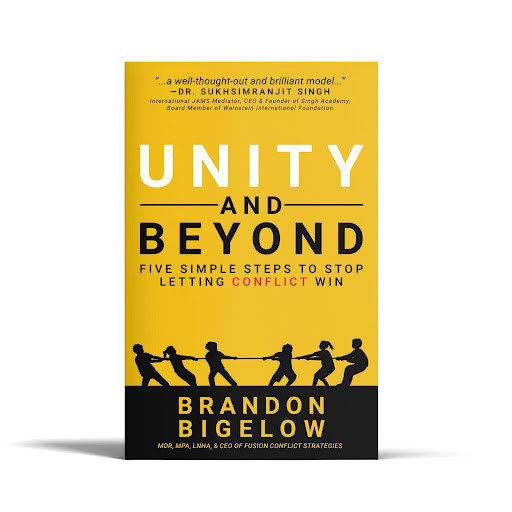
The five steps of UNITY
UNITY stands for Unpack, Navigate, Identify, Take ownership and Yield. What separates it from all other conflict management models is where the work sits. The first three steps involve no contact with the other party that you're in conflict with at all.
You begin by unpacking your own biases, literally listing them in the left margin of a page or whiteboard, with the other person's perceived positions in the opposite margin. You navigate those biases rather than defending them. Then, after much dissection of the "meaning behind the meaning" you identify commonalities, where you believed once was only disagreements. The process then moves to drawing lines between entries in the two columns that first appeared to have nothing in common, but now, seen through a more sympathetic lens, are much more aligned than you originally believed them to be. Bigelow guides readers through exercises for exactly this moment, when someone stares at the two seemingly disparate columns and insists they are irreconcilable.
Only at step four, take ownership, do you pick up the phone and begin the conversation of potential alignment and reconciliation. By then, he argues, the conversation is transformed, because you arrive humbled rather than armed. The book even supplies opening dialogue, with one firm instruction: to foster continual collaboration, keep the word "I" out of the initial exchange.
The final step, yield, is the one people misread. Yielding is not surrendering, and it is not conceding that the other person was right. It means committing to the possibility that there is another way to see the situation. The ideal outcome is what Bigelow calls dual yielding, where both parties move towards the middle and agree on a consistent mechanism for checking in; remaining open to multiple possibilities and outcomes so the resolution holds.
The order, he insists, is not negotiable. All the heavy lifting within yourself must be finished before you reach out. And even when the other person is not ready, the work should never be viewed as a failure. The one who initiated the requisite self-discovery, in the first place, will forever alter the way in which they view supposed differences in others. You will, simply put, never approach conflict the same way again.
The grandmother in New Mexico
Bigelow learned the meaning of yield in a nursing home in a small New Mexico town. The company he founded had acquired the building, one of seventeen operations it grew into within three years, and it happened to be where his grandmother Mollie had spent her final years. The Mollie he remembered was four foot ten of pure grit, a woman who once marched into a parking lot with her purse in tow to drive off a man attacking a woman, a surreal and courageous scene that made the local front page of the newspaper the very next day.
The staff remembered someone else entirely. They described a tender, warm presence they would bring into disputes because she softened every room. Bigelow was in tears. He had only ever seen his grandmother through one lens of "tough love" and discipline, and yielding to a fuller, more complete, picture of the complexity and beauty of who Mollie Bigelow actually was, changed how he viewed people generally.
That is the deeper claim of the book, and perhaps why it has found unexpected audiences. Written for executives and managers, it is now being used by therapists and family counselors, who tell him the sequence matches what they know works in practice. Conflict, it turns out, does not respect the boundary between office and home.
Asked what he wants readers to carry away, Bigelow does not hesitate. The best way to get permanently better at conflict is to get permanently better at seeing yourself as part of the problem, and a massive part of the solution. The storm is coming either way. The only real choice is which direction you find yourself facing and how drenched you ultimately become.
© Copyright IBTimes 2026. All rights reserved.