Humanoid Robots Are Closing In on Their ‘ChatGPT Moment,’ Chinese Startup Says. It Predicts a Breakthrough Soon.
Spirit AI says its robots already have a 90% success rate performing simple tasks in structured living-room environments.


The co-founder of one of China's most heavily funded humanoid robotics startups said its technology could be approaching the much more consequential milestone of robots that can understand what people tell them and figure out how to carry out the task.
Spirit AI co-founder and chief scientist Gao Yang said the robotics industry could reach a breakthrough comparable to the rise of generative AI as soon as mid-2027, potentially allowing humanoid robots to complete a broad range of general-purpose tasks from natural-language instructions.
"We anticipate reaching the GPT-3.0 milestone by mid-2027," Gao told Reuters. "You will be able to speak to a robot in natural language, and it will execute a series of reasonable physical actions to attempt the task."
"The brain is indeed the weakest link in the complete robotics stack," Gao said. The field, commonly known as embodied AI, seeks to develop artificial intelligence systems capable not just of generating text or images but of perceiving, reasoning and acting in the physical world.
Spirit AI describes its technology as a "Universal Brain" designed to allow robots to operate across different environments rather than being programmed for one narrowly defined job. The industry has increasingly been searching for its own "ChatGPT moment," when a technological advance suddenly demonstrates that a previously specialized technology can have much broader commercial applications.
Spirit AI added that its robots already have a 90% success rate performing simple tasks in structured living-room environments. But Gao cautioned that a robot capable of following instructions in a controlled setting is still very different from one that can reliably navigate the chaos of an actual home.
"The next one to two years mark the initial window for industrial applications," he said. "Two years from now, we'll see robots deployed in commercial service settings doing simpler tasks. Entering homes is far harder than both."
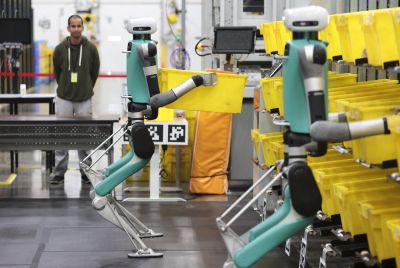
The company has dozens of its Moz1 wheeled humanoid robots deployed on production lines operated by battery manufacturer CATL and retailer JD.com, which is also an investor in the startup. Spirit AI says its technology has also been used to handle flexible wire harnesses on CATL production lines, a particularly difficult robotics problem because cables bend and deform unpredictably.
Founded in 2024, the roughly 300-person company has raised more than $670 million and is valued at approximately 20 billion yuan, or $2.9 billion, according to Reuters. Gao declined to discuss whether Spirit AI plans to go public.
A major part of Spirit AI's strategy involves humans repeatedly opening refrigerators, cutting vegetables, and manipulating everyday objects. Around 1,000 contractors across China wear data-collection equipment while performing physical tasks at homes and factories. The resulting information is used to teach AI models how humans interact with real-world environments.
Spirit AI has deliberately emphasized messy, real-world information, or what it calls "dirty data," rather than relying primarily on carefully controlled simulations. The company said earlier this year that it had accumulated more than 200,000 hours of interaction data and was targeting more than 1 million hours by the end of 2026.
Gao argued that simulations remain particularly weak at recreating flexible objects such as electrical cables. Diverse, imperfect human movements can therefore provide the information robots need to handle the unpredictability of the physical world. However, robots still struggle with fine-motor tasks such as unscrewing bottle caps and with situations significantly different from those contained in their training data.
Safety will also become increasingly important as machines move from factories into stores, workplaces and eventually homes. For now, Gao said Spirit AI's robots use whole-body force controls that can automatically trigger emergency braking when the system detects excessive physical force.
© Copyright IBTimes 2026. All rights reserved.
- Recommended For You